

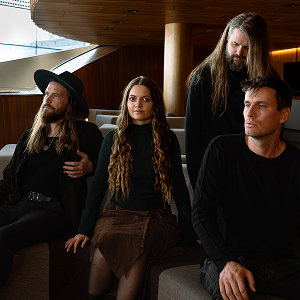
Scandinavian Alt-Prog-Folk collective Kalandra are set to return on November 13th with their third studio album, “The Other Side,” released via By Norse Music. Celebrating 15 years since their initial formation at Liverpool’s Institute of Performing Arts, the four-piece, vocalist Katrine Ødegård Stenbekk, guitarists Jogeir Daae Mæland and Florian Bernhard Döderlein Winter, and drummer Oskar Johnsen Rydh, have built a captivating sonic universe bridging Nordic Folk, Dark Atmospheric Rock, and Post-Rock. Following their debut “The Line,” the “Kingdom Two Crowns: Norse Lands” video game soundtrack, and 2024’s “A Frame Of Mind,” “The Other Side” delves directly into the subconscious realm of dreams and nocturnal visions. We caught up with the band to discuss the creation of the new record, their evolutionary path, live experiences, and their perspective on the modern Alternative scene
“The Other Side” revolves around the surreal imagery of dreams and nightmares. You started dream-journalling by your bedsides to catch raw fragments of your subconscious upon waking. How did working from these volatile, nocturnal visions alter your usual approach to lyricism and musical structure?
Katrine: “I have this odd thing that when I sleep on my back I often go through some sort of sleep paralysis. I know it’s better for my back and my arms to sleep on my back, so I try to get comfortable with it, (I also struggle with an on-and-off tendonitis in both arms from too much computer/music production). Anyway, it gives me the weirdest experiences, and the dreams feel so incredibly real too. I often dream my duvet is slowly being removed. I’ll usually know intellectually by then that I am dreaming but I just cannot seem to wake up. And then I start to float upwards towards the ceiling, and either I’ll be heading towards the window or I’ll be turning around looking at myself sleeping from above.
If I’m looking at myself sleeping it’s because I’m calling myself back to bed inside my mind not wanting to explore where we’re going, and there’s a mental battle going on for a while before I swop back into myself. I’m not really ready for… the ride.. or the unknown I guess.
But if I’m headed out the window I can feel the curtains against my face and the wind on my feet. And I’m hovering over the city flying towards the forest, watching the foggy treetops below my feet.
I experience the calling of some women in my family, alive and not alive, wanting to have some sort of meeting or gathering. It’s about then that I think I have had enough of this… so I fight very hard to wake myself up and tell them that I am simply not ready yet.
That’s what Descend the Stars is about. It sounds like an optimistic lullaby to me, but it’s not really that comforting. I also thought that perhaps writing about it would make me braver next time around, but I haven’t been given another chance to “visit” them again, so I think my subconscious made a note.
But if the song makes you sleep well then I am happy for you.“
While constructing your new bespoke studio during the writing process, you embraced a “less is more” philosophy, moving away from dense 70+ track arrangements toward a clearer sonic palette. Was it challenging to exercise that technical restraint, and how did giving more space impact the final mix by Tony Draper?
Katrine: “Yes I think it was a very hard challenge for all of us to digest. It’s very difficult for us to accept a “less is more” kind of attitude, because one can always do more. When is the song truly finished?
But we really discovered the true impact of what it means when we sent off A Ship Has Left the Shore to our mixing engineer Tony. He really managed to make the song come to life, it breathes.
I would love for us to be able to come to that realisation sooner rather than later in the future. It’s also about accepting that we are enough as we are.“
Self-producing an album inside your own dedicated space can be immensely liberating, but it can also make it difficult to step back and declare a track finished. How did you navigate the self-production phase without getting trapped in endless technical revisions?
Katrine: “uhmmm, deadlines? Some of us don’t function without deadlines.
Jogeir: I think working as a team and knowing our different strengths and weaknesses is the key to overcoming that trap. We are all perfectionist in our own way, but our internal dialog works different under different types of pressure. Some of us push for us to start out early, and others works best near the finish line. And when the deadline arrives, you kind of have to let go of the revision mindset. What you got is the best version of us that we managed to achieve. Of course, there are always things we would like to improve. But there is diminishing returns in quality per hour spent on something.“
Across the new material, Heavy guitar textures inspired by Alice In Chains and Bring Me The Horizon sit comfortably alongside echoes of Dead Can Dance and Doomgaze acts like Leonov. How do you strike the balance between crushing guitar weight and the ethereal, woodland stillness that defines Kalandra?
Katrine: “The balance hmmm. I don’t know how to answer that question. But one thing is important to me and that is that the vocal is telling a story, and that the arrangement must back the narrator. And in the moments I’m not singing, the arrangement must convey the story I’m not telling.“
Florian: “The short answer would be “we know it when we hear it”. But it is very much a matter of storytelling, if the sound of the instruments fit and describes the emotion we want to convey then it stays in the production. The contrast of going from a big bombastic chorus into a sweet and lulling bridge makes the woodland stillness you describe that much more impactful.
As for being inspired by other artists I admit that I am a huge fan of AiC but it didn’t inspire much more than an approach to a guitar tone on one song (Beauty & The Beast).
And I really like how Bring me the Horizon combines guitars and synth to make this wall of sound.“
The lead single, “Let Me Be Open,” touches on shedding the fear accumulated in adulthood and reconnecting with childhood curiosity. Was this track deliberately chosen as the first taste of the album to offer a sense of hope amidst darker thematic territory?
Katrine: “Do you find it hopeful? Hehe. It was actually our record label who suggested that we should open with that song because it was the most diverse in terms of arrangement and instrumentation I think. It was a good indicator of what’s to come on the record so we trusted their vision.“
Jogeir: “I definitely see it as hopeful, and I remember thinking it might have been a bit too hopeful compared to the rest. So I was a bit surprised that we chose it as the single. But in retrospect, it kind of feel like an underlying plea or reasoning for dwelling into the darker material that is to be found on the album, so it definitely works as a first single.“
You have often joked about your inability to write upbeat tracks, yet Animal drives forward at an uncharacteristic 136 BPM with guest vocals from Faroese artist Elinborg. What sparked this percussive experiment, and how did Elinborg come to feature on it?
Katrine: “It was Elinborg who contacted us on Instagram first. We’ve been paying attention to each other a bit back-and-forth I think for a few years. But when she reached out, I thought yes that makes sense. The vocal sound she has is quite unique, and I just think I immediately knew that our two voices would blend nicely together. In a way, we don’t sound at all alike, but at the same time it just really works. She’s also not afraid to push her chest voice and get that “wild woman” out, if you know what I mean, and I knew that would be important in this song. Animal was the song that we had in our archive since 2022, but we just never seem to manage to finish the lyrics. We had about 54 pages in Google Doc for potential lyrics… but when she expressed an interest in working together, we immediately thought this could work really well. And it actually helped us finish the lyrics for Elinborg.“
Jogeir: “So yes, we are able to write upbeat tracks, but we have to spend a long time before we finish them.“
“A Ship Has Left The Shore“ relies almost entirely on vocal and piano melodies to convey grief. What made you decide to leave this arrangement so uncluttered rather than building it into a larger orchestral crescendo?
Katrine: “hehe, it was definitely the time constraint. I think I need to let Jogeir explain more about those intense 24 hours we finished it.“
Jogeir: “The time constraint was definitely a factor. It was basically recorded and produced in the span of 24 hours with no sleep. But writing the song and the demo took way longer… If we had had more time, we probably would have added more layers/strings etc. But we also kind of knew that it would work very well in a more minimalistic style, so it kind of had to be the last song we recorded.
That being said. The core of the arrangement is definitely piano and vocals, but there are so many layers of vocals and atmospheric synths/field recordings etc. added in the background. So it does still sound quite massive to me, specially towards the end. ‘The less i more’ concept definitely applies to the production here. I don’t think adding more instrumentation would have made it more impactful, as there is only so many sounds you can put in a mix before you have to hide something else.“
The single “Lost in the Dark“ has a special background, it was originally written by your university friend and former band member Helen Morrisson. What made you unearth this specific song now and reimagine it for ”The Other Side”?
Katrine: “Helen has been a long time friend since the university days. She’s a wonderful songwriter, and I think I learned the majority about revealing my vulnerability through song from her. I think the world deserves to know. And I feel incredibly honoured to be able to bring her song to life.
But that’s the thing about a lot of musicians and songwriters I feel. There are so many fantastic and talented people out there that might never reach… the rest of the world, you know. This might come across as a bit preachy but I guess what I’m trying to say is I just think it’s important to note that just because we’ve managed to reach a little bit of success with our music doesn’t make us more talented or greater than any other musician out there. Because there is hard-working talent everywhere when you get to know people.
I know so many musicians who were way better than me that decided they didn’t want to pursue music anymore as a career, which is obviously a wise choice, hehe, but it doesn’t take away anything, they are still incredibly talented and mindblowingly creative people.
Earlier this year, you released an officially approved Nynorsk (New Norse) reinterpretation of Radiohead’s Everything in Its Right Place. What initially drew you to translate such an iconic track, and how did it feel to receive official clearance from Radiohead themselves?
Katrine: it first started out as a jam during soundchecks, just for fun. I looked at my manager Giulia and she looked at me with a nod, like “ this is cool”. I looked at my band and I thought “ why not?”. A fun joke turned into something a lot more serious than we had anticipated. We didn’t actually expect that we would be able to release it so we just thought we could have this audio for ourselves. Just like what we did with Helvegen on YouTube. But yeah, it was great to experiment with it and be able to release it.“
Prior to this record, you released the winter EP “Mørketid,” combining original songs like Ghosts with traditional Scandinavian hymns. Did the dark, winter-focused atmosphere of that EP bleed directly into the writing sessions for “The Other Side“?
Florian: “Well everything we write ends up honing our songwriting skills in the end, so I’d say so. That goes for production as well. The mixture of Baritone acoustics, fuzzy guitars and Enya esque vocals you hear on Ghosts certainly snuck its way onto this album.“
Looking back at your roots, Kalandra was originally formed in 2011 while studying at Paul McCartney’s Liverpool Institute of Performing Arts. How did spending those early years in the UK underground live scene shape the foundational mindset of a Nordic collective?
Katrine: “For me personally I think it was one of the best years of my life. I learned pretty much what I needed to learn in order to create a sustainable band in this modern world. Not all Institutes teach you how to survive when you finish your degree, or how to do your tax return being self-employed. The knowledge I learned also helped me be able to break down music contracts in the industry, and see what’s being implied in between the lines.“
Marking 15 years as a band in 2026, your evolution spans from early club shows to scoring video games like Kingdom Two Crowns: Norse Lands and releasing three full-length studio albums. What feels like the most significant shift in how you write and communicate together as musicians today compared to a decade ago?
Jogeir: “We’ve definitely grown a lot both as musicians and people since the early days, and when we communicate now. First off we used to be a bigger band back in the early days. 7 members at the most. At that time all the writing happened in the rehearsal space, we still do that as well, but we tend to demo and produce quite a lot more on computers these days. Communication has always been important, and we grow and change both humans and musicians, so that is a continuous process. I couldn’t say what is the most significant shift there, but we’re not the same people anymore.“
Video game scoring requires writing music that serves an interactive narrative. Did working on Norse Lands permanently change the way you approach world-building and narrative pacing in your standalone studio records?
Jogeir: “For me, the writing for Norse Lands came quite naturally. In our studio records we tend to do a lot of communication and introspection to find the themes and moods we want to write, and then we try to create something interesting. However, for the game we got instructions to follow for set moods, so it was almost a bit liberating. But that aspect didn’t really crossover to our studio albums. We did get to experiment with quite a few norse/historic instruments, which we certainly have used later as well.“
Over the years, you have toured alongside acts as diverse as Wardruna, Heilung, and Leprous, as well as performing at festivals like Hellfest. How has performing in front of audiences ranging from Dark-Folk/Pagan scenes to progressive metal crowds influenced your live presentation?
Katrine: “That is an interesting question that needs a little bit of thinking. Overall, I think I take everything I see with a pinch of salt and I apply what I like to our own set up. I think it’s important to not just play the music for example, but also evolve on the visual aspect. That being stage design or costumes or lighting. People want to experience an atmosphere when they come to concerts and I want to be able to provide that, whether it’s an escape or being really present.“
Earlier this year, you sold out Oslo’s 1300-capacity Rockefeller venue, and you are about to embark on the Norwegian Mørketid tour in late 2026. What does playing intimate home-country venues like Bodø’s Sinus or Oslo’s SALT mean to you at this point in your career?
Jogeir: “It feels good to play at home for sure. When we play in Oslo we can bring friends and family along both on stage and into the audience, and its quite a different atmosphere to when we travel on longer European tours. It’s also nice to see now that it’s no longer just family and friends coming to our shows, like in the old days. We did perhaps neglect playing in Norway for a while, maybe because we felt there hasn’t been much interest in what we’re doing here at home compared to in Europe, but after playing Rockefeller this year, we kind of got the proof there are quite a lot of people here back home that wants to see us play.“
In Spring 2027, you head out on an extensive headline tour across Europe and the UK with Finnegan Tui. How are you planning to translate the delicate, dreamlike atmospheres of ”The Other Side” into a full touring stage production?
Jogeir: “Right now, we’re not sure, we’re still working out how. But I’m certain we’ll figure it out. I guess you just have to come and see for yourself!“
Katrine, you have spoken about the tension between sharing personal, vulnerable songs about mental health and maintaining personal boundaries within today’s demanding attention economy. How do you manage that balance as a modern artist?
“Ehehe, I don’t. I love taking time off from social media but it comes with the job nowadays, but it’s not really helping me expand my horizon so to speak.“
Music genres are increasingly fluid, with Kalandra sitting at the intersection of Alt-Prog, Nordic Folk, and Cinematic Post-Rock. How do you view the current music ecosystem for independent bands who don’t fit neatly into traditional genre categories?
Katrine: “I think it’s incredibly important to experiment and not lose your curiosity to musical creation, because then it’s like killing creativity at it’s core. I think it’s very healthy for an audience too to be exposed to a myriad of genres and soundscapes that blend influences. Although there is a difference in being a traditional folk musician for example and someone who likes to play with influences. We’re doing the latter. But if the goal is to keep tradition alive, then obviously someone has to carry that torch and keep it straight, hehe, but it’s not me.“
Many thanks to Kalandra for sharing their time and insights with Progressive Rock Journal. Their new studio album, “The Other Side,” drops on November 13th via By Norse Music. You can catch the band live on their Norwegian tour in Winter 2026 and across Europe and the UK in Spring 2027. Be sure to check out our full album review here on Progressive Rock Journal.
“The Other Side” is available on black vinyl, limited edition coloured vinyl, digibook and on all digital platforms, pre-order here: https://bynorsestore.com/en/bnm-pre-orders
Lineup:
Katrine Ødegård Stenbekk / Vocals
Jogeir Daae Mæland / Guitar, Keyboard
Florian Bernhard Döderlein Winter / Guitar
Oskar Johnsen Rydh / Drums