

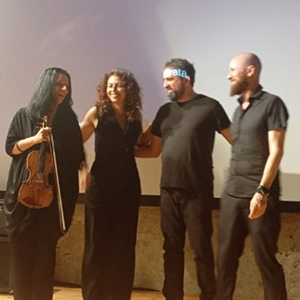
I Sincopatici are a Milan-based Avant-Prog ensemble founded by pianist and composer Francesca Badalini, dedicated to breathing fresh contemporary life into masterpieces of early 20th-century silent cinema. Following their 2024 debut “Decimo Cerchio (L’Inferno 1911 O.S.T.),” the group returned on January 9, 2026, with “La Corazzata Potëmkin,“ a striking 41-minute original re-score crafted to celebrate the centenary of Sergei Eisenstein’s 1925 landmark film, accompanying a newly AI-recolored version of the picture. Joining Badalini and long-time bassist Andrea Grumelli are violinist Silvia Maffeis and drummer/electronic artist Teo Ravelli, forming a quartet that bridges Neoclassical Chamber Music, Dark Ambient textures, and Heavy Avant-Garde Rock. After our full review of the album, editor Jacopo Vigezzi caught up with the band to discuss their stylistic evolution, technical live scoring, and the creation of their new release.
Francesca, you founded I Sincopatici in Milan building upon your long-standing work scoring silent films for the Cineteca Italiana since 1999. How did the concept of expanding this vision into a full band ensemble first take shape, and what was the core philosophy behind modernizing early 100s cinema soundtracks?
Francesca: “After years spent as a solo artist, improvising or composing alone or with ensembles that onlly played my score, I felt the need to do something different, more personal and more in tune with my longstanding desire to build a team, to work together with other musicians to develop not my music, but our music.“
Your 2024 debut album, “Decimo Cerchio (L’Inferno 1911 O.S.T.),” was recorded in collaboration with vocalist and performer Claudio Milano. How did that vocal-centric experience influence the band’s early sound, and what motivated the shift toward a purely instrumental quartet for the new album?
Francesca: “Our path is actually very different compared to what our discography says. Before Decimo Cerchio was born we already composed and performed Battleship Potemkin and many other “live soundtracks”. For us every movie is a different project, so, even if our style and our core line-up remain the same, we think about what kind of sound I need for our interpretation of the film. Even I play different instrument (always piano, but often also electric guitar, synth, toy instruments or even zither as was the case for Decimo Cerchio). In the same way I’ve always wanted to add vocals to one of our cineconcerts but I hadn’t found the right movie until I saw Decimo cerchio. So I proposed to call Claudio because I love his vocals and his performance.“
On “La Corazzata Potëmkin,” the current lineup features Silvia Maffeis on violin and Teo Ravelli on drums and live electronics alongside yourself and bassist Andrea Grumelli. How has this change in personnel redefined the ensemble’s internal dynamic and overall sonic palette?
Francesca: “As I said before it wasn’t really a change. We still perform Decimo Cerchio and other cineconcerts with a slightly different line-up. However yes, the internal dynamic is different. Besides in Battleship Potemkin we wanted the movie to stand out more. As in Decimo cerchio there are improvised sections, but with different sound palette we improvise differently, more by instinct than by choice: what each of us hears while we’re playing during the screening is constantly changing and listening to each other is crucial for developing our improvisation.“
Your sound moves fluidly between delicate classical chamber arrangements, like piano and violin, and aggressive Avant-Prog, fretless basslines, and live electronics. How do you maintain structural equilibrium between these acoustic and electronic worlds without one overpowering the other?
Teo: “It’s not something we think about that much, it just happens. Using live electronics is very different from composing an electronic piece from scratch, the way we use it is always contextual and tied to the the other instruments, it enhances the sound by responding to what the other instruments are playing and then they respond to this enhancement by playing something over it; this creates some kind of loop that’s always balanced somehow. We rarely start from electronic sounds.“
“La Corazzata Potëmkin“ was composed specifically to commemorate the centenary of Eisenstein’s 1925 classic. What made this particular Cinematic landmark the right subject for your second record, and how daunting was it to approach a film with such huge historical weight?
Francesca: “We performed the live accompaniment for Battleship Potemkin many times so we knew the movie very well and we simply love this movie. Besides we are used to working on great movies (even if we also gladly work on lesser-known movies) so it wasn’t daunting at all. We think anyone can give a new voice to these movies fearlessy: every voice is interesting and communicates something new to the audience.“
The album accompanies a special edition of the film where the original black-and-white visuals were recolored using Artificial Intelligence. Did working with these vibrant, newly recolored images impact your choices regarding tone colors, synth timbres, or harmonic tension?
Andrea: “Actually, the music was composed initially for the original version of the film, so B/W (plus the famous fragment with the colored red flag). The first version of the music for the film was mostly composed years ago, for a similar line-up but different musicians. What mostly changed during the years, was a constant updating of the music given the personal tastes of the single musician. This appears the most in the more improvisational sections of the music, when everyone is asked to contribute with his own sensibility to the flow of the music. Moreover, we of course changed our way of playing during the years, this led to including more effects on the instruments and electronic parts than in the original version that was more “classical oriented”. For the AI version the parts were adapted because the length of the movie is significantly less than the original one (40 minutes vs. 1h10). This meant that the musical material was rearranged and compressed in 40 minutes, leading to the exclusion of some musical parts that were less coherent with the new version of the movie.“
How does the composition process unfold within I Sincopatici? Does Francesca bring fully written themes mapped to film cues, or is the music developed collectively through group improvisation in front of the screen?
Francesca: “Usually I bring some written themes (but sometimes other members do too) but we can modify or elaborate it together and during the rehearsals often we create new themes improvising together. Then, there are sections that we prefer not to fix in place, which are completely improvised every time.“
Edmund Meisel’s original 1926 orchestral score is famously tied to Battleship Potemkin. Did you consciously distance yourselves from historic musical interpretations of the movie, or did past scores serve as a reference point during writing?
Francesca: “We choose case by case. Normally the original music doesn’t exist anymore. Sometimes, for example for Metropolis, we chose to start from the original score rearranging the score with our style and our sound. This is when we feel that original score can works for us. But with Meisel it was different for me: I saw Battleship Potemkin with the orchestral accompaniment composed by Meisel but I felt that approach wasn’t right for us. I found that music beautiful and masterfully orchestrated but dated, no longer able (in my vision) to support the extreme modernity and the strength of the movie, it didn’t resonate with me.“
The opening track, “Uomini E Vermi,” captures the crew’s claustrophobic revolt against corrupted rations through ominous ambient soundscapes, elastic bass lines, and mechanical synth textures. How did you translate that physical sense of decay and industrial confinement into musical notes?
Teo: “It’s all about tone really. We started from the bass line and the piano chorus, then went on from there: electronics build up to get the tension going, when the drums enter they are pretty quiet but slowly grow just like the crew’s rage and frustration. Distortion is also key in these moments, not just in the classical sense (fuzz, crunch and so on) but also using detune, chorus and reverb to create a sense of ‘something disturbing is about to happen.’“
Running nearly ten minutes, “Dramma Sul Ponte” conveys the chaos of mutiny through sharp violin dissonance, percussive piano accents, and stark dynamic contrasts between quiet ECM-style chamber moments and Heavy Rock bursts. How do you construct such long, volatile pieces so they stay cohesive both with and without the film?
Andrea: “Usually the music is composed based on the images of the movie, so we normally start with subdividing the movie in main scenes and writing the main themes of the score for such scenes, accordingly to the mood of the scene. Then we try to arrange the themes with the ensemble, adding each one’s ideas and sensibilities to the score that sometimes is drastically modified in the process. Some sections of the movies are dedicated to Improvisations. In these cases, according to the nature of the images, the improvisation can be rather different, from a more ambient-like part for instance for some narrative part or landscapes, to a more convulsive improvisation, like in the case of ‘Dramma Sul Ponte.’
We wanted to create the contract between the tension of the first part of the section and the images of the riot. So we used a more martial-dramatic music in the first part and a chaotic improvisation in the second, ending with an epic theme that would underline the success of the revolt, and the cost to be paid for this. Of course we insert some variation in these macro-sections in order to follow what appears on the screen and the narrative of the movie.“
In “Il Morto Chiama,” there is a clear shift toward an elegiac, Floydian clean guitar tone, mournful violin lines, and the deep reverberation of a dropped anchor. What guided the decision to use a more spacious, melancholic Rock language for this scene of collective mourning in Odessa?
Teo: “That segment is kind of an oasis in the middle of the movie, you come from the violence of “Dramma Sul Ponte” and are headed straight for the “Scalinata” which is even more violent in a way, so it was pretty natural to give the music some breathing space. The images are much less frantic and more humane, it’s more about feelings and pictures than war and quick montage so we felt that kind of vibe suited this chapter much better.“
The famous massacre sequence on the Odessa steps in “La Scalinata Di Odessa” opens with unexpectedly serene piano and fretless bass before collapsing into a violent maelstrom. How did Eisenstein‘s theory of the “montage of attractions” directly influence your rhythmic cuts and dramatic pacing here?
Andrea: “In this case, we wanted to create a contrast between the beginning of the act, with the scenes of harmony and fraternity between the sailors of the Potemkin and Odessa’s citizens and the barbaric massacre of civilians. So, the fist part is a very harmonic and melodic part, when the images show the ships of the citizens of Odessa carrying food and help to the insurrected sailors of the Potemkin, greeting them from the staircase of Odessa. Then, when chaos erupts, the music suddenly changes to dramatic and martial, with an explosion of sounds that underline the images of the Cossaks with the ferocious and inhumane attack, slaughtering the people of Odessa, causing countless innocent victims“
The final piece, “Una Contro Tutte,” drives toward an intense climax with hard-rocking electric guitars and booming bass before settling into a peaceful piano and violin duet. What emotional outcome did you want to leave the listener with at the end of the naval battle?
Teo: “The victory of human rights and feelings over tiranny and dictatorship, feelings of brotherliness growing out of the struggle. It’s pretty epic but the final moments have a melancholic shade as many lives were cut down to achieve this victory so it’s both a celebration of life and death and that’s something that concerns every single human being on the planet.“
The record blends traditional acoustic instruments with live electronics and custom soundscapes. Were Teo Ravelli’s live electronics and Andrea Grumelli’s soundscapes processed live in the room during tracking, or constructed layer-by-layer during post-production?
Teo: “It was all recorded live, there was some minor editing in post-production but 99% of what you hear is live. We wanted people to hear exactly what we’re playing live, there is no overdubbing, just some processing.
Live electronics work in the moment; we could have processed the tracks in post-production but it would have taken a lot away in spontaneity and feel.“
“La Corazzata Potëmkin“ spans 41 minutes across five distinct movements. Was it a priority for you that the album works seamlessly as an autonomous Progressive/Avant-Garde listening experience independent of the movie?
Andrea: “Actually, the priority was to try to capture the essence of a cine-concert, so we recorded it while watching the movie, as we would have done performing this live. The idea is that the listener can experience similar feelings to the ones felt in a real concert. That’s the reason why we recorded all live, with practically no overdubs or post-production.
I think that experiencing the album as a piece of music unrelated to the movie is a quite different experience. In a way, the music is evocative and has a narration on its own, so the listener can imagine a story around it and in my opinion, it works beautifully also without the movie. Nevertheless, I think the best would be try to listen to it while watching the movie for a total immersion in it. (to watch the movie + music, go to: https://youtu.be/EJfpdAiTt9s)“
When performing a live cine-concert, how strictly o you adhere to synchronization? Do you rely on click tracks and visual cues, or do you leave room for real-time improvisation depending on the hall’s energy?
Andrea: We do not use click tracksand all the music is normally played live but we strictly adhere to synchronization with the movie as our music is conceived to be the narrative of the story. So, our scores and notes are full of references to some visual clues that would indicate the starting point of a theme or a section. The improvisation sections are normally also indicated by visual clues as we intend the music to be a sort of narration of the whole events of the movie through our music. Of course the improvisational parts can be quite different according to the reactions to what is played by the other musicians, it also can vary a lot depending on the effects on guitar/bass and electronics that we constantly update, according to our taste.“
A live soundtrack performance demands a unique dual attention from the audience, who watch a silent movie while absorbing live Avant-Prog and Post-Rock. What has been the most surprising or memorable reaction from an audience during your cine-concerts?
Francesca: “Usually the audience is moved and pleasantly surprised (sometimes those who are’t usedto these screenings think it might be boring)
The funniest reaction came from a sound technician: after a screening of Battleship Potemkin he told us, ‘Wow, pensavo fosse una cagata (to quote Fantozzi) e invece che figata!‘”
Italy has an iconic heritage in film scoring and Progressive Rock, from Goblin to modern Experimental groups. Where do you feel I Sincopatici fit within today’s international Avant-Prog and modern soundtrack landscapes?
Andrea: “I think (or I’m happy to think that) I Sincopatici have a particular section on their own in this particular sub-genre. A lot of the scoring for old silent movies is done with classical instruments or more modern, ambient-like or electronics. I like to think that I Sincopatici are a sort of bridge between these different genres as we include, classical oriented themes with more rock attitude, improvisation with more sound FX and electronics part. In general, a blend of different genres that are put at place for serving the narrative of the movie.“
Scoring silent cinema requires creating dramatic tension without vocal hooks or lyric narratives. Is there another classic film you are already eyeing for a future re-score, or are you interested in writing non-cinematic standalone music as well?
Francesca: “In the next few months we are going to record another album with our music for Nosferatu. Besides, we are playing live a lot of our cineconcerts, for example Nosferatu on October 25th (at Jardin Musical, in Switzerland) and on November the 5th (at Ecoteatro, Milano), Stan Laurel and Oliver Hardy’s movies on December 22nd (at Ecoteatro, Milano), Metropolis on January 16th (at Ecoteatro, Milano) and we are performing a special screening of Decimo cerchio for high schools. But we always look forward to creating new music. Sometimes Festivals commission new cineconcerts: for example this year we scored The Fall of The House Usher for the Nonantola Film Festival and M. (Fritz Lang’s first sound movie, with dialogues and rumors, a very different experience) for AriAnteo. I personally would love to play with Sincopatici on Nanook of the North, The man who laughs, Schatten…
For standalone music…at the moment we haven’t thought about it (also because all of us has other projects outside of film) but who knows?“
To conclude: for listeners discovering I Sincopatici for the first time through “La Corazzata Potëmkin,” what do you hope they take away from this dialogue between 1920s revolutionary cinema and 2020s Progressive music?
Andrea: “I hope they embark with us in the journey of rediscovering the initial septs of the art of cinema in the 1920’ via the silent movies balanced with new soundtracks that could modernize the narrative of these masterpieces. The idea is to relive some classical movie that sculped the history of this art through new lenses, with our music composed to experience the movie in a new way.“
“La Corazzata Potëmkin” stands as a compelling testament to I Sincopatici‘s ability to revitalize silent cinema through a sophisticated, forward-thinking Avant-Prog lens. Rather than offering literal or period-accurate period accompaniment, the Milanese ensemble has crafted a vibrant, autonomous work of modern Chamber Rock and Electronic Experimentation. Be sure to check out our full track-by-track review of the album (here) on Progressive Rock Journal.