

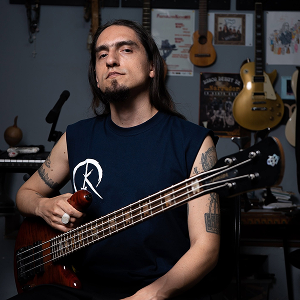
Peruvian bassist, composer, and producer Oliver Castillo, well known for his 30-year tenure with Lima Rock outfit Dmente Comun, completes the initial arc of his solo project with ”Laboratorio V03.” Following “Laboratorio V01” (2020) and “Laboratorio V02” (2023), this third installment expands the project’s signature bass-driven, instrumental framework into a broader, animal-inspired narrative. Featuring 13 tracks themed around wildlife and biodiversity alongside 12 guest musicians, “Laboratorio V03“ marks the culmination of the project’s foundational trilogy. Ahead of our review of the album, Jacopo Vigezzi caught up with Oliver Castillo to discuss the new record, his collaborative process, and the evolution of LABORATORIO.
“Laboratorio V03“ completes the trilogy you initiated in 2020 with “Laboratorio V01” and continued with “Laboratorio V02” in 2023. How does it feel to reach the finish line of this initial cycle, and at what point did you realize V03 would serve as the closing chapter?
LABORATORIO started because I wanted to make more music outside my usual bands. I slowly developed the songs that became V01, and after releasing it, I felt there was something special about the project, so I decided to make a second album. It was only after V02 that I decided to turn LABORATORIO into a trilogy. Together with Renzo “Corpz” González, we developed a visual story connecting the three albums: a scientist who experiments on his own body, adding characteristics and abilities from different creatures, until he finally escapes from his laboratory at the end of V03. Now that the trilogy is complete, I actually feel more excited than ever to keep making music and working with other musicians. I’m already developing ideas for the next chapter of LABORATORIO.
The 13 tracks on “Laboratorio V03“ are explicitly named after animals, ranging from Dragones and Hipocampo to Ornitorrinco. What inspired wildlife and biodiversity as the thematic spine for this record?
It all started with V01. One of the first songs I worked on was “Libélula,” built around a repetitive bass line, almost like a mantra. It reminded me of an insect flying, and I even imagined a dragonfly flying around the musicians while they played. From that moment, I started playing a little game with each composition, trying to connect the feelings and images the music gave me with different insects. Over time, I started including sea creatures and other animals that I felt matched the personality of each song. What started as a simple connection between music and insects became an important part of LABORATORIO’s identity.
Compared to the minimalist approach of V01 and V02, “Laboratorio V03“ features more elaborate arrangements and expanded production. What prompted this shift toward a larger, more adventurous soundscape?
Most of my musical career has been with Dmente Comun, my main band, which is a power trio. I’m very familiar with that format, so most of the songs on V01 were composed and produced in a similar way. With V02, I started exploring other possibilities, adding more melodic instruments and trying different approaches to bass lines. My good friend Kenneth Quiróz, who sadly passed away, helped me realize that some songs needed a second bass line to better connect the rhythmic and harmonic parts. From there, I started moving away from the trio format, adding more guitars, keyboards, and other instruments. By V03, I was no longer following that structure. Some songs have two or even three bass lines, and I gave the guest musicians the freedom to record as many instrumental parts as they felt the music needed.
You collaborated with 12 guest musicians across the album. How did you match specific guest players, such as Tavo Castillo on “Dragones” or Alec Marambio on ”Perro“ and “Calamar colosal,” to particular tracks and animal concepts?
Sometimes I start composing a song with a specific musician already in mind. Other times, I feel a song needs a certain instrument or a musician with a particular style, maybe closer to funk or jazz, so I look for someone who could bring that sound. It also works the other way around. Sometimes there’s a musician I really want to work with, so I send them two or three demos and let them choose which one they prefer. The animal names usually come later, when the demos are almost finished. I choose the creature based on what the music makes me feel, not before choosing the guest musician.
On tracks like “Hipocampo“ (featuring Theremyn_4) and “Pez volador“ (featuring Pauchi Sasaki), Electronic textures and distinct instrumental voices blend with your basslines. How do you balance guest soloists with your core role as the lead bassist and composer?
Every song starts with an idea I develop on the bass. Then I record a bass-and-drums demo with the tempo, structure, and main changes already defined. I send that demo to the guest musicians and give them the freedom to develop their own parts. Once I receive all their recordings, I go back to my bass lines. Sometimes I add another bass part or small arrangements to make everything work better together. This helps me give each musician enough space to show their personality, while keeping the bass as a strong connection between all the songs on the album.
You co-produced “Laboratorio V03” with Daniel Willis, who also handled mixing and mastering. How did working together shape the sonic character and clarity of these complex arrangements?
Daniel and I are cousins, and we’ve played together in Dmente Comun for over 30 years, so we know each other very well. I handle the musical production of each song and the sound of the main bass line, while Daniel works on the sound of the additional bass lines. He makes sure each bass sounds clear and that they work together instead of competing with each other. He also plays an important role in the overall sound of the album. With so many different musicians, instruments, and styles, his work on sound design and mixing helps everything fit together and gives the album a consistent sound.
The artwork for V03 was created by Renzo “Corpz” Gonzalez. How does the visual aesthetic connect with the album’s wildlife concept and the musical direction of the trilogy?
When the music for V01 was ready, I talked to Renzo about the idea behind the collaborations. I proposed a story about a scientist who experiments on his own body, adding abilities and characteristics from different creatures and slowly transforming himself. We shared some visual references, especially album covers from the 1990s with very detailed illustrations and lots of hidden elements. We decided to use that style for LABORATORIO. That’s how we created the visual identity of the project. The scientist changes and evolves through the three albums, and the artwork includes many small details connected to the music and my personal life.
With tracks like “Parasaurolophus,” “Termita,” and “Tortuga marina,” the album covers diverse tempos and moods. Did you write the music with specific animal movements or behaviors in mind, or did the titles emerge after the compositions were finished?
The titles usually come when the music is almost finished. While I’m composing, I give each idea a temporary name just to identify it. It could be any word that comes to mind or an object I have around me. When a song is almost ready, I start thinking about which creature could represent it best. I consider the tempo, the feeling, and the different moments of the song, and try to find an animal that reminds me of that music. Sometimes I discuss the names with the guest musician, or with my eight-year-old son, Adolfo, who also loves insects and other creatures. It’s a very natural process, and sometimes we make the decision together.
Having spent over 30 years as the bassist for Dmente Comun, what led you in 2020 to establish LABORATORIO as an independent solo outlet?
It all started with a muscular problem I’d had for many years, which got worse around 2015. It made me wonder how much longer I would be able to keep making music, so I felt I needed to produce more than what I was already doing with my band. Like many musicians, I had several unfinished ideas and songs. I started checking old hard drives, finding those ideas, and working on them again. To start the project, I contacted three guitarists I had played with before and who were also good friends: Charlie Parra del Riego, Ricardo Méndez from Difonía, and Walter Cobos from Ni Voz Ni Voto. I remember writing to all three on the same day, and they all agreed to participate. That’s how LABORATORIO started. Since then, I’ve learned to work with different musicians and adapt to their ways of making music. It’s been a great experience, and I’ve learned a lot from it.
LABORATORIO is fundamentally a bass-driven project. How has your approach to composing on the bass evolved from your work with Dmente Comun to leading an instrumental ensemble?
Since I started making music, I’ve always been influenced by bass players who like to do things differently. César Bustamante from Frágil, Les Claypool from Primus, Flea from Red Hot Chili Peppers, and Mel Schacher from Grand Funk Railroad, among others, showed me that the bass can do much more than just its traditional role. I’ve always enjoyed playing melodies, chords, and different arrangements on the bass, and trying new techniques. This has helped me create bass ideas that can become the starting point for complete songs. I’ve also always loved instrumental music. Dmente Comun isn’t an instrumental band, but we recorded some instrumental songs on Metamorfosis (2004), and many of our songs have instrumental sections where we experiment with different sounds, moods, and dynamics. So I see LABORATORIO as a natural evolution of my work with Dmente Comun and everything I’ve learned during more than 30 years with the band.
Looking back at “Laboratorio V01“ (2020), “Laboratorio V02“ (2023), and now “Laboratorio V03” (2026), how do you view the stylistic progression across all three records?
V01 is more rock-oriented, with more guitars and a sound closer to a power trio. It was a familiar way of working for me because of my experience with Dmente Comun. Starting with V02, I began exploring different instruments, styles, and ways of producing music. Both V02 and V03 are much more open, and I started working with musicians from very different musical backgrounds. I think you can hear that change across the three albums. I’ve learned a lot from working with musicians of different styles and generations, and I’ve really enjoyed the process. In a way, that’s what LABORATORIO is about: learning from every collaboration and growing as a musician.
Given the number of guest performers across 13 tracks, what was one of the most unexpected or memorable moments during the writing and recording sessions for V03?
I really enjoy the whole process, but my favorite moment is always hearing what each guest musician sends me for the first time. When I share a demo, I usually give them a few ideas about the intensity of certain parts, the feeling I’m looking for, or maybe a musical reference. But I try not to influence them too much. I want each musician to approach the song in their own way, bringing their personality and musical influences. That’s why the first recording I receive is always a great surprise. It’s the moment when I hear how someone else has understood and developed an idea that originally existed only in my head.
Since LABORATORIO relies heavily on guest collaborations in the studio, how do you translate these intricate compositions into a live concert environment?
That’s a challenge I haven’t faced yet. For now, LABORATORIO is a studio project, mainly released on digital platforms. I’ve also released physical editions of the three albums here in Lima. I know it would be difficult to bring this music to the stage. Getting so many musicians together, organizing their equipment, and making everything work live would be a complex production. I’d love to explore that possibility someday, but it’s not something I’m planning in the near future.
How do audiences react to a live set focused entirely on bass-led, Progressive, and Cinematic instrumental music?
As I mentioned, I haven’t performed LABORATORIO live yet, so the feedback I’ve received comes from people who listen to the music on digital platforms or have bought the physical albums. The response has been very positive, and I’m happy to find people who enjoy a project that’s so different from what we usually hear. I know there isn’t a large audience for this kind of music here in Lima, but there are people who discover it and really enjoy it. For me, that’s already very important.
Is there a particular track from “Laboratorio V03” that has taken on a new energy or form when played live?
Since I haven’t performed LABORATORIO live yet, I don’t know how the songs might change on stage. One idea I find interesting is to rearrange some songs for a larger group or a regular band. That way, we could play several songs with the same musicians instead of changing guests and instruments for every song. This could give the music a different energy and create new possibilities for the arrangements. I haven’t worked on this idea yet because live shows aren’t in my immediate plans, but it’s something I’d like to explore in the future.
How would you describe the current state of the Progressive, Experimental, and instrumental Rock scene in Lima and across Peru?
There are many different musical projects in Lima, including progressive, experimental, and instrumental bands. But I don’t think we have an organized music scene for these styles. We don’t have a regular network of venues, radio stations, or media where people can easily discover this kind of music. You have to spend time searching on social media and digital platforms to find these artists. For musicians, it’s the same. Each project has to find its own audience because there isn’t a strong structure connecting artists and listeners. There are many interesting musicians and bands that could work together and support each other, but I think we still need a more organized scene to help these projects grow and reach more people.
Releasing music independently on platforms like Bandcamp and Spotify allows artists to reach listeners worldwide. What has your experience been connecting with Progressive Rock audiences internationally?
It’s been a difficult process, but I’ve learned a lot. V01 was released during the pandemic, so we didn’t have a big promotion campaign. With V02, we focused more on South America, mainly because most music promotion services here in Lima work with media from this region. For V03, I decided to try something different. For the first time, I started contacting music websites and magazines in other languages and countries outside South America, hoping to reach new listeners. I’ve been very surprised by the positive response from some international media. Several people have shown interest in listening to the album and helping promote it. It’s still early, but I’m very happy and thankful for the response. It’s exciting to see that LABORATORIO can reach people outside Peru.
Now that the first LABORATORIO trilogy is complete, do you plan to take the project in a new direction, or will you return your focus to Dmente Comun for a while?
Right now, I’m working on Dmente Comun’s next release. We’ve already released the first single, “Hiperalerta,” and we’re going into the studio to record the songs we plan to release next year. As for LABORATORIO, even though my original plan was to make a trilogy, I don’t want to stop the project with V03. I think there’s still a lot more to explore. I’ve already started composing some ideas for V04, and I’m planning to start working on the concept for a second trilogy toward the end of next year. These are still early plans, but I’m excited to see where LABORATORIO goes next.
Do you have a message for the readers of Progressive Rock Journal and international fans discovering ”Laboratorio V03”?
First of all, I’d like to thank everyone for taking the time to listen to V03 and discover LABORATORIO. Even though I lead the project, it brings together many musicians from different parts of the Peruvian music scene, with different styles, influences, and backgrounds. I think this shows some of the musical diversity we have in Peru. Besides enjoying the album, I hope listeners become curious about other Peruvian artists and bands. I’d love LABORATORIO to help people discover bands like Dmente Comun, legendary Peruvian progressive rock bands like Frágil, and many other projects that deserve more attention. Thanks to Progressive Rock Journal for this opportunity, and to everyone interested in discovering our music.
“Laboratorio V03“ stands as a creative milestone for Oliver Castillo, successfully wrapping up a trilogy that has pushed the boundaries of bass-driven progressive and Experimental Rock. Stay tuned to Progressive Rock Journal for our upcoming full review of “Laboratorio V03.” In the meantime, you can stream and purchase the album directly via Oliver Castillo‘s Bandcamp and Spotify pages.