

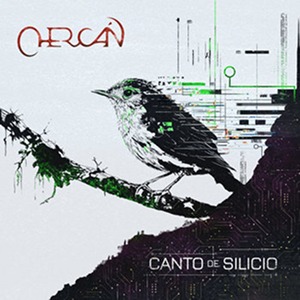
Chercán arrived on the scene in 2019 out of Valdivia, in Chile’s rain-forested south, an initiative born in the hands of drummer and percussionist Rodrigo González Mera, already a recognizable figure in the local scene through his work with La Desooorden and Homínido. Their self-titled debut, released in March 2025, was a document of genuine fire: a visceral, torrential brand of Avant-Prog threaded through with Jazz Fusion, Heavy Rock, and orchestral string passages. The ambition was undeniable. Yet the production, while energetic, suffered from a roughness and an unevenness in the balance that kept the record just short of the heights its musicianship implied. “Canto De Silencio,” landing on October 23, 2026, is the answer to that gap. It is a record of decisive formal maturity and, crucially, of a mix so clean and confident that the individual voices of the ensemble finally breathe with the spatial clarity they deserve. The recording sessions were split across three facilities: Estudio Monteranco in Futrono, where drums, guitars, bass, saxophones, and vocals were captured under the engineering of Máximo Torres, Estudio El Pequén in Valdivia, where González Mera handled the percussion and synthesizer layers, and Estudios ZUR in Santiago, home to the guest string quartet sessions. The final mix was shaped by Jorge Fortune at Telúrica Estudio in Coyhaique, with mastering by Carlos Barros at Isla Negra Producciones, Santiago. The result is a record that sits with the definition and dynamic balance the debut lacked. Over its 49 minutes, “Canto De Silencio” is a record without a single wasted gesture. The technical execution is immaculate, the arrangements unfold with a naturalism that never tips into mannerism, and the tension never sags across its full span. It is, in short, a solid, mature, and fully realized statement of intent from a band that has clearly heard what its first record was asking of it, and delivered. Released as the first single in September 2026, “Pareidolia” announces the renewed precision in the band’s arranging almost before the first bar fully resolves. It opens on a clean, Math-Rock-inflected guitar riff from Roberto Faúndez, underpinned by Pablo Barría on bass, who adds a low, textural weight via the Korg Monologue. Martín Peña‘s vocal delivery is markedly more articulated and focused than on the debut, his phrasing sits inside the rhythm rather than hovering above it. Matías Bahamondes, moving between flute and saxophone, weaves counter-lines against González Mera‘s synthesizer textures within a polymetric framework built over a 4/4 base of distinctly Acid/Heavy Prog derivation. The lyric thread concerns the mind’s tendency to perceive pattern where none exists, and the slow surrender to that impulse: “Tu cerebro ve y no es la forma real / Pareidolia / Veo el caos a mi alrededor / Que no sospeché ni creí / La disyuntiva se acabó / Elijo el infinito.” A clean, purposeful opening. A brief Psychedelic aside shaped almost entirely by the Kaoss Pad in Peña‘s hands, “∞.” It functions as a bridge, a 41-second exhale that carries the listener’s ear from the angularity of “Pareidolia” into the next movement without a hard stop. An enigmatic, mid-tempo piece “En lo incierto” in which Peña assumes a dual role: he plays the guitar solo and layers decorative six-string figures, while simultaneously shaping the textural bed on the Kaoss Pad. Barría‘s Korg Monologue gives the low end a slow, modulating density over which González Mera‘s drumming carves out hypnotic time-signature shifts. The lyric confronts uncertainty directly, “Cicatrices en el cielo / Precipicio hacia la vida,” and extends the metaphor into the realm of the technologically unknown: “¿Es un hechizo tecnológico? / Allí aparece / A través de sombras y del tiempo / Habita y habla / En lo incierto.” A track that rewards repeated, close listening. “⇸” is the second interstitial fragment in the record’s architecture. Thirty-nine seconds of transitional texture that eases the ear into the next, more lyrical statement. Arguably the most refined moment on the album, “Ojos de cristal.” Faúndez shifts to acoustic guitar, and Bahamondes answers on flute in a dialogue of considerable restraint. The pivotal element here is the guest string quartet: Benjamín Ruz Guzmán on violin and overall string direction, Braulio Rivas Tapia on viola, and Sebastián Fierro Neira on cello. Their entry lends the progress a genuinely Chamber Music dimension, a warmth and harmonic depth that the band’s own instrumentation alone does not fully achieve. The lyric is a pointed indictment of vanity and of technological-material control: “Tus ojos agonizan belleza / Me robas la esencia / Buscas la perfección […] Tus ojos de cristal / Reiré complacido de vivir / Enfrentándome al dolor / Del control desenfrenado.” The track earns its six-minute span comfortably. A micro-interlude “⫸” built around a few carefully detailed guitar figures from Peña. It is the shortest piece on the record and serves as a brief pivot toward the more forceful material that follows. “Pieles de metal” is Rhythmic, driven, and tightly coiled. The pulse comes from Barría‘s Korg Monologue in a synthetic bass role, and the string ensemble directed by Ruz returns to add harmonic gravity. The rhythmic section, González Mera at the drum kit, the interplay with the low-end, holds together with a lockstep consistency that lets Peña‘s vocal lines float above with melodic clarity without sacrificing forward momentum. The subject is alienation in the age of artificial intelligence and the stubborn desire to reclaim something recognizably human: “Estamos rodeados de títeres / Rodeados de cenizas / Se quemó nuestro instinto / Seguiremos instrucciones / Pero / Un día podré / Volver a volar.” The central instrumental development, with its shifting time signatures and alternation between sung passages and dense, choral instrumental bursts, builds to a crescendo in which the full band releases its accumulated energy in a compact, meticulously arranged close. A more expansive, eclectic breath, “Última luz.” Bahamondes‘ flute trades phrases with the synth-bass in a call-and-response that never becomes predictable, while the structure oscillates fluidly between atmospheric stillness and dynamic Progressive openers. The thematic core is environmental: the loss of freedom, the fragility of the natural world. “La enfermedad bombardea / El espíritu del ser verde […] El cielo dictatinó nuestra culpa / De malgastar la libertad.” It is a track that binds a lyric of urgent, present-day relevance to the idiom of the Chilean Progressive tradition, recasting familiar formal gestures within a contemporary context of considerable emotional weight. The fourth and final Kaoss Pad–driven electronic bridge, “֎” guiding the listener into “Sueño diferido” with a gentle, undifferentiated wash of texture. Issued as the second single in September 2026, “Sueño diferido” moves in a dreamlike, evolutionary pulse, carried by Barría‘s Korg Monologue and González Mera’s synthesizer layers. It is a track that exposes the individual players at their most assured and reveals a volume management that is, frankly, exemplary, no instrument steps on another, every voice finds its register. The lyric is a metaphor for hibernation and temporal stasis: “El tiempo se detiene / En el corazón […] Hiberno en una cámara / Mientras sigue el sol latiendo / Flotando en la marea / Sonidos de algas eléctricas buscan la luz.” The piece develops its central idea through a gradual intensification that culminates in a choral instrumental passage where all five voices converse across Progressive textures, demonstrating a band cohesion that is no longer theoretical but fully realized. “Materia invisible” is the longest track on the album, and structurally the most complex. The guitars of Peña and Faúndez alternate with Bahamondes‘ saxophone lines in a rotating ensemble texture, while the frequent shifts in time signature, handled with a fluidity that speaks to a great deal of collective rehearsal, underscore the ensemble’s maturity. The lyric reaches into the territory of imperceptible threats and cellular or catalytic regeneration: “Un lado oscuro / Capaz de envenenar […] Fusiles sin metal / No se puede detectar […] Átomos en evolución / Capacidad catalítica / Partículas / Pequeñas esperanzas.” A demanding listen, but a rewarding one. The closing statement “La evolución” gathers the album’s principal threads into a single, purposeful arc. Faúndez takes up the 12-string guitar, Bahamondes plays flute, and the Ruz–Rivas–Fierro string quartet is present for what is, in effect, the band’s fullest sonic statement. The track grows with a natural, almost inevitable momentum toward a choral climax of considerable expressive force. The final image is one of evolutionary hope: “Estamos rodeados / De débiles títeres […] Que buscamos revolucionar […] Y ver ese fuego / En tus ojos de esperanza en la evolución.” A fitting end to a record that has been building, track by track, toward this synthesis. “Canto De Silencio” is a record of absolute value, free of structural wobble or compositional concession. It extends the refined thread of the Chilean Progressive tradition, where technical command, lyrical directness, and orchestral sensibility have long coexisted, and positions Chercán firmly within it. The band’s authorial control over arrangement, the fluidity of their ensemble interplay, and a production that is finally at the level of their creative ambition combine to make this a record that is solid, concrete, and persuasive from the first note to the last. The step forward from the 2025 debut is not incremental, it is qualitative. The songs here carry greater lyrical intensity, the compositions are more assured, and the execution is uniformly at a high level. Chercán have demonstrated that they are capable of growth without losing the visceral energy that first distinguished them, and this record leaves one with a strong, well-founded expectation for whatever they produce next. They are, without question, one of the most compelling forces in the current Latin American Progressive landscape, and an act that any reader of this journal would be well served to follow.
Tracklist
01. areidolia (06:14)
02. ∞ (00:41)
03. En lo incierto (05:20)
04. ⇸ (00:39)
05. Ojos de cristal (06:10)
06. ⫸ (00:35)
07. Pieles de metal (05:22)
08. Última luz (05:10)
09. ֎ (00:37)
10. Sueño diferido (05:48)
11. Materia invisible (06:41)
12. La evolución (05:55)
Lineup
Martín Peña / Vocals
Roberto Faúndez / Guitars (Electric and Electro-Acoustic) and Backing Vocals
Pablo Barría / Electric Bass and Backing Vocals
Matías Bahamondes / Saxophone
Rodrigo González Mera / Drums, Percussion, and Synthesizers
Guest:
Benjamín Ruz Guzmán / String Quartet Arrangements and Direction, Violins
Braulio Rivas Tapia / Viola
Sebastián Fierro Neira / Cello
Javiera González / Cello
Ariadna Kordovero / Cello