

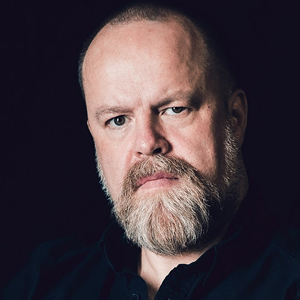
As a founding member and main guitarist of Airbag, as well as an established solo artist, Bjørn Riis has consistently shaped Norwegian Progressive Rock with his emotive guitar work and lush Atmospheric soundscapes. Following the release of “Fimbulvinter” and the live mini-album “Lifandi,” Riis completes a deeply personal trilogy with his new four-track mini-album, “Divergence,” released via Karisma Records. We caught up with Bjørn to discuss the evolution of his solo path, the themes behind “Divergence,” his guest features, and his perspective on the contemporary Progressive scene.
Having established a recognizable guitar style both as a founding member of Airbag and through your solo discography, how do you define the creative boundary between Airbag’s collective output and your solo compositions?
I’m not sure there is a boundary really. An idea or a song usually starts off with me sitting down with a guitar or a keyboard and as that idea evolves, it reveals it self whether it’s a solo song or Airbag. I don’t usually sit down and decide what to write and my approach to arranging the guitars depends on what fits with the song. Having said that, I guess my songs tend to have a slightly looser feel. I don’t have to cinsider what other members have to say.
Looking back at your journey from “Lullabies in a Car Crash“ to “Fimbulvinter,” how do you feel your approach to atmosphere, tone, and song structure has evolved over the years?
Listening back I used to put too much stuff into the arrangements and production not relying on the strength of the song alone. My recent material is much more stripped down but at the same time, each element counts more. I guess that’s a result of becoming more confirdent as both a song writer and producer.
When embarking on a solo release, does the songwriting usually originate from specific guitar motifs and soundscapes, or do you start with conceptual and lyrical ideas?
Both. It can be me just noodeling on a guitar or keyboard or, an idea that pops into my head when I’m on the sub to work or whatever. On the last album, Break Free started with this guitar riff that I played during warm ups at a rehearsal, while the single, Mercy, srated out with a couple of lines that I’d written down on my phone.
As a songwriter and producer, what are the primary artistic advantages and challenges of working in solitude compared to a full band environment?
The biggest thing I guess is that I’m responsible for everything. Good and bad! But I have some trusted friends that are my filters along the way. But I enjoy both really. I learn a lot from doing most of the solo projects alone and I enjoy the experience of playing with others, feeding off each other and crearting something new from a small idea one of us brought in.
Your new mini-album “Divergence” completes a trilogy alongside “Fimbulvinter” and “Lifandi.” Was this trilogy structure envisioned from the start, or did it take shape organically during the writing process?
It took shape along the way. I never intended to do the live EP, Lifandi, but I thought the recordings from those shows sounded great and I thought why not? I already had these songs for Divergence, which moved to after Lifandi so everything tied in together and very much felt like the same project. A lot of the fans and reviews also picked up on this after Lifandi, which was very interesting. I never expected Lifandi to get that much attention being only a 4-track live EP, but apparently it struck a nerve.
You have noted that the material for “Divergence” largely stems from the “Fimbulvinter” sessions. What made these four tracks demand their own distinct mini-album format rather than inclusion on the previous full-length?
I really love those songs and while I’m not a big fan of just releasing left-overs, I thought that the 4 songs were strong and fitted well together.
“Divergence” consists of four tracks: “Carry Me,” “Mercy,” “Break Free,” and “When I Think of You.” How do these songs connect musically and narrative-wise across the EP?
Obviously, the production connects them and I have these small musical themes and sounds thta goes through all four songs. For me it’s more of a feeling. I don’t think it needed to be a full album. These four songs form a strong cohesive narrative of their own and although it’s only an EP, 30-35 minutes is enough to create a full experience and not just something that you trow together for the sake of releasing. These 4 songs represent where I am artistically at the moment and it didn’t feel right to write 2-3 more.
The single “Mercy” features a duet with Norwegian artist Mimmi Tamba. How did this collaboration come together, and what did her vocal presence bring to the song’s emotional dynamic?
Mimmi is an incredibly talented Norwegian artist that I’ve known and worked with for some time now. She’s on some of my older albums as well. I think we fit well together but there’s also a contrast, with her bringing that soul element similar to what Pink Floyd did on Dark Side of the Moon. I’ve always been a fan of that.
Lyrically, “Mercy” addresses healing from emotional trauma and recognizing that recovery requires support. How did you balance that intimate vulnerability with the song’s Heavy, Atmospheric guitar work?
I don’t think there are any heavy guitars on the track but most of the stuff I do on the guitar is improvised. I don’t sit down an plan these things. I knew I wanted a solo at the end and what I recorded is pretty much the first run-through. It’s an extension of my voice really.
“Mercy” incorporates elements reminiscent of the American singer-songwriter tradition. Which non-Progressive or acoustic songwriter influences have played a key role in shaping your Melodic sensibility?
I’m a huge fan of the Laurel Canyon Calaifornia sound of the 70s, like Jackson Brown, Eagles and the more poppy Nashville stuff, like Emmylou Harris and Gram Parsons.
On “Divergence,” you handled all instrumental performances yourself. What were the most demanding aspects of tracking every instrument, from rhythm arrangements to lead guitars, on your own?
I’m confirdent as a guitarist so everything else is pretty much a learning process.
You teamed up once again with Vegard Kleftås Sleipnes for mixing and mastering. How has your working dynamic with Vegard developed to capture the dynamic range of your music?
He and I have the same background and musical references and the fact that we’ve worked together for nearly two decades now, means that he knows what I want. At the same time, I trust him to challenge me as well, which he does.
The album cover features a photograph you took at Rubjerg Knude Lighthouse in Denmark, framed by Asle Tostrup‘s design. How does this imagery of erosion and light reflect the themes of contrast and change on “Divergence”?
I thought it was fitting, with the lines, the movement and the contranst.
You recently contributed a guest performance to Marco Ragni’s album “The Radical Act.” How do you approach crafting a guitar solo or guest contribution for another artist’s vision compared to your own projects?
They usually give me some pointers – either what sound they want or specific ideas. But I’m mostly left to come up with something on my own, which is what I prefer. Marco makes great songs, with a lot of things happening, so it’s always a challenge to come up with ideas that fits and that he likes. It’s great fun and I think his new album is probably his best.
Earlier this year you released Lifandi, capturing your live solo arrangements. How does the experience of performing your solo material live compare to touring with Airbag?
I guess I’m more comfortable as the guitarist in Airbag. There’s too many distractions having to sing, play and being in charge of it all as a solo act but I really enjoy it too. With Airbag we plan everything but I like to have a more loose rock and roll feel to my shows, leaving more room for everyone on the stage to shine and basically just having fun.
Is there a specific live show or memorable anecdote from your solo performances that stands out as a key moment in connecting with your audience?
Lifandi was recorded on the day that Ace Frehley from Kiss died, which was very emotional. I’ve been a die-hard Kiss fan since I was a kid and all my fans knows that. There was a lot Kiss shirts in the audience that night, I talked about how much he’d meant to me and my music and we all just came together and honoured him that night. It was special.
As an artist who has been active in Scandinavian Progressive Rock for years, how do you perceive the current state and health of the international Progressive music scene?
We’ve noticed that there are a lot of younger people at our shows lately and I’ve talked to other bands about this too. Old or young, progressive rock fans go to concerts, buy physical product and basically just enjoy music on a level that’s very reassuring and inspiring. For them it seems, good music is good music, so it odesn’t matter if it’s prog, pop, or rock and I think that’s the strength of the so-called prog genre and new bands as well – there is a lot of cross over.
Physical editions, such as the limited marble vinyl LP and digisleeve CD, remain an essential part of your releases on Karisma Records. How important is the tangible aesthetic experience of an album to you in today’s streaming-dominated landscape?
Physical product is still very important to many and we see that both vinyl and CD are still on the rise.
With “Divergence” bringing this personal trilogy to a close, what directions or sonic ideas are you interested in exploring next in your musical journey?
I have no idea. I do have some stuff that I’m working on and we just finished the new Airbag album so the furure looks bright!
We want to thank Bjørn Riis for taking the time to share his insights with us at Progressive Rock Journal. “Divergence” is available now for pre-order via Karisma Records on CD, limited marble vinyl, and digital formats ahead of its release. Be sure to check out our upcoming review of the mini-album right here on Progressive Rock Journal.
Thank you! – Bjorn
Read our Review of the new mini-album “A Fleeting Glimpse” here: [Review] Bjorn Riis – A Fleeting Glimpse