

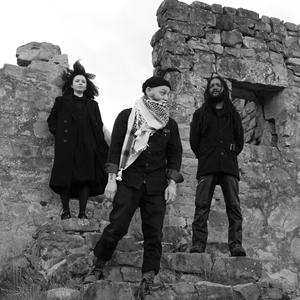
Emerging from Cape Town, P+A+G+E+S operate at the crossroads of doom, Atmospheric Noise, Drone and Sludge-infused Post-Metal, shaping a sound that privileges weight, tension and emotional gravity over convention. Their debut full-length album, “No More Can Be Done,” released on October 25, 2025, represents the culmination of a creative path that began years earlier and gradually evolved into a focused artistic statement. Addressing themes of existential unease, environmental decay and geopolitical despair, the record unfolds through dense textures, stark repetition and carefully constructed dynamics. With the release of the single and video “Shine On,” the band offered an initial visual and conceptual entry point into the album’s inner world. We spoke with P+A+G+E+S to explore their origins, their musical language, and the ideas behind “No More Can Be Done.”
Could you introduce P+A+G+E+S and outline the band’s genesis, including the transition from your earlier incarnation (active between 2014 and 2019) to the project as it stands today?
We are P+A+G+E+S (pronounced, ‘pages’) – a South African doom, atmospheric noise, drone and sludge punk post-metal trio. From 2014 – 2019, we were known as, ‘Morning Pages’, where we originally had our roots in post-rock, noise and were (and still are) very inspired by Godspeed You! Black Emperor, Set Fire to Flames and Thee Silver Mt. Zion. Since 2017, we pivoted toward a heavier, drudging tone with the addition of vocals. We updated our name to P+A+G+E+S in 2025 and the members are Caitlin Mkhasibe (drums), Frank Lunar (bass), helo samo (guitar, vocals, sampling and textural noise).
After 2017, your sound moved decisively toward Doom, Atmospheric Noise, Drone and Sludge-based Post-Metal. What motivated this shift, and how did it reshape your compositional approach?
We always loved slow, heavy, noisy music such as Omega Massif, Isis, Pale Horse (UK), Burning Witch, Khanate and Sunn O))) and we had discussions around our lived experiences, justice and grief caused by the loss that we were respectively going through at the time. Compositionally, our songs continue the slow build and length of earlier inspirations from post-rock, with drone and sampling in between or overlayed in songs. We worked on how to still have a full, weighted sound live and recorded with just us three members, which are less members than our initial ensemble as Morning Pages.
Your music balances oppressive heaviness with moments of restraint and space. How important is contrast in defining your sonic identity?
We lean into this really hard because we feel this is the best way to portray the ideas that we’d like to convey. We wouldn’t necessarily say that it’s important in defining our sonic identity, but rather, it is just something that is naturally occurring to express the mood of an idea. The idea of juxtaposition helps define having gentleness and room to breathe with heaviness through the emphasis of space between notes or varying outputs of volume.
“No More Can Be Done” is your debut full-length album, recorded in February 2025 and released in October the same year. When did the idea for this record first begin to take shape?
We started speaking about the album and writing for it in 2019. We had plans to record in 2020, but because of the pandemic, that got delayed. In March of 2024, we continued writing, re-writing and rehearsing. This delay came as a benefit, giving us time to reflect on the material and refine it to a point that felt good and ready to be recorded.
The album addresses themes such as existential dread, environmental collapse and geopolitical despair. How did these concerns emerge during the writing process, and how consciously were they developed?
These topics are things we are concerned about outside of the project since we talk about them a lot based on our lived experiences and understanding the intersectionality of various kinds of oppression caused by imperialism. It was natural to bring that into the music and it felt more authentic to us than writing as though they didn’t happen, out of fear that speaking truthfully would be uncomfortable for some who are privileged enough to not have had to be exposed to various life experiences.
Repetition plays a central role in several tracks, from the opening movements of “The Passage” to the closing statements of Moribund. What does repetition allow you to express musically and emotionally?
The repetition is meditative and serves as a mantra and to emphasise the message or sonics of that particular phrase. This approach comes from the drone influences we have.
“Moribund” closes the album with stark imagery related to pollution and the absence of life. What role does this track play within the overall narrative of the record?
The current situation with the environment is dire. Corporations value profit over life and are finding crazier ways to keep exploiting natural resources. This is something that is incredibly hard to change and deserves a lot of attention – The bleak feeling that it is an impossible task.
“Devastation Junkie” stands out lyrically for its confrontational language and political overtones. How did this track come about, and how does it fit within the album’s broader thematic framework?
Regarding the broader thematic framework, the album instils a message of perseverance against the odds. We have to fight oppression to survive. The term “Devastation Junkie” refers to imperial fascists throughout history that use violence and war to dominate and steal whatever resources that they want, while making new rules for a world that continues to benefit them. This track’s title implies that pleasure is taken from this aggressive and patriarchal method of control through destruction. This track was inspired by israel’s continuous oppressive regime on the innocent people of GAZA, Herero and Nama genocide (Namibia), 1492 colonization of the Americas (north america & Canada), 1788 colonisation of Australia and the 1652 Dutch colonisation of South Africa, later by the british, and then the apartheid regime. This has been happening for a very loooooooooooooooong time. Western colonial imperialists fucked over, conquered and enslaved indigenous people and the land they inhabited and still continue to do so.
The vinyl edition excludes “Devastation Junkie” in order to preserve audio quality. How did format considerations influence your decisions regarding sequencing and track selection?
Side A, which deals with the more existential aspect of the album, was always going to open the record. ‘The Passage’ deals with the dread that can overwhelm us: from the fear of losing loved ones, having to keep up to afford a roof over your head and have food, not knowing how things could change instantly. This track is followed by ‘Ascension’, which asks if the pain and dread goes away after we leave this earth. With Side B, we had to decide which track to exclude from the vinyl. ‘Shine On’ was going to be the single release so that had to remain. ‘Moribund’ always felt strong as a closer and we decided to land on those for the pressing.
The album artwork depicts the life cycle of a dandelion. What symbolic meaning does this image hold in relation to “No More Can Be Done”?
The dandelion is a misunderstood plant that is seen as a weed but has many health benefits when ingested. It is resilient and can gently spread with the wind. We felt this was a good metaphor for the marginalized and hope built within community.
“Shine On” was chosen as the first single and accompanied by a video built around a fire ritual and a paper-doll metaphor. Why was this track selected to introduce the album?
‘Shine On’ was written after we’d written ‘The Passage’ and we kept finding that we organically enjoyed playing this song when we’d start our rehearsals. During the writing process, this song started with the main drum pattern and we spent a lot of time deconstructing that pattern to work around the guitar for the intro. We wrote it so that all the instruments would eventually build back up to that main drum pattern as the song progressed. During the stages of recording, as well as when we privately shared our music with a small group of people and with those who came to our pre-lease showcase, we got good feedback on that song in particular. We felt it was best to consider this as a single but we did spend a lot of time weighing up whether we should introduce ourselves with ‘The Passage’ instead.
Lyrically, “Shine On” revolves around the idea of light persisting through darkness. How does this message interact with the generally bleak tone of the album?
The whole album is written around the idea of overcoming adversity, by becoming aware of these issues, being able to name them and talk about them is part of that upliftment. The desire for a better world means we first have to meet each other at the truth and only then can we work together creatively and within our means to figure out ways forward, whether that is through considerate interpersonal interactions, through the arts or participating in something on a grassroots level.
The album was recorded at Sound and Motion Studios in Cape Town with Simon Ratcliffe. What was your approach in the studio, and how did you aim to capture the intensity of your sound?
Simon specializes in unique amp and mic placements within a room to create spatial atmosphere and, for us, he really re-enforced a huge, weighted sound that we were aiming for with just us three members. We did live, single takes together that we were proud of, instead of starting with the drums and layering everything else over it. The vocals and doubled guitars for left and right panning were done as separate takes, only deconstructed this way for dynamic mixing. We wanted the album to sound like us if you came to see us play live at a show. We learned so much from Simon and have incorporated some of it into our practice.
Your music relies heavily on texture, noise and atmosphere. How do you translate these elements into a live setting?
All the textures and sounds are done live as we wrote and recorded the music to specifically translate directly to a live performance. We had set out to do it that way because we wanted the record to sound as authentic to us playing live.
Looking back at past live experiences, is there a particular moment or challenge that significantly influenced how you now approach performance?
When we were Morning Pages, improvisation was our catharsis and a way to stay true to the name of the band that was based on a meditative exercise in Julia Cameron’s book, ‘The Artist’s Way’. Every morning, the exercise required you to write 3 pages to clear your head and ground you. For every show as Morning Pages, we’d prepare new instrumental pieces. We’d found that we preferred a bit more time to prepare our ideas and refine them. A calmer approach with more time towards planning, writing, shows and general admin are what we’ve decided is a better approach leading up to performances as well.
Operating from Cape Town, how do you perceive the local Heavy and Experimental Music scene, and how does it inform your artistic outlook?
There are many talented bands locally and some key organisers and promoters that help keep the momentum of the heavy and experimental scene are SENSA (Sonic Exploration Network Southern Africa), Foul Play, Planet Karavan, Emalyth Events and Metal4Africa, to name a few. Also, there are many independently organised shows put on by artists themselves. The infrastructure for getting signed to a label for doing independent, underground heavy music and touring are not as robust as in certain parts of Europe or America, but we will continue to pour our hearts into what we do. We really appreciate the hard work that Sludge Underground does to document and do interviews within the scene and what Warren Gibson of Mongrel Records (PR as Plug Music Agency) and Rouleaux van der Merwe of Permanent Records do to help cultivate and maintain the ecosystem of the South African music scene. What excites us is the chance to reach a wider audience and build relationships with other musicians and artists. From what we can see online, thanks to the African Metal Photo Archive, countries like Botswana, Morocco, and Kenya have visible heavy music scenes, and slowly, African bands are beginning to become aware of each other’s releases and shows via social media. We’re really happy about this kind of camaraderie and seeing the local scene become more inclusive.
With “No More Can Be Done” now released, how do you see this album positioning P+A+G+E+S within the wider contemporary Heavy Music landscape?
It’s hard to say as we are just starting to play a few shows to support this album but we have hope that we are a small part of a global shift in bringing inclusivity to the heavy music landscape. For a long time, there has been a misconception that heavy music should be apolitical, which is apolitical sentiment. Queer folks, women and BIPOC don’t always feel safe at live shows and our experiences of pain and suffering expressed through heavy music is slowly taking up space.
With “No More Can Be Done,” P+A+G+E+S deliver a debut album that is uncompromising in both sound and intent, channeling weight, repetition and stark imagery into a cohesive artistic statement. Rooted in the realities of their environment yet resonating beyond geographical boundaries, the record captures a moment of reflection, tension and resistance. As the band continues to bring this material into the live realm, “No More Can Be Done” stands as a defining chapter in their evolving narrative—one that invites listeners to confront discomfort while searching for persistence within the noise.
Purchase “No More Can Be Done” on Bandcamp: https://pagesdoom.bandcamp.com/album/no-more-can-be-done