
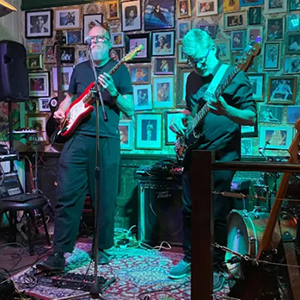
London-based Art-Rock duo MARZIHU (comprising Ian Allison and Didge) operate at the crossroads of Progressive Rock, Cinematic Post-Rock, Electronic Soundscapes, and Heavy thematic commentary. Ahead of our upcoming review of their debut concept release “DIS,” out on November 20, 2026, we sat down with Ian and Didge to explore the genesis of the project, their intricate stage setup, and the dark, haunting world of their new record.
Given your eclectic backgrounds, from Ian performing at the Royal Albert Hall, and on James Blake’s single‘Death of Love’ this year, to Didge’s UK bass work, how did you decide to join forces as MARZIHU?
IA: “We became best mates at Uni, studying design, and have kept in touch since. I was in Manchester, UK for a while, flirting with A&R and playing theatres and venues like the iconic Band On The Wall, and then moved to London following that band’s implosion, which brought us back together, geographically. I’ve performed in a few settings since including my other current project The Bedlam Furnaces. We’ve both always worked in the arts and have been toying with the idea of a big project together for some time, Eventually the stars aligned!“
Didge: “Ian and I have known each other for years. We first collaborated on some experimental music at uni. Since then our paths diverged and we contributed to a number of separate bands and music projects. It was only in the last couple of years that we started working together as Marzihu following on from when Ian contributed some guitar work on some of my “Didge” solo work. We’ve always got on and been the best of mates.“
Your sound blends Cinematic Post-Rock, Electronica, and Progressive elements. Did this hybrid style take shape organically during sessions, or did you start with a precise sonic blueprint?
Didge: “We had a vague idea early on about where to take Marzihu, but there were a few false starts. We didn’t want Marzihu to be a band in the traditional sense. I’d say the “lightbulb moment” came when we started to integrate the spoken word into the music, giving it direction and a way to explore narratives.“
IA: “Yeah – it was very story-driven. We experimented with mood for a while; at one point it was nearly an electronic alt-folk project. It really came together when we decided what we wanted to say. A few beers may have played a role! We didn’t aim for a genre, we kept open minds and were led by the story. We’re both very eclectic musicians.“
On stage and in the studio, you balance organic guitars and bass with laptops and pedalboard tech. How do you keep live electronics from feeling rigid alongside dynamic playing?
IA: “A few ways, really. We actually set ourselves the task of creating a live show – which meant layering specific storytelling elements against a dynamic musical framework. Crucially though, every piece has room for improvisation. For example, Didge hits certain harmonic markers but is free to roam between beat-keeping, melody, chords, modes etc. The guitar solos were improvised before the chosen versions were recorded, and we both improvise live – but always weaving between these layers, and tap-dancing on our pedalboards!“
Having played in various projects over the years, what specific creative space does MARZIHU allow you to explore that your previous ventures didn’t?
Didge: “Marzihu is quite a unique canvas for us. It’s very different from my previous collaborations which largely have been more stereotypical bands and consequently traditional song styles and structures. Marzihu is very much the opposite of that. Our approach to crafting the songs comes through assembling a lot of parts and then editing them back to something that makes sense – the elements have a purpose or they get rejected.
IA: “Agreed. We’re highly focused on having something to say, and choosing a palette of sounds, and creating arrangements, that tell that story. Nothing is off the table until we’re happy the story is being told. Plus we’re not trying to be a ‘band’ – as it brings a lot of lazy assumptions and restrictive tropes with it. We consider the music and the message to be much more important than us as performers.“
“DIS“ tackles “the unholy trinity of disinformation, war, and tech,” referencing Dante’s city of Hell. What sparked the urge to build your debut release around this thematic nexus?
IA: “Witnessing the horrendous conflicts and needless aggression in the world, it seemed to us that there were converging forces allowing and even encouraging this to happen. We wanted to encourage people to question everything. DIS was short for ‘disinformation’ and also alludes to ‘disrespect’. The city of DIS is not only Hell’s city of the worst – Dante’s poem was highly political; our work challenges people to have agency, not to defer intervention and justice to the supernatural.“
The record is structured as five main tracks separated by five brief “Ceasefire” interludes. How does this continuous, interrupted format reinforce the narrative of modern conflict?
Didge: “The Ceasefires are a great device, keeping the audience engaged while giving us time to adjust our gear settings for the next piece… and to have a swig of ale. Haha!“
IA: “True! Also, in the back of my mind was the book Straw Dogs by John Gray. He speaks, in part, about the myth of human progression. Each track makes a point, then there is a ‘Ceasefire’ which inevitably leads to the next track; even in peace we prepare for war. It’s also a musical way of moving between keys and moods, and glues the live show together – we play it through without stopping.“
On vinyl, “Ceasefire 4” acts as both the end of Side A and the start of Side B. How did physical format constraints shape the album’s flow?
IA: “Well spotted! In the show, we play Ceasefire 4 once. The challenge with vinyl is you have to change sides but the Ceasefires are written to lead out of one track and into the next – Didge proposed the solution of leading out of Side A, and into Side B by repeating the track. Being, like Didge, someone who will sit in a car to hear a song finish properly, it seemed like the obvious solution! On the CD, and on Bandcamp, you have the option of hearing the vinyl arrangement as well as the separate tracks.“
Didge: “Yes, the vinyl did play a part in the track order and how we approached the songs. “The Book” is very much the fulcrum of the pieces being somewhat lighter in nature to the other tracks. So the decision to have this as the last long piece on Side A was intentional. Following that Ceasefire 4 concludes Side A and is repeated on Side B, thus connecting the two sides and implying that the music is a continuous body of work.“
“Prometheus” addresses “the mechanisation of war.” How did you adapt this ancient myth into a commentary on technological warfare?
Didge: “Having stolen fire from Mount Olympus, the myth of Prometheus is about his perpetual punishment. We felt it was a good allegory to the unrelenting nature of war and the continual stupidity of mankind.“
IA: “Prometheus started out as a huge and relentless riff – reflecting a grim, grinding, mechanised death machine. It evolved into a piece called Minotaur – a thing cursed to destroy and ultimately live alone in its world. As it developed and spoken word was added, Prometheus became more reflective of the piece, as Didge says.“
On “A Device,” Ian recorded dedicated war drums alongside Heavy vocal processing. How did you construct the acoustic weight and tension for this piece?
IA: “This track is maybe another answer to your question about keeping freedom around tracks that involve sequencing etc. The drums are performed live, throughout – I layered a 19-inch renaissance drum. This was combined with looped drum elements and finally the scarily talented Glenn Welman added kit. Contrasting live and processed elements creates energy and tension.“
“The Book” focuses on “The Great Books and their potential.” In an era dominated by digital noise and misinformation, what role do historical texts play in your concept?
IA: “Once, the means of publication was in the hands of the few and was difficult and costly – that gave weight to certain ideas. Now, it’s in the hands of the many, and ideas can be given weight by sheer force and scale. The Great Books can be used for great good and great evil. We’re just posing a question about the application of ideologies and philosophies.“
Didge: “The Book was also the first piece on this EP where we added the spoken word. It was inspired by a Carl Sagan interview about how books can metaphysically bring dead people back to life. It really got us excited.“
“Little Pigs” incorporates fable figures like the Big Bad Wolf to examine why war happens. Why choose childhood allegories to address grave geopolitical questions?
IA: “We’re not trying to be reductive. The piece is looking at war through the eyes of a child. It’s looking at how, no matter how these things are dignified and wrapped in politicians’ and religious leaders’ excuses, the causes of war are actually depressingly banal, simple and common.“
“For Crying Out Loud” explores Drone warfare using altered vocal tracks simulating drone pilots. How did you approach the balance between human empathy and detachment in the mix?
Didge: “It narrates both sides of the idea of drone warfare: that of the innocent victim caught up in the event and then the cold-detachment of drone operators using tech that has gamified and dehumanised conflict. The contrast is quite striking and even I get emotional when performing this piece or listening to it.“
IA: “Didge captures it well. As he says, the contrast is deliberate, as is the use of drone descriptions – it book-ends the opening theme of the mechanisation of war. Modern war means you disappear suddenly as a result of tech that you may never see or hear.“
Textural spoken word is a key pillar of “DIS,” using heavily altered real-world sources without targeting real figures. What was your methodology for rewriting and processing these vocal fragments?
IA: “We sourced inspirational fragments, then re-scripted them to our exact purpose, and we used both voice-acting and audio-processing to move them away from their original sources, including considering accents, presented gender, etc. In addition to the words spoken, the idea is that nothing we hear can now be trusted – and can be taken wildly out of context. That’s part of our commentary on disinformation.“
While MARZIHU is a duo, you brought in Glenn Welman on studio drums. How did this collaboration shape the final dynamics?
Didge: “We are both big fans of acoustic drums. They add depth and the human feel that drum machines can’t really bring. I’ve used Glenn before on a few projects, so I suggested to Ian that we use him. Glenn is a fantastic player of many styles and he’s very much into metal and heavy rock, so we knew that he would be a good fit for the directions that we wanted on DIS.“
IA: “We were open to what everyone could bring to the process. I’m used to writing and arranging all of the music for The Bedlam Furnaces, so for Marzihu I wanted to embrace the opportunity to collaborate. For example, we wrote the drum parts, but provided opportunity for Glenn to improvise. The production process involved us re-writing and re-recording some parts. We also had to learn when to stop!“
The album ends with a dedication: “To love, and all those who live by it. Remember: you are the unamplified majority.” In a Dark record, why was it essential to leave listeners with this message?
Didge: “DIS is an intensely dark collection of tracks – a reflection of some of the worst aspects of humanity. But, you know, Ian and I are both optimists, and believe that most people are good by nature. We wanted to acknowledge that.“
IA: “Totally. That line is a final reminder that, for the present, algorithms are designed to feed anger and outrage, as it gets more clicks – and pay-per-click and evidence of browsing is the basic business model of most Antisocial Media. The truth is there’s far more good and decency out there than malevolence. Evil makes more noise and is amplified. It’s good to be reminded of that.“
The recording of “DIS” was prompted by audience reactions to your live shows in London earlier this year. How did performing these pieces live influence the final studio arrangements?
Didge: “Playing live we were blown-away by the audience’s response. We wanted to keep the recording as close as we could to how we perform live.“
IA: “Yeah – we play DIS live pretty much as you hear it on the record. The main difference being we allow some improvising – which keeps us on our toes and brings us full-circle to how DIS was conceived.“
Photographer Tony Harris used strictly in-camera effects for the artwork rather than digital post-processing. Does this preference for physical, tactile art extend to your live visual presentation?
Didge: “Tony is a great photographer and was really up for some experimental work based on a loose brief and some visual orientation. We let him run with it. The use of real, natural, trial-and-error work really appealed to us and created results that we would never have come up with had we approached it purely digitally.“
IA: “There is so much AI slop around now that we thought it was cool, in a work that discusses manipulation and disinformation, to have in-camera, practical effects for the photography. Tony was the perfect partner – he got what we were trying to do. Live, some things are obviously live and real (I don’t play air-guitar!) others are deliberately harder to spot…“
Managing live guitars, bass, keys, and laptops simultaneously as a two-piece is intense. What has been your biggest technical or logistical challenge on stage?
IA: “The debate around what constitutes ‘live music’ is interesting to us. Having played live in many formats, I can say without hesitation that what we do in Marzihu requires more concentration. You have one chance, no room for error – because we’re trying to make a continuous, immersive sound. So blending scripted and anarchic live performance, juggling pedals and laptops is demanding to say the least. Then freeing yourself to bring passion into the mix and make sure the audience has the best experience possible means lots of technical rehearsal!“
As a London-based independent act releasing physical vinyl via elasticStage alongside digital platforms, how do you view the current landscape for Experimental Art-Rock?
IA: “Genre becomes an issue, even when completing the metadata for a release. I love stoner doom folk as much as the next person, but a lot of people won’t understand the label. I get the need for genres, but it also creates gatekeepers etc. That aside, there’s a lot of amazing musical experimentation and artists out there, it’s thriving – but building an audience is tougher than ever, and the way people engage with music is evolving rapidly too. People crave authenticity more and more – experimental and art rock has bags of potential for that, if you free yourself from working towards a genre.“
With “DIS“ releasing on November 20, 2026 and new material already in development for 2027 tours, what direction is your writing taking next?
Didge: “I’m really glad you asked that. Ian and I are looking to push against the use of AI and create entirely proprietary “organic” soundscapes, using our own recorded materials. We will continue to use the spoken word as part of our signature, and bass and guitars will also remain a feature.”
IA: “Yes – we’re already developing the next story, and as Didge says, starting to build the palette. I’ll always love a huge, driving riff – but we also had a great time recently inventing new ways to play a grand piano and have been experimenting with found objects. I’ll leave that there…“
Our thanks to Ian Allison and Didge of MARZIHU for taking the time to share these insights into their creative process. “DIS” releases officially on November 20, 2026 across vinyl, CD, and digital streaming platforms. Keep an eye on Progressive Rock Journal for our upcoming album review of “DIS.”
Purchase “DIS” on LP, CD and Digital here: Bandcamp | Digital | Vinyl & CD