

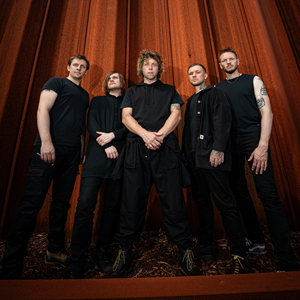
Only Human emerge from Denmark with a debut album that feels both urgently contemporary and deeply rooted in Progressive Metal’s most intellectually ambitious traditions. “Planned Obsolescence” — out on March 27 via Season of Mist — is a concept record that confronts technocracy, manufactured obsolescence and the slow erosion of humanity in an age of algorithmic control. With three singles already released and critical attention building, PRJ sat down with the band ahead of the album’s release to explore its genesis, architecture and broader cultural stakes.
Only Human is a relatively new name in the Progressive Metal landscape, yet “Planned Obsolescence” arrives with the conceptual ambition and compositional density of a band with a much longer creative history. Could you describe the circumstances of the band’s formation — what brought you together, and what artistic intent shaped the project from its very earliest stages?
Patrick: “I suppose I’ve always found conceptual albums more inherently interesting. I’m a firm believer in strong aesthetics and clear substantive messaging. We could have thrown a bunch of songs together and it probably wouldn’t be half-bad. But it also wouldn’t stand out or feel like it needed to exist. I love progressive rock and metal, but it’s often something I’ve struggled to share with people outside the sphere of lovely nerds obsessing over odd time signatures and jazz scales. So the idea was to start a band where I could indoctrinate my friends into the genre, use grand concepts as a hook to get them interested, then hit them with the subtlety once they got more into it. When I met Andreas I knew we had something, exactly because he had never played progressive metal before but was instantly hooked on the material. Plus, we really hit it off. Later, Guillaume joined in, also new to the genre.“
The band’s name itself carries considerable philosophical weight. “Only Human” speaks to limitation, fallibility, and perhaps defiance. Was this a deliberate framing for everything the project would come to represent, or did the name’s resonance with the album’s themes crystallize only later in the creative process?
Patrick: “The name initially started out as a line on “Death Cult” (where it still lives today!). That song was written before we had a clear concept in mind for the band. Back then we had some loose ideas bouncing around, but no good idea ever starts out fully-formed at conception, it needs iteration and refinement. I really like the phrase “only human” because it, to me, evokes empathy. At the same time, I think it’s just fundamentally a true statement. We will never be more or less than human, even a few of us are trying their dardnest to leave humanity behind and travel to Mars or live in cyberspace. So it became a mission statement about what this project would be about and why it should exist.“
Denmark has produced a quietly distinguished tradition of Progressive and Experimental Rock — one that often operates somewhat outside the more dominant British, Italian or German lineages. How conscious are you of your national musical context, and do you perceive a distinct Danish sensibility informing your sound?
Patrick: “To be completely honest, nationality doesn’t at all play into any conscious creative choices for me. I’ve mostly looked outwards for inspiration for most of my life. I’ve been wondering what the “Danish sound” is. Still haven’t found it. And if I ever do, I will probably steer away from it as soon as possible because I’m contrarian to the core.“
“Planned Obsolescence” navigates a sophisticated fusion of classic progressive rock, modern metal and what might be described as an electronic or synthetic texture. Which artists — across any era or genre — have most profoundly shaped your compositional language, and how did you go about synthesizing these influences into something identifiably your own?
Patrick: “Before anything, I first look to film scores. They are great because they’re built around story-telling and drama and they can vary a lot while staying cohesive within a single film. If a song doesn’t evoke the same sense of drama, tension and/or catharsis, then it isn’t going to make the cut. Every song also needs a strong central theme, setup and payoff. I’ve taken a lot of inspiration from the electronic act NERO and many other EDM and Drum & Bass artists in that regard as I find that genre particularly well-suited for that stuff. In the rock department, bands like Muse and Nine Inch Nails also laid some foundational pieces for how to combine these genres together to create, not only great sounding, but also meaningful art. Lastly, Periphery, TesseracT, Anathema, Haken, Devin Townsend, and a great many other modern prog acts have each had a part to play in where I’ve drawn inspiration in my song-writing. Listen closely and you’ll hear each of them throughout the record in some form, but I probably couldn’t even tell you myself most of the time. What it comes down to, for me, is whether the songs ring true in the end. They should be honest and evoke a response. Someone told me “Automata” helped them deal with their dysphoria and, while that’s not at all what I had in mind for the track, it’s a reminder that music is a conversation between listener and performer. It’s hard to tell right now where our voice is uniquely our own but I’m also weary of putting too much stock in that. Because if you worry too much about that, you’re going to lose perspective and chase trends. I’d rather just be myself and let the conversation play out.“
The album’s central concept — the idea that technology is deliberately designed to expire, and by extension that human beings are increasingly treated as consumable products — is both politically charged and philosophically unsettling. What was the intellectual and emotional starting point for this concept? Was it a single moment of clarity, or did the theme accumulate gradually through observation and conversation?
Patrick: “Having worked in tech for a decade as a programmer, I had grown fascinated by the techo bro psychology and their obsession with futurist ideas that seemingly always involved less human interaction and more isolationism. Back when we were starting out, it was kind of a niche fascination of mine. But over the past few years, it seems to only have gotten more prevalent in the mainstream. Trust is degrading and the information landscape is increasingly shaped by multi-national corporations that run by the same people that think now is a great time to build massive energy intensive AI data centres while the planet is slowly becoming completely inhospitable due to climate change. There’s a fundamental disconnect between them and us. At best, they live in science fiction land, naive to the consequences of their actions. At worst, they are actively seeking to accelerate the collapse. At the very least, they don’t view every other person on this planet as an equal to them. We’re their expendable workforce and their blind consumer. If they could replace us with AI tomorrow, they would.“
The tracklist moves from “Drift” through to “Breach” across eight songs, and there seems to be a deliberate arc — almost a narrative or dramatic progression. Could you walk us through the conceptual architecture of the album? How do the individual tracks function as chapters within the larger statement?
Patrick: “So, Drift was always envisioned as an opener. The idea was to give a taste of the entire album and the places it would go in terms of intensity and dynamics. And, as I spoke about before, I take a lot of inspiration from film and drama. The album is deliberately built to somewhat follow the dramatic curve with its valleys and peaks based on song intensity. I’m old school in the sense that I like to listen to albums from start to finish. “Death Cult” and “Aspire” sort of represent these valleys, to me. Certain songs are also more closely related thematically, such as “Techno Fascist” + “Automata” which address some of the techno feudalist critiques and “The Sun and the Moon” + “Steep Descent” which goes a bit further into the philosphical aspects.“
“Techno Fascist” is perhaps the album’s most direct confrontation with its subject matter. The title alone is provocative and precise. What was the compositional genesis of that track — did the lyrical concept precede the music, or did the sonic character of the piece give shape to its ideological argument?
Patrick: “‘Techno Fascist’ was the last track we wrote over a multi-year period. If I remember correctly, the song name was something I picked up and just had sitting in the my notes app for a few months. Then I was working on the intro to the song and it just made sense to save the song as “Techno Fascist” as a working title. This sparked some more ideas of where to take the song and everything came together, really, quite naturally. I’m not one to write lyrics first. I’ll always work on instrumentals first, then melody, then at the very end, work in some lyrics to match the melody. It can be a tedious process, especially if a really nice line just doesn’t match the syllable count. But it’s more important that the primary medium – what you hear – always comes first. I find it very important to work in broad strokes before I jump into the nitty gritty.“
The album spans a considerable dynamic range — from passages of remarkable delicacy and melodic openness to moments of genuine crushing weight. How did you approach the architecture of individual songs in terms of tension and release, and what principles guided decisions about when to push into heavier territory and when to draw back?
Patrick: “I think it mostly just comes down to taste. Dynamics play a big role in how I approach writing, and I have a strong distaste for repetitive riffs and long drawn-out sections that don’t “move the plot”. It’s definitely a style with some drawbacks and I don’t want to just zoom around aimlessly between riffs. My hope is that the music evokes a sense of natural progression with a cohesive undercurrent running through each track, regardless of whether it’s a soft or heavy.“
Progressive Metal has a long and sometimes fraught relationship with the concept album format — it can produce transcendent work, but it also carries risks of didacticism or conceptual overreach. How did you navigate the challenge of making an album that is genuinely about something without allowing the concept to overwhelm the purely musical experience?
Patrick: “Abstraction is probably usually my go-to tool. It helps avoid moralizing the subject matter and allows the art to speak to more than one thing and open up to alternative interpretations. It’s also somewhat of a crutch, however. To commit to an idea makes you vulnerable to scrutiny, and I’m all about that vulnerability. The balance, I think, comes down to taste. At the moment it’s at a place where I don’t feel it comes across as too heavy handed but also doesn’t feel diluted of purpose. But it’s music before anything else. The high concept ideas don’t fully materialize until we have the finished track and can put them into a larger context. So it’s like “does it sound good?” and THEN “great, what concepts and ideas does this inspire?”, not the other way around.“
The vocal approach on the record moves between clean melodic passages and more extreme textures. How did you conceive of the vocal as an instrument within the album’s broader sonic palette, and what relationship does the human voice carry — symbolically, perhaps — within an album so concerned with the erosion of the human?
Patrick: “To borrow from Bob Ross it’s probably just “a happy accident”. The original plan was not to have me sing at all, rather just play the guitar and write songs. We would look around for vocalists but never really landed on something that clicked with what we had in mind. At the time I was already doing vocals for our demos, and so one day Andreas and Guillaume just posed the idea that I should try it for real. I’d been quite self-conscious about my vocal abilities so I just assumed I wasn’t cut out for it. But they encouraged me to take vocal lessons and I got really into it. But if I was going to do it I wanted to take the same approach as with the rest of the song writing. Bring some theatrics into the picture and really perform the song rather than just sing the notes. I try to lean into the quirks of my voice rather than shy away from them. That’s how anything interesting is made.“
There is a striking tension at the heart of “Planned Obsolescence” between the bleakness of its diagnosis and what feels like a genuinely affirmative, even defiant, creative energy. The album seems to argue simultaneously that things are going wrong and that resistance is possible. Was that tension intentional — a kind of formal enactment of the album’s central message?
Patrick: “I don’t like to shy away from depressing subjects, quite the contrary. We need to lay the cards out on the table. I think we all feel doubt and uncertainty, especially in these times. And if I’m honest, things aren’t so hot right now (or maybe too hot). We are speedrunning towards extinction at an unprecedented rate, and the best the most privileged of us can do on an individual level is distract ourselves while it happens. Anxiety and despair feel like entirely valid responses to the state of the world. But we also can’t linger in that because it doesn’t solve anything. We need a re-alignment of what’s important; fixing problems and spreading solidarity. Part of that involves divorcing ourselves from the powers that be; the billionaries, politicians and algorithms that drive us further from each other. Those who would see us as interchangeable objects with an expiration date. I feel, now more than ever, we need to see the value our human experience over all else.“
Eight tracks, eight distinct pieces — yet the album coheres as a unified listening experience. Was there a point in the writing or recording process where the sequencing and structural decisions became clear? How much did the album’s final shape differ from its earliest conception?
Patrick: “Variety was an important piece early on which carried on throughout the selection process. We have a ton of backlog material with interesting ideas that could have made the cut if we found they fit the progression of the album. Then is the important question of tone, intensity and mood. If I’m completely frank, I don’t know if we hit it out of the park as much as we had hoped for, but we got pretty far for a first endeavour in my opinion. We like to build up in “acts” with peaks and valleys between. I think it makes for a more interesting listening experience.“
Could you speak to the recording process itself — the environment, the production choices, and the extent to which the album’s sound was conceived in advance versus discovered in the studio? Who shaped the sonic character of “Planned Obsolescence,” and what were the key aesthetic decisions?
Patrick: “Recording this album has been very iterative and asychronous. A lot of bedroom producing, sharing bits and pieces on our bloated Google Drive, meeting up to record certain parts that needed tight one-on-ones, etc. So it’s like we’ve been in the studio for the past 3 years. All of the ideas on this album have initially come from me, been presented, then everyone has worked on their parts individually and brought a bit of their DNA to the table. We’d spar and change bits and pieces, sometimes re-write entire sections. Then at the end I’d edit the final mix to where we liked it to be, with final cut privileges. Darlings have been cut, that’s for sure. In the future we’re hoping to shake things up a bit, spreading the involvement more but still playing to each of our individual strengths. When it comes to big picture ideas and song structure, I think that’s where I have mine. At the nitty gritty instrument specific level, that’s where everyone else brings their ideas to the table.“
Season of Mist is a label with a remarkably diverse and ambitious roster — a home for Extreme Metal, Post-Metal, Avant-Garde and Experimental work of all kinds. How did the relationship with Season of Mist come about, and what does the partnership represent for the band at this stage in your development?
Patrick: “We started shopping the Techno Fascist video around with the demos that would eventually make up the album. Season of Mist was a long-shot but it never hurt to try. We had a strong feeling about Techno Fascist, but also didn’t exactly have much in terms of name recognition. Luckily for us, there seemed to be interest from them in expanding their horizons towards more modern progressive metal and building up new talent. It was a bit of a “oh shit, are we going to be a real band” moment. I know we’ve worked our asses off, but that sense of imposter syndrome doesn’t quite escape the back of your mind. It’s a massive motivator to improve our craft as musicians and creatives while trying not losing sight of our own identity.“
“Planned Obsolescence” arrives fully formed — there is very little that sounds tentative or provisional about it. For a debut record, that level of compositional and conceptual confidence is rare. What was the internal standard you set for yourselves during the writing and recording process, and at what point did you feel the album had genuinely met it?
Patrick: “It never quite meets the standard of what you have in mind. At a certain point you just have to accept it for what it is and say “close enough”. Having a deadline helps too. It forces you to focus on the important bits and see the work from a more holistic perspective. A good ONLY HUMAN song, in my opinion, should pass the “squint test” from an auditory perspective. It doesn’t need to sound wholly unique or groundbreaking, it just needs to stand out from the rest of the output. Additionally, it needs at least one strong foundational element to anchor itself around. For instance, in Steep Descent, there’s a strong focus on grooves and a cosmic sense of scale. Aspire, a song centered around alienation, is built around the feeling of detachment and isolation experienced in your typical large city. The guitars and vocals feel small and insignificant while the drums and synths lend more weight to the urban environment I’m envisioning.“
Concept albums of this kind — albums that engage seriously with political and technological critique — carry a certain responsibility toward their audience. How do you think about the listener’s role in the experience of “Planned Obsolescence”? Is the album designed to provoke, to disturb, to console, or to catalyze some form of action?
Patrick: “I’m always uncomfortable directing others towards any belief they didn’t arrive at naturally. I’m also aware that it’s an inevitable (and probably good) thing that we all have the power to change each others’ minds. There are undoubtedly political undertones running through the album, but these days I think it’s unavoidable if you want to say anything meaningful. An album isn’t going to set the world on fire or fix any problems. The best I can hope is that it inspires someone to, at the very least, feel hopeful despite the circumstances they might be going through. Maybe it inspires more than that, who knows. I hope the heavy subjects function as a springboard for connection and empathy rather than an invitation towards dooming (to use a colloquial term) that at lot of us can fall victim to.“
Looking beyond the album’s release — are live performances planned, and if so, how do you envision translating “Planned Obsolescence” to the stage? Does the concept lend itself to a particular kind of live presentation?
Patrick: “Yes! We have an upcoming intimate release party on May 2nd in Copenhagen. And this summer we’ll be playing Næstved Metal Festival and Sweden Rock. Later in the year, we may have some shows cooked up, but I don’t think I can divulge too much yet. In terms of live presentation we’re still working out our stage show. Like anything we do, it’s an iterative process involving a lot of DIY and cooks in the kitchen. I’d like to think we’re pretty damn good live, but we’d also like to move a bit beyond the fundamentals and evolve the experience once we get a million bucks to afford the production equipment. So… next year? … probably.“
Finally, and perhaps most broadly: in an era when technology genuinely does reshape human experience at a pace that outstrips our capacity to understand it, what do you hope listeners carry with them after engaging with this album? What is the essential message of “Planned Obsolescence” — not as a political manifesto, but as a work of art?
Patrick: “You can’t, and shouldn’t, automate the human experience.“
Progressive Rock Journal extends its sincere gratitude to Only Human and the team at Season of Mist for their time and generosity. “Planned Obsolescence” is released March 27, 2026. Pre-Orders are open now.
Pre-Order & Pre-save “Planned Obsolescence” here: https://orcd.co/onlyhumanplannedobsolescence