

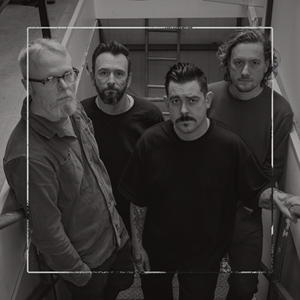
Within the more intricate and intellectually driven corners of the contemporary Progressive landscape, Poly-Math have carved out a distinctive space through a sound that balances structural precision with expressive depth. Their approach seamlessly intertwines complex rhythmic architectures, textural layering, and a dynamic sense of movement that avoids self-indulgence in favor of narrative coherence. With new material on the horizon and a recently released single hinting at the direction of their upcoming work, the UK band appears poised to further refine and expand their artistic identity. In this conversation, we delve into the origins of the band, their evolving compositional language, and the conceptual and sonic framework behind their new release.
All answers written by Joe Branbton (Bassist)
Can you take us back to the very beginning of Poly-Math? How did the project come together, and what were the initial creative intentions behind it?
Sure, Poly-Math began life as a 3-piece and as a side project for our guitarist, Tim Walters. He is a drummer first, and was playing in the Post-Rock band, Monsters Build Mean Robots. He was looking for an outlet for his guitar playing, and Poly-Math formed from our drummer Chrispy and I being in between projects. Then, 6 months into playing we were offered an opening slot at the first ArcTanGent Festival in the UK. Our set was so well received that we decided to start focussing more thoroughly on Poly-Math to see where it could go. The idea with Poly-Math was always to have a greater level of creative freedom than any of us had in our other bands. We wanted to be able to try new things and take different directions. I feel like Math-Rock was becoming quite homogeneous at the time, and we wanted to delve into Prog and more classic genres.
At what point did you feel that the band had developed a clearly defined identity, rather than being an open-ended experiment?
I feel like that happened pretty early. We had a couple of digital release singles that maybe hadn’t quite found our form, but it helped that Tim and I especially listened to more or less all the same music. I think that helped us form a coherent idea pretty fast.
How has your internal dynamic as a band evolved over time, both in terms of composition and decision-making?
I think we’ve always really been Tim’s band. He writes most of the tracks, sometimes almost completely. He certainly often comes up with the kernel of drum ideas, basslines and sometimes even basic keys parts. But in general he’ll come to us with un-stitched sections. That actually tends to be how we write. We’ll have a bunch of disembodied riffs or looped improvs and then it’ll be down to the rest of us to stitch it all together.
Your sound sits at the intersection of Math Rock, Progressive Rock, and Experimental textures—what artists or scenes have most shaped your musical vocabulary?
Yeah, I guess historically we get lumped into Math-Rock, but as a band we listen to very little of that genre. We consider ourselves a Prog-Rock band first and foremost. Our biggest influences are King Crimson, Omar Rodriguez Lopez, The Mars Volta. But, we also listen to a lot of Jazz and Ethio-Jazz. Mulatu Astatke, Ill Considered – whilst those influences are less apparent, they certainly drive our improv and creativity behind the scenes. On this new record, we’ve definitely employed more Ethio-Jazz inspired motifs than ever before.
How do you balance technical complexity with emotional resonance in your compositions? Is that a conscious process or something that emerges naturally?
That is a great question. I think the answer has changed for us over the years. Definitely early Poly-Math fell into that cliche of Math bands to overplay. We do that much less now. I think songs like Starless by King Crimson with its almost single note guitar solo have had a huge impact on exactly what we’re looking to communicate with our music. Some of Josh’s keys work on the new album and the last EP are some of the best, most creative things I’ve ever heard. He’s never afraid to be sloppy deliberately. It’s that human touch that makes it so very good.
Rhythm plays a central role in your music—do you approach it from a theoretical standpoint, or is it more intuitive and performance-driven?
I think with rhythm work we’re driven by trying to make it interesting. We love throwing people off and being unusual, so I guess it’s an even slice of both. Part aiming to be complex, part just trying to make it as fun as possible.
The new single offers a first glimpse into your upcoming material—how representative is it of the overall album?
I think both the new singles are pretty representative of the new direction. Less heavy, more old school, and with more grooves, but still a healthy dollop of heavy rhythms.
Can you walk us through the conceptual core of the new record? Is there a unifying theme or narrative thread connecting the tracks?
Sure, the new record is in name inspired by the book ‘Something Deeply Hidden: Quantum Worlds and the Emergence of Spacetime’ by American theoretical physicist Sean M. Carroll. Although sonically it played no real part. Our keys player, Josh Gesner is a Physicist, and we loved the ideas and concepts in the book.
Sonically, this record is a step towards a more improvisational, groovier version of Poly-Math. Something more steeped in classic tonality and less concerned with big riffs.
How did the writing process differ compared to your previous releases? Were there any significant shifts in methodology or mindset?
This is actually the first album that we had mixed and produced ourselves, alongside Mark Roberts – the producer of our last few records. Other than the drums, which were recorded in Brighton Electric with Mark Roberts, all the other instruments were recorded by each individual band member in their respective home studios. A lot of the writing of our music happens in the recording stage, so this was a really different experience for us. But, as an independent band, having the freedom to spend days on our parts without worrying about studio time was very liberating and I think allowed us to be more creative and improvisational.
Are there particular tracks on the album that you feel best encapsulate its essence? What makes them stand out within the tracklist?
That’s tough, because I really do love the whole thing. But I think ultimately, ‘No Such Thing as Now’ is my favourite track that we’ve worked on. I feel like that song in particular is very representative of what we’ll become next. It’s more improvisational, it blends odd time signatures with ethio-jazz inspired basslines and percussion. It just has a different feel than the rest of the album.
Your arrangements often feature intricate layering—how do you approach orchestration within a Rock framework?
A lot of that is done in the demo stages. We usually record rough demos of all of our songs. We all use the same DAW, so we can record ideas and share them around for layering and arrangements. A lot of the layering will be done by Tim at home. He usually comes up with an orchestra of guitars on top of everything and we’ll spend the next few months stripping it back and working out what should stay and what is unnecessary.
What role does improvisation play in your studio process, if any? Do ideas emerge organically or are they meticulously constructed?
Up until now, really quite little. We’d write live improv sections, but never really record any. Everything was very fixed. Now that we’re writing at home without time and budget limitations we’re exploring everything much more thoroughly. I think for Josh especially, improv is a big part of how he writes. He’ll play something in warts and all, then he’ll redo it over and over until he’s refined it…and then inevitably delete it all and go back to the scrappy original take. As a bass player, getting to sit back on a groove and listen to Tim and Josh trade improvised solos is a real highlight of being a part of this band. We’ve been together for so long that I feel like we really know each other’s note tendencies with improv, so it’s really rewarding to put something together with them and see it work out.
Can you discuss the production side of the record? Did you aim for a specific sonic aesthetic or atmosphere?
Sure, we wanted this to be much more simple and stripped back. Sometimes we can get carried away and cloud things with guitars and effects. This time we were aiming for a natural, retro, percussion heavy sound. We wanted each instrument to have room to breathe. The guitars are more simple, they tend to just be driven and not caked in octavers and flangers. The bass is present and simple, the keys have room to fill the space, and we tried to think about the percussion more as a fundamental part of each track than as an extra tagged on at the end.
Were there any unconventional techniques, instruments, or studio approaches that shaped the final result?
The one that springs to mind was writing the ending to, ‘Euthyphro Dilemma’. The track needed to end in a cacophony of noise. So we recorded Chrispy playing synth into a rack of effects that Josh controlled, and at the same time, Tim playing guitar into a pedalboard that I controlled. The whole thing was live, and just had a more organic feel to the madness than if we’d have built it with any purpose.
You have several live dates lined up—how do you translate such complex material into a live setting while maintaining its energy and precision?
The songs are all written live first. So, the album tracks are just layered up, slight reimaginings of them. We’ve always loved playing live the most. It’s the best part of being in a band, and throwing ourselves around a stage and delivering high energy, musically interesting sets is kind of why we do this.
Looking back, are there any particularly memorable live experiences or unexpected moments that have left a mark on the band?
We’ve been doing this for so long now that it’s hard to pick individual moments. We love playing festival slots, like when we played ArcTanGent Festival with 3 drum kits, with Tim and Josh splitting between their instruments and drums. We love touring Europe. Germany especially has always been incredible for us. We tend to do silly things at our bigger shows, like have confetti cannons or 100 inflatable bananas, or maybe me running through the crowd pouring tequila into people’s mouths. Honestly, the last 10 years getting to do this with these fellas has been the best time of my life.
How do you perceive the current state of the Math Rock and Progressive scene today? Do you feel part of a specific community or movement?
That’s a tricky one to answer. I think Math-Rock has largely disappeared over the last few years. The bands we used to tour with have either split or reimagined themselves as Pop-Punk or Metal bands. Progressive Music has modernised and become part of the metal scene. I’m not dismissing these things, I’m grateful that Prog is still going, but the sort of classically influenced Prog that we love and that we want to be a part of does seem to have disappeared, sadly.
In your view, what directions do you see this genre evolving towards in the coming years?
I would love to see a resurgence in Prog bands that have psych elements to them. Some more 70’s inspired Prog that leans more towards rock than metal, but I think it’ll probably just continue to become more a part of the metal scene.
As Poly-Math continue to navigate the delicate balance between structural intricacy and expressive clarity, their new material promises to further expand the boundaries of their sonic identity. With a renewed focus on compositional depth and textural exploration, the band stands as a compelling voice within the modern Progressive landscape. Our thanks to the band for their time and insight—stay tuned for the full review of the release, where we will explore the album’s nuances in detail.
The Lasers Edge will release “Something Deeply Hidden” on CD, LP, and digitally on April 10, 2026.
Digital/Physical Pre-Orders, and Pre-Saves available here: https://linktr.ee/wearepolymath
Poly-Math Something Deeply Hidden UK & European Tour 2026:
4/10/2026 Le Pub – Newport, UK
4/11/2026 The Flapper – Birmingham, UK
4/16/2026 MusikBunker – Aachen, DE
4/17/2026 Neue Zukunft – Berlin, DE
4/18/2026 Secret Location – Leipzig, DE
4/20/2026 Live At Rama Studio – Mannheim, DE
4/22/2026 Cafe V Lese – Prague, CZ
4/23/2026 Kuba – Jena, DE
4/24/2026 MK Bar – Esche-Sur-Alzette, LU
4/25/2026 Kunsthalle Im Kalkwerk – Limburg, DE
5/07/2026 Crofters – Bristol, UK
5/08/2026 Oslo – London, UK
5/09/2026 Dust – Brighton, UK
5/21/2026 Carousel – Nottingham, UK
5/22/2026 Wharf Chambers – Leeds, UK
5/23/2026 Little Buildings – Newcastle, UK
Lineup:
Joe Branton / Bass
Josh Gesner / Keys
Tim Walters / Guitar
Chris Woollison / Drums