

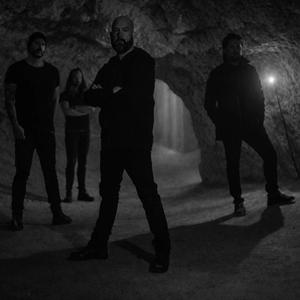
From the cold shores of Malmö, Sagor Som Leder Mot Slutet have spent a decade building one of the most quietly devastating bodies of work in instrumental Post-Rock and Post-Metal. With four studio albums, a motion picture soundtrack, and a sound that balances crushing heaviness with Nordic fragility, they’ve carved a unique space in a crowded landscape — one where weight and silence coexist, where melody becomes geology. Their fourth full-length, simply titled “IV,” drops April 24th via dunk!records (EU) and A Thousand Harms (US), and from what we’ve heard so far, it marks a significant leap forward in both ambition and sonic power. We caught up with the band ahead of release to talk origins, evolution, and the mountain-sized record they’ve been building toward.
The name Sagor Som Leder Mot Slutet translates roughly to “Tales That Lead to the End.” That’s a striking starting point for a band. Where did that concept come from, and how does it still inform what you do in 2026?
It came to us quite early when forming the band. While trying new ideas and writing our first songs, someone mentioned that the music we were working on sounded just like small stories, or even fairytales, but not necessarily with a happy outcome. That sentence stuck with us and we collectively felt it fitted the music – and still does.
Take us back to the beginning. How did the band form, and what was the initial creative impulse that brought you together? Was there a specific sound you were chasing, or did it emerge more organically?
All founding members had previously or historically played together in different constellations and when one of those bands came to an end the opportunity appeared to get together and do something different that we all felt we wanted to do. From the start we were pretty certain that we wanted to do something more atmospheric but also heavy. Our collective sources of inspiration mashed at a really good point, really creating synergistic effects. That’s why the material for the first album was recorded in record speed as a pure DIY project with no rules and boundaries exept pure creativity.
Your bio describes you as mixing “darker and heavier themes with gentleness and fragility — both attacking and caressing the senses at the same time.” That duality feels like a precise self-portrait. Was that tension always intentional, or did you discover it along the way?
You could say that it’s kind of both. We want to create really atmospheric music but also, at times, really heavy and raw. Sometimes though it’s more like the creative process is an entity of its own, moving at its own will and you can never be certain where a new song will end up as a finished piece.
Who were the key influences in the early days? And have those references shifted significantly as you’ve moved deeper into your discography?
There were some that might have been a bit more prominent. If you ask different band members you will get answers stretching from cinematic soundtracks, experimental emotional music like Olafur Arnalds or Ulver, through prog metal/rock like Opeth or Katatonia all the way to gothic metal royalties such as Paradise Lost and Type O Negative. Naturally you also run into new music all the time that will, conscious or not, inspire you. Working with Magnus from Cult of Luna on “II” and “III” of course influenced the sound too.
You’ve been working instrumentally since the beginning. Is the choice to keep things wordless a philosophical decision, or more a natural result of how the music comes together?
You could actually say that it is a conscious, natural step from when we started the band and we wanted to explore what happened if you didn’t have any lead vocals. With that said we have had some minor vocal as well as spoken parts.
Looking across “I“(2016), “II” (2018), the Iris soundtrack (2019), and “III” (2022) — how do you map the evolution of the band across those records? What changed most significantly from one chapter to the next?
A thing that has evolved through the albums is a set theme for each release. We want the writing process to be quite organic and create soundscapes and atmosphere around each chapter. Our first album is often refered to the feeling of walking alone in a dense, old forest and you may find some folkloristic influences there as well. The second album is about setting out on an aquatic journey reaching the far ends and depths of the world. The third focused on travelling through space and time.
The Iris motion picture soundtrack sits somewhat apart from the main numbered series. What was that experience like, and did scoring for a specific visual narrative shift anything in your approach that later fed back into your own work?
When scoring something visual it’s even more about enhancing a certain emotion connected to a specific scene, but also finding a fitting palette to the overall atmosphere. We spent some time in the studio just improvisning atmospheres and soundscapes with guitars – no real melodies, but a lot of effects. Then we added the score melody themes as layers on top depending on the scene, characters and emotion.
Now to “IV.” The press material describes it as a “completely revamped take” on your storytelling — progressive, crushing, heavily rhythmic. What triggered that shift? Was there a deliberate decision to push things harder this time?
It was indeed. We had discussions about what direction to take on this album and the consensus was – heavier! That’s why you will find more heavy rhythmic parts both on drums as well as guitars and bass. The songs are more in-your-face and build up faster. We also wanted the arrangements to sound more dark – even distorted.
The album draws its thematic core from earth, stone, and mountainscapes — raw, geological, unrelenting. The track titles themselves feel almost elemental: “Urberg,” “Magma,” “Aska,” “Rot,” “Karg,” “Dvala.” How did that conceptual framework come to define the record, and did the imagery shape the music or the other way around?
As we wanted to create songs with a heavy and crushing atmosphere it came quite natural. The heaviest parts of our world as we know it is in the magmatic core, in the bedrock and mountains. On the other hand we didn’t want to leave out tenderness and emotional parts – and watching nature is quite beautiful – though unforgiving and relentless at times. Hopefully we found a good balance.
Walk us through the seven tracks of “IV” — is there a deliberate arc or narrative flow to the sequencing? And is there a track you consider the emotional or compositional centerpiece of the album?
We wanted to start with a soundscape building up the overal theme – a bit gloomy and dismal – and as contrast to what happens right after. “Urberg” sets that feeling while leading into “Magma”, which is probably the heaviest song we have written to date and very in-your-face with a lot of rhythmic parts (perhaps only competing with “Vemod” from our debut album). Next we have “Strävan”, starting off very pulsating and raw, but evolving into an ode to melodic guitars and choirs. In ”Aska” we wanted to combine utter and crushing darkness with perhaps the most gentle parts of the entire album – a stark contrast in itself – and it also became the second single of “IV”. “Karg” translates to barren and that’s exactly what we strived for with this song, a slow repetative build-up progressing into a huge wall of sound with layers and harmonies. With the atmosphere it alludes to walking in the Nordic mountains during winter. “Rot” is probably the song where you can hear the most different influences – from 70’s to modern progressive, a touch of heavy rhythmic moving parts as well as a dose of doom/gothic metal – the way we interpret it. We chose “Dvala” as the closing story as it’s both sombre and nostalgic in its general tone and also has a fitting spoken part. In many ways it’s a sibling to songs like “Avsked”, “Saknad” and “Tomhet” or “Eter” in the regard of facing loss, parting and the end of a chapter.
“Magma” was the single and video released in March. What made that track the right first statement for this new chapter?
It really is a statement song introducing new sounds straight away, but also catchy enough to grab the attention of the listener. It’s dangerlously easy to headbang to as well.
Martin Mileros produced the album, while mixing duties went to Piotr Turek of Telepathy and mastering to Machine the Producer in the US. That’s quite a specific team. How did each of those collaborators shape the final sound, and what did you want from this production that felt different from your previous records?
Martin, aside for playing the drums, has always been an integral part in arranging everything that isn’t guitars and bass, so that felt natural to us just as on previous albums. We had met and watched Telepathy for some time and when we heard the soundscape and mix Piotr managed to create on their last album “Transmissions” we all agreed that we wanted to work with him for our next release. He completely understood our vision and helped modernize our sound. When aiming for mastering Piotr instantly vouched for The Machine which he had collaborated with before.
Piotr Turek is himself part of Telepathy, a band working in heavily related sonic territory. Was there a shared language that made the collaboration immediate, or did it push you in directions you hadn’t expected?
Yes, we could definitely feel the common ground musically and that helped us to work together. Sometimes he introduced something new and sometimes we caught him off guard with an idea – an all together prolific experience. He has a very good ear for when to minimize and when to maximize. The dynamics are better than ever on a “Sagor” album and fits the theme perfectly.
“IV” is available in several vinyl editions — milky smoke with black blob, the splatter variant (now sold out), and a signed trilogy set pairing it with represses of “I” and “II.” How important is the physical format to you as a band, and was the visual and tactile presentation of this record a significant part of the creative process? How does the artwork connect to the geological themes of the record?
As we are all fans of physical releases and quality hifi, CD and vinyl in particular, we of course want our listeners to experience our music on the best formats. A lot of love has been poured into the album to make it sound as good as possible. We also want something that catches the theme of the record visually to help the listener get lost in our stories and worlds. That’s why we went for a geological theme and also mixing greyscale with colours from magma and volcanic eruptions. We think that the coloured vinyls for the re-pressings matches their themes respectively too.
Are there any live dates or tours planned in support of “IV”? What does a Sagor Som Leder Mot Slutet live show look and feel like — how do you translate this music to a stage?
As we speak we are planning dates and we can assure you that we will play the new songs both locally, in neighbouring countries as well as in continental Europe. We are still an independent band and play our music because we love it. Hopefully that translates in our live shows. That means you will experience both gentle brooding as well as explosive outbursts – just like our music.
What have been the most meaningful live experiences you’ve had so far — moments or shows that felt like the music hit people in the way you’d hoped?
There are couple but playing our first abroad show at Vivid Post Rock Festival in Norway in 2016 was really special as it was our introduction show to the international scene. Another highlight is definitely our show at Dunk!festival in Belgium 2022. We received so much positive feedback from that show it really elevated us.
Where do you see the instrumental Post-Rock and Post-Metal scene right now? Are there contemporaries or newer acts that you find genuinely exciting, or perhaps aspects of the genre’s direction that concern you?
That’s a great question. We love to see bands expand the genre – that’s probably what is the most exciting about it – there are no rules or judgements when it comes to instruments, the length of songs etc. The more unexpected the more fun it gets and helps grow the scene. You always have the heroes like Cult of Luna, Russian Circles an The Ocean – but it’s also very appealing and rewarding to find something new. Just listen to Bruit , Aufhebung or even Faetooth – brilliant stuff right there.
Pre-Order “IV” here: Bandcamp | dunk!records Webshop | A Thousand Harms Webshop