

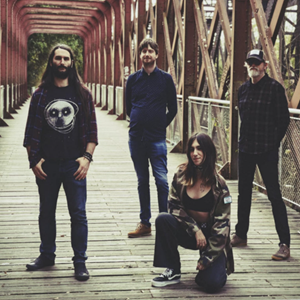
Unité Douleur arrive at an interesting moment in the contemporary Progressive Rock landscape — a quartet whose “Pollen Haze” EP, released March 21, 2026, draws from Progressive Rock, Alternative, and Post-Rock with a compositional clarity that sets them apart from much of the current output in the field. Ahead of the release, PRJ sat down with the band to explore the origins of the project, the making of the EP, and what lies ahead.
Unité Douleur is not an immediately obvious name — there’s both unity and pain built into it. Where does the band come from, and what brought the four of you together as a creative unit?
Dino:: “P.A and I had a previous band (Cachalot) that just ended, and I was coming out of a difficult time in my life. I needed a fresh, more optimistic project to go along this reconstruction phase. While waiting for a hospital appointment, I was staring at the department plaque on the wall. “Unité Douleur”. I realised what it meant to me. The band’s name literally means “pain management unit”, but the word also means unity. Each one bringing their pain to build something bigger, together. Human contact was essential, so I turned to familiar faces to start this project. J.F and P.A were obvious choices, and they answered immediately. Louise was a new encounter. She answered our classified ad, and things went great from day one.“
When did you first identify the sound you were collectively moving toward? Was there a moment where the direction became clear, or did it emerge gradually through the rehearsal and writing process?
Part of the songs were already written before we started playing together, and were a starting point for the band. We spent 2025 working on these songs, letting each one find their place and add their personality to these songs, and then started working on new ones. The way forward appeared naturally, along the seasons.
Your music draws from Progressive Rock, Alternative, and Post-Rock without fully committing to any single one of them. Which artists and records have been most formative in shaping how Unité Douleur approach composition and arrangement?
We have quite diverse influences – doom-metal, post-punk, prog rock, alt rock… About composition, it’s not a conscious process, anything goes with the current inspiration, but for Dino, who is the main composer, it’s probably somewhere between Deftones, The Cure and Neurosis.
“Pollen Haze” is the title of the EP — there’s something both organic and slightly unsettling about that image. Where does the title come from, and does it reflect a broader thematic thread running through the four tracks?
After our first EP “Below Zero”, which explored winter, the cold that numbs the feelings, it seemed natural to look at the next season, spring. Nerves wake up, old scars reopen, yet something still grows. Hope is there despite the pain, if you let it show. The progression from winter to spring was visually expressed by Claire Leloire, who drew both illustrations.
The EP opens with “She Starts Fires” — a track that balances raw, distorted guitar work against more expansive, atmospheric passages. Was that contrast a deliberate compositional decision from the outset, or did the track find its shape during the recording process?
The strong contrast was a deliberate choice from the first stages of writing. This heat you have to tame slowly, soft and warm to the one who can wait, and searing to the one who rushes.
“Vernal Bloom” sits in an unusual position — part introspective ballad, part Post-Rock construction. How did that piece develop, and what were you trying to achieve with the more cinematic, electronic textures in the opening section?
To us this is the one that represents the most this notion of eclosion, of awakening after a period of stillness. A new beginning after a long winter. The introduction is meant to draw this picture of life slowly resuming its course, in the pale sunlight.
“Bag of Nails” is arguably the most explicitly Progressive track on the record — the extended build, the bass-driven central sections, the formal arc. What was the genesis of that composition, and how long did it take to reach its final form?
This song was a part (with Walls) of the last songs written by Dino for Cachalot. They almost disappeared before they were ever played, but the band wanted to keep them after listening to the demos. It was soon decided to integrate them into the band’s first releases. Writing the music and the lyrics was quick, but the long part was trying to refine it to the bare minimum. Keeping it sober to stay in line with the subject. It was among the first songs we had ready for the scene. Being about the inertia you sometimes feel when you’re in a negative mental state, its place on this EP seemed natural.
PRJ included “Bag of Nails” in “Compilation Vol. XIV: Forests of the Ancient Mind” — how did that collaboration come about, and what does it mean for the band to have the track placed in that kind of curatorial context?
As we were trying to promote our first EP « Below Zero », we contacted several music blogs and websites. And PRJ was among the first to respond. We talked briefly about the opportunity of being part of the compilation. A couple of months later, we were honoured to be part of it along with a review for the release of our second EP. For a new band like us, it means a lot, because it is very hard nowadays to be noticed among so many good bands from around the world. And it’s especially true when it comes from somebody who really cares about music. Grazie mille, Jacopo.
“Walls” closes the EP at seven minutes — the longest and arguably the most layered piece on the record. It feels like a deliberate closing statement. Was it written with that function in mind, or did it naturally gravitate toward the end of the sequence?
It sounded to us like an ending, indeed. It was true musically and thematically. The lyrics are the conclusion to this EP. You can stand back up after a dark time, face your demons, open your heart to the outside world again, put yourself back together despite the pain, but you never completely tear your walls down.
Where was “Pollen Haze” recorded, and who was behind the production? How much of the EP’s final sound was shaped in the studio versus arriving fully formed from the rehearsal room?
Just as for “Below Zero”, we did all the recordings in J.F’s home studio “Room 101”, which is also our rehearsal space. The EP’s sound is not much different from how we sound in rehearsal. If we feel that it’s needed, we sometimes add a guitar track to accompany a solo or for dramatic effect. We don’t refrain from adding some “decoration” on record, but we try to stay as faithful as possible. The vocals are the most different part, because Dino often adds several layers of vocal harmonies, which are of course impossible to reproduce live. As for the first EP, mixing and mastering were handled by Jack Bowman (BAY Custom Studios). It was a blessing to work with him, because we wanted to distance ourselves from the expected sound of heavy rock/metal productions, and this is a genre he doesn’t usually work in.
Were there tracks written during the same sessions that didn’t make the EP? And if so, what guided the decision to work within a four-track format rather than extending toward a full-length?
Dino writes a lot, only a small fraction of that survives until recording. The remainder is abandoned of used as inspiration for future songs. For our first releases, we wanted a short work cycle, to easily shape our personality and way forward. Follow our instincts without locking ourselves in a narrow box. The EP format allows us to do this more easily.
The vocal dynamic between JF Hamel and Dino Van Bedt — lead guitar and vocals, rhythm guitar and lead vocals — is an interesting configuration. How do the two vocal roles interact within the arrangements, and how do you divide that territory compositionally?
Probably because of our rock influences, we try to think of the song structure right from the start. Music is often built around the vocals, and sometimes it means simplifying some ideas to make more room. Dino is a baritone, and J.F is a tenor, so the voices usually find their places quite naturally.
Louise Niez‘s drumming throughout the EP is notably disciplined — present and forceful where the material demands it, restrained elsewhere. How does the rhythm section approach its role within a band that operates across such different dynamic registers?
Louise: “I think the key to being able to propose interesting patterns and fills that fit in very contrasted songs is to pick from a lot of different genres and styles, and that’s what I try to do.“
P.A: “All bass lines are composed by Dino, so I just interpret and sometimes alter them to fit my playstyle. In the future, I would like to play a bigger role in the writing process.“
Unité Douleur sits within a broader contemporary Progressive and Alternative Rock scene that is producing a significant volume of new material. How do you situate yourselves within that landscape, and what do you think distinguishes the most interesting work currently being made?
This is a difficult question, because it wasn’t a conscious decision. We come from a doom-metal / post-metal background, and the slip happened slowly through the years. Influences piled up without us thinking about it. It was indeed very hard for us to pick a genre label. From what we gathered, we now describe ourselves as “Atmospheric Alternative Metal”, and we’re still not sure about that. No matter the label, we try not to get buried in an over-codified genre. The human and spontaneous side is what matters.
Have you performed the “Pollen Haze” material live yet? And what does the band’s live context look like — are these compositions that translate naturally to the stage, or do they require a different approach outside the studio?
Yes, we play both Eps in concert, and a few songs we have yet to put on tape. Our sound is quite simple to transpose to the scene, we use few artifices. Dino triggers samples from a pedal and that’s about all. The vocals are a bit simpler of course, since only Dino and J.F sing.
What comes after “Pollen Haze”? Is the intention to move toward a full-length record, and if so, does the direction feel like a continuation of what the EP establishes or a deliberate expansion of it?
For now, we are happy with the EP format, it allows us to assert our personality by small strokes. The sequel is coming soon, and we keep on exploring our universe. We try to expand our comfort zone while keeping a common thread.
Final question — what would you want a listener coming to Unité Douleur for the first time, through this EP, to take away from the experience?
Maybe that they just listened to something human, sincere and imperfect, just as themself. And as a last message, to stay in line with our name : pain is human, healing is too.
PRJ extends its sincere gratitude to Unité Douleur for dedicating their time to this conversation and for sharing the vision and passion behind their music. Their commitment to artistry and the depth of their creative insight have made this dialogue both inspiring and illuminating.
“Pollen Haze” is available now via Bandcamp: https://unitedouleur.bandcamp.com/album/pollen-haze
Read our Review of “Pollen Haze” EP here: https://progrockjournal.com/review-unite-douleur-pollen-haze-ep/
The track “Bag of Nails” from this EP was featured in Volume XIV of our weekly compilation series: https://progrockjournal.com/prj-compilation-vol-xiv-forests-of-the-ancient-mind/