

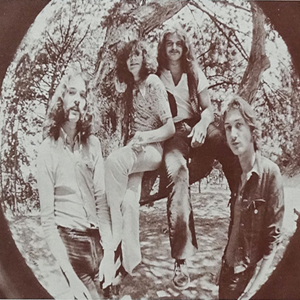
Vienna, Austria, 1970. In the vast and often impenetrable jungle of collectible Rock, few names evoke the same reverential awe and morbid curiosity as Paternoster. Formed in Vienna in 1970, this quartet stands as one of the most fascinating anomalies in early Seventies European Rock. While neighbouring Germany was exploding with the Krautrock movement, Austria remained relatively arid ground for Progressive Rock — making Paternoster a rare and poisonous flower in a musical landscape dominated by entirely different sounds.
The aura of legend surrounding the band stems not only from their extraordinary music, but from the near-mythological scarcity of their sole self-titled album, released in 1972 on CBS Austria. With barely 270–300 copies sold at the time, the record has since become one of the most expensive artefacts in the worldwide Rock underground, reaching prices exceeding $10,000 at elite collector auctions. Yet, as we shall see, the true value of Paternoster lies in a sonic depth that transcends any vinyl fetishism.
— The Genesis: “Die Ersten Tage” and the Cinematic Roots —
Before giving birth to their omonimo masterpiece, Paternoster took their first steps in 1971 by composing the soundtrack to a sci-fi “hippie” film entitled “Die Ersten Tage” (The First Days), directed by Herbert Holba. This experimental feature, presented at the Berlin Film Festival and broadcast by Austrian television, was the primary reason the band secured a record deal and the means to record their debut.
The soundtrack — unreleased for decades until its rediscovery by Now-Again Records — represents the band’s “complete cycle.” It contains sketches of tracks that would later be developed on the official debut, blending fuzz guitar grooves reminiscent of Italian library music with moments of pastoral Folk and expansive Prog. It was in this cinematic context that the group refined their style: a fusion of Pink Floyd in the Syd Barrett-era, Soft Machine, and Procol Harum — but with a far darker, more nihilistic undertow.
— Paternoster (1972): A Work of Weltschmerz and Funeral Organs —
Recorded in just two days — March 9th and 10th, 1972 — at the Quodlibet-Studio in Vienna, the album Paternoster is a listening experience that many critics have described as one of the saddest and most harrowing ever committed to tape. The very name of the group, derived from the Latin Pater Noster, reflects the work’s central themes: a deep religious scepticism, a scathing critique of the organised Church, and an obsessive exploration of death and suicide.
The sound is dominated by Franz Wippel‘s Hammond organ, conjuring atmospheres akin to gothic requiems, underpinned by Gerhard Walter‘s distorted, Psychedelic guitar. Wippel’s voice — described as a world-weary drawl — lends the album a dramatic urgency that can feel almost unbearable for the unprepared listener.
Examining the individual tracks, moments of pure Progressive brilliance emerge:
“Paternoster” — Opens with a Latin chant over organ drones, evolving into a Psychedelic jam that seems to drown underwater.
“Realization” — A tighter piece, where Walter‘s cutting guitar challenges the Jazzy bass lines of Haimo Wisser.
“Stop These Lines” — A claustrophobic funeral march, dominated by tormented vocals and sudden peaks of distortion.
“The Pope Is Wrong” — Perhaps the most celebrated track: a direct assault on ecclesiastical authority, culminating in a dissonant and provocative climax.
“Mammoth Opus O” — The nine-minute closing odyssey, an instrumental epic that ends with an abrupt shift toward a lighter sound — almost as if mocking the listener for the madness just endured.
— The Rediscovery: The Journey of Egon and Stephan Szillus —
For decades, Paternoster amounted to little more than an internet rumour — until Eothen “Egon” Alapatt, founder of Now-Again Records and close collaborator of Madlib and J Dilla, resolved to track them down. The mission began with an Instagram post in 2015, in which Egon offered rare records to anyone who could connect him with the surviving members.
The call was answered by Stephan Szillus, a German music journalist with a background in hip-hop — formerly editor-in-chief of Juice Magazine. Driven by what he himself described as a journalistic hunter’s instinct, Szillus traced Franz Wippel through his former employer, the Austrian broadcaster Ö3. Wippel, now retired, was amused to discover that his old album had become a global cult object — joking that Google was returning results about his band rather than the typical Paternoster elevator.
A meeting in Vienna in March 2015 brought previously unknown materials to light: period photographs, a Super-8 film shot during a mountain holiday, and — above all — the band’s blessing for an official reissue.
— Tragedies and Destinies: What Became of Paternoster? —
The band’s history is marked by an abrupt ending and divergent fates. After the commercial failure of 1972, the group did not formally dissolve — they simply ran out of steam, because the members had bills to pay.
Franz Wippel went on to work in advertising and as a radio author for more than thirty years. Gerhart Walenta (drums) is the only member to have remained active in music, passing through a punk band and performing today with the Carosellis. Gerhard Walter (guitar) is the most enigmatic figure: after playing with the Viennese punk outfit Mordbuben AG, he is said to work today for the Vienna city council — but remained untraceable even for Szillus himself.
The most tragic note concerns Haimo Wisser (bass). After the dissolution, he moved to Tyrol and became involved in the local underground scene, but in the 1990s, suffering from severe psychosis, he took his own life. His son Thomas — known as rapper Mista Wisdom — played a crucial role in providing information and approving the reissue project, opening what he described as a personal Pandora’s box regarding his father’s death.
— The Sonic Legacy: From Prog to Hip-Hop —
Why do Paternoster still resonate today? According to Szillus, their music is totally ahead of its time. Their ability to blend melancholy, fatalism, and black humour is distinctly Viennese — but the sound carries a universal quality that has attracted hip-hop producers and rare groove aficionados alike. Tracks such as “Realization” are goldmines for sampling, with their Heavy drum breaks and Jazzy Bass lines.
The Now-Again reissue, mastered by Dave Cooley — a specialist who has worked with both J Dilla and Madlib — was produced from an original vinyl copy, as the master tapes were lost following the closure of CBS Austria in the 1990s. The result is a sonic fidelity that finally does justice to the group’s baroque and nihilistic vision.
Paternoster remain a genuine UFO in the Rock landscape. They are not Krautrock in the strictest sense, yet they share with that movement the Experimental audacity and the use of primitive Electronic effects. They are, in the words of many admirers, the most Doom album ever recorded — a work of almost unbearable sadness, yet possessed of a hypnotic, undeniable beauty.
As the reissue liner notes state: “Anyone with a weakness for deep Seventies Psychedelic Rock simply must hear this.“
— Discography —
(1972) — Paternoster — CBS Austria (Reissued by Now-Again Records, 2016 — with 60-page booklet)
(2016) — Remixes And Versions — Heart Working Class (Limited edition — alternative versions and remixes)
(2023) — Die Ersten Tage (The First Days) — Now-Again Records (Previously unreleased 1971 film soundtrack — includes vocal demos and debut album sketches)
— Lineup —
Franz Wippel / Organ & Vocals
Gerhard Walter / Guitar & Vocals
Haimo Wisser / Bass
Gerhart Walenta / Drums