

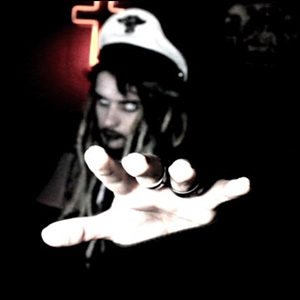
Emerging from the depths of New York’s underground Metal scene, Saint Omen has carved a singular path in the realms of Doom, Stoner, and Occult Metal. The one-man project weaves ritualistic atmospheres, Heavy grooves, and Cinematic storytelling into a sound both hypnotic and punishing. With the release of “Mysteries Of Rebirth” in late 2025, the artist invites listeners into a darkly immersive world, balancing raw intensity with meticulous composition. This interview delves into the genesis of Saint Omen, the creative journey behind the new album, and perspectives on both local and global underground music landscapes.
Can you tell us about the origins of Saint Omen — what inspired you to start this project, and why the name?
Saint Omen started because I needed full control. No collaboration, no compromise, no translation. One person, one voice, one outcome. The name is simple. I love The Omen. Not holiness in a religious sense, but reverence, devotion, and sacrifice. An omen is a warning. A saint is something people follow. Saint Omen exists in that space between fear and belief. It’s meant to feel like a presence. Something that shows up, leaves a mark, and doesn’t bother explaining itself.
Being a one-person entity, how has that shaped the music and creative decisions compared to a traditional band setup?
Working alone keeps the channel clear. When more people are involved, intent drifts. Vision gets diluted. I follow what presents itself and remove what doesn’t belong. If something resists, it’s discarded. If it stays, it’s meant to. Saint Omen does not have a band dynamic. It’s a singular presence. That’s how the message survives intact.
When did you realize you wanted to explore Doom, Stoner, and Occult elements together — was there a defining moment or influence?
I didn’t arrive there by intention. I arrived there by shedding things that no longer fit. I wanted to leave the old hair metal tropes behind and focus the darker energy that’s always been present in my work into a single channel. That darkness was already there, but it didn’t feel honest until I found the space doom allowed. Once that door opened, everything started to make sense. When I was working on earlier material, tracks like Black Mass and Taken By The Black appeared almost on their own. Those songs showed me where the center was. Everything else followed that gravity. I never set out to make “doom” music. But the world needs names for things, and that one stuck. What mattered more was finding a language that could carry the weight without softening it.
Your sound blends ritualistic atmospheres with Heavy, grooving riffs — which artists, genres, or non-metal inspirations have been most formative?
I don’t like tracing it back to a single bloodline. That always feels too clean. Saint Omen is shaped by everything I’ve spent time with, not just metal. Classic rock, psychedelia, jazz, film scores. What connects them isn’t genre, it’s feel. Repetition, patience, space, restraint. Groove matters as much as distortion. Silence matters as much as sound. And yes, if Ozzy Osbourne never existed, none of this would sound the way it does. Everyone knows that part already.
Lyrically, “Mysteries Of Rebirth” touches on transformation, mysticism, and existential themes — how do you approach your lyrics, and what inspires them?
Everything starts as a question I can’t stop asking. Mysteries Of Rebirth came from stepping away from the finality of Death Unto My Enemy. That record ended something. This one listens to what started whispering afterward. Hell Money was the first voice to show up. It’s about what people hand over willingly. Time, dignity, blood, faith. Currency that carries a presence with it, something that learns you and owns you slowly. Devil Eyes follows the moment after the agreement is made. When you realize you’re being followed, not chased. Bone Shakin’ Mama is a deliberate rupture. Loud, ugly, excessive. American trash in its purest form. A distraction. A celebration. A way to drown out the screaming for a few minutes. Smokeless Fire came from studying Djinn. Power without a body. Influence without proof. Something that moves through rooms without leaving ash. That idea stayed with me. Satan Man arrived almost by accident, written quickly on my parlour guitar. It sounds light. That’s the trick. The message underneath is about bargaining with something that never forgets. Undead goes back to fixation. Vampires. Decay that refuses to end. Immortality as a punishment. I’ve circled that theme before, and it wouldn’t let me leave it alone. I don’t write lyrics to explain anything. I let them surface when they’re ready. The album isn’t about stories. It’s about consequences. What happens after you say yes. What’s left when the transformation is already underway.
Doom and Stoner Metal have many sub-cultures; do you feel aligned with any specific movement, or are you creating something entirely distinct?
At first, I wanted to belong to something. That impulse fades quickly once you understand how cliquey those spaces really are. There’s an unspoken uniform in parts of the doom and stoner world. Long hair, beard, beer belly, Sabbath worship, Electric Wizard on repeat. Old 70’s era Playboy nude cutouts. Aesthetic certainty. Sonic safety. If you don’t resemble that image or reinforce it, you’re quietly dismissed. A lot of bands mistake familiarity for identity. Same imagery recycled endlessly. Pentagrams, vintage poses, provocation without risk. It looks rebellious, but it’s actually careful. Rehearsed. Everyone sounds alike, and then they disappear just as quickly as they arrived. Nothing was truly at stake. I don’t feel aligned with any specific movement. Saint Omen exists outside of that economy. I’m more interested in risk than approval, There’s also a myth of community that doesn’t always hold up. People connect constantly, but listening is rare. Support often only flows when it’s transactional. That clarity changed how I move. The only people that matter are the ones who are listening. Not record labels. Not PR firms. Not suppliers. Saint Omen is built for the cult. If you belong, you already know. If you don’t, the message won’t ever reach you.
What was the conceptual starting point for “Mysteries Of Rebirth,” and how did the album’s vision evolve during the writing process?
Mysteries Of Rebirth started with a simple instinct: I needed to move forward. Not repeat myself. Not circle the same ground again. At the beginning, there was pressure. Expectations. The idea that the record needed a label behind it to matter. I spent a long time believing that version of the story, and it slowed everything down. The album took shape slowly, over nearly two years, piece by piece. Every decision had to survive scrutiny. It had to feel right, not just sound right. Early on, it was heading toward something familiar. Another doom record. Heavy, correct, safe. At some point I realized that wasn’t enough. I wasn’t interested in making a convincing imitation of something that already existed. I had more to offer than another Sabbath-worship exercise, and once I accepted that, the real work began. The vision shifted when I stopped asking for permission. When Devil Eyes found its way onto the airwaves, the album had already learned how to walk on its own. That was the moment I understood it didn’t need a label to validate it, especially not one that hadn’t helped build it. Self-releasing was a decision rooted in ownership. Mysteries Of Rebirth wears doom as a skin. Beneath it is something broader. The album didn’t evolve to please anyone. It evolved because it refused to stay small.
The album opens with a ritualistic intro — how intentional was the sequencing, and what kind of experience did you want listeners to have?
The sequencing was deliberate, and it’s intentionally hostile to impatience. The opening isn’t there to grab you in the first five seconds. It’s there to slow you down. That ability has been eroded over time. Most people scrolling through social media aren’t listening anymore. They’re sampling, skipping, reacting, moving on. Attention has become disposable, and so has the idea of seeing something through to the end. Mysteries Of Rebirth doesn’t cater to that. The intro is an invocation, not a hook. It’s a threshold. If you’re willing to cross it and stay with the record for its full length, there’s a reward waiting. If you can’t spare thirty-five minutes of your attention, then the album was never meant for you in the first place. The doorway is there. Whether you walk through it is the test.
Could you walk us through the meaning or story behind tracks like “Devil Eyes,” “Smokeless Fire,” or “Undead”?
These songs aren’t stories in a traditional sense. They’re moments along the same descent. “Devil Eyes” is about what happens after the agreement is made. Not temptation, but aftermath. The realization that something has attached itself to you once a line is crossed. It isn’t pursuit. You’re not being chased. You’re already claimed. “Smokeless Fire” arrived differently. Something took hold while I was writing it. It formed quickly and without resistance, to the point where it felt like it was writing itself. I recorded it in isolation, alone in a cold, empty barn over Thanksgiving. No distractions. No warmth. Just repetition and focus. I was deep into Djinn lore at the time, the idea of power without form, influence without proof. Fire that burns without smoke. That track speaks for itself. “Undead” returns to fixation and immortality. Vampires as a metaphor for decay that refuses to end. Persistence as a curse. Existing beyond the point where life still makes sense. It’s less about horror and more about what survives when everything else should have stopped. Each track stands on its own, but together they trace a pattern. Consequence. Influence. Endurance. Different faces of the same transformation.
There’s a Cinematic quality to the album — was there a specific arc you wanted listeners to experience from beginning to end?
Yes, there was always an arc in mind. I’m drawn to storytelling and suspense, to the slow build rather than the immediate payoff. I wanted the album to feel like a progression, not a collection. An entry point, a descent, moments where the tension stretches out, and no clean release at the end. The listener isn’t meant to jump around. They’re meant to move forward with it. Each track plays a role in that arc. Some establish the world, some push deeper into it, others linger in the consequences. Pacing was crucial. Repetition, restraint, and space all serve the larger movement of the record. Mysteries Of Rebirth is designed to unfold. It doesn’t rush to explain itself. It lets the unease build and trusts the listener to stay with it until the end.
How do Occult and Ritual elements influence your songwriting — as metaphors, literal inspirations, or both?
Both. But not everything is meant to be explained. The occult elements work as metaphor on the surface. That’s the version people are allowed to touch. Beneath that, there’s belief, practice, and intention that doesn’t translate well into language. If the music reaches you, it already did its job.
Regarding production, what choices did you make to preserve both heaviness and atmosphere? Did you work solo or collaborate in certain aspects?
Heaviness came naturally. That part was never the challenge. The real work was tightening it so it served the larger shape of the record instead of overwhelming it. Atmosphere was harder to control. I wanted contrast without collapse. The ability to move from sonic fury into stillness, into restraint, and back again. Tracks like Those Who Harm, the title track, and the opening and closing moments needed space to breathe without losing tension. Everything was done solo. No outside hands shaping it. Just focus, repetition, and attention. The goal wasn’t balance for its own sake. It was clarity. Letting the message come through without distortion, even when the sound itself is punishing.
Are there specific passages—lyrical or instrumental—that you feel encapsulate the album’s essence?
Yes, but they aren’t always the obvious moments. Instrumentally, it’s the moments where the music locks into a pattern and doesn’t release it. When repetition turns physical, Those Who Harm carries that weight. When a riff stops feeling like a riff and starts feeling like a condition. That’s where the album speaks clearly. Lyrically, lines from Hell Money and Undead carry the core of the record. Not because they explain anything, but because they point directly at consequence and persistence. The idea that once something is taken, it doesn’t return cleanly. That what survives isn’t always what you intended to keep. There are also quiet passages that matter just as much. The spaces between songs, the moments where the tension hangs without resolution. Those are intentional. They’re part of the language. The album’s essence isn’t in a single hook or line. It’s in the accumulation. What builds up slowly and stays with you after the sound drops out.
The album’s digital release includes visual and Ritual elements like liner notes and “relics.” How important are these extras to the overall experience?
Those elements are essential because they slow everything down and leave something behind. The digital liner notes and relics exist to restore attention. To bring the listener back to a time when music wasn’t disposable, when context mattered, and when records carried weight beyond sound. They offer fragments of the world of Mysteries Of Rebirth, not explanations. Enough to orient you, not enough to exhaust the mystery. But the cassette is the ultimate truth. It’s the physical evidence they couldn’t erase or burn once the frenzy passed. What remains when the noise dies down. Analog, imperfect, and real. Something you hold. Something that ages with you. That’s why the tape exists through Doomshire. The man behind it was willing to move without hesitation, to trust the record when it mattered most. No safety net. Just belief in the work itself. That decision allowed the album to survive in the form it was meant to take. The tape isn’t merchandise. It’s proof that the record stood on its own when it needed to.
As a one-man project, do you plan to perform live? If so, how would you translate Saint Omen to a stage environment?
There are no plans to perform live right now. The work is still inward, still forming, still meant to exist without witnesses. Forcing it into a public setting too early would strip it of its weight. If it ever reaches a stage, it won’t be announced like an event. It will happen when the conditions are correct. When the environment can hold it without breaking it apart. There won’t be confusion when that moment arrives. The signal will be clear.
How do you view the current Doom/Occult Metal scene in New York and globally? Are there communities, bands, or movements that excite you right now?
I don’t feel any connection to the current doom or occult metal scene, locally or globally, and I’m not interested in scenes that confuse relevance with substance. A lot of what circulates now is interchangeable. Same sounds, same imagery, same talking points. Music has become a vehicle for posture instead of intent. Everyone wants to be seen standing for something, but very few are offering anything worth listening to. I have no interest in politics in music. Not left, not right. That belongs somewhere else. Entertainment isn’t a podium, and musicians aren’t politicians, no matter how badly some of them want to be. Watching artists chase validation through opinions instead of sound is exhausting, and the constant cycle of outrage and cancellation only proves how empty it all is. If your work needs a stance to survive, it probably isn’t strong enough on its own. Saint Omen is about sound, atmosphere, and consequence. Nothing else. What matters is what you can deliver sonically. Everything outside that is noise.
Do you already have ideas for what comes after “Mysteries Of Rebirth,” either musically, conceptually, or in terms of collaborations?
I don’t see Mysteries Of Rebirth as an endpoint. Doom will always be present, but I’m moving outward into less defined territory. What comes next won’t resemble what came before.
Your track “Devil’s Eyes” was included in “PRJ Compilation Vol. III – Into the Doomsday” alongside other Doom projects. How did that feel, and what does being part of this curated snapshot of underground Doom mean to you?
It felt right. PRJ gave the track a real channel to be heard, not filtered through PR firms or hype cycles. That matters. PRJ curates with intent, not desperation. No chasing exposure, no favors, no noise. If something appears there, it earned its place. I see the compilation as a snapshot, not a statement. A moment where work that actually holds weight is allowed to speak. I’m grateful Devil Eyes was part of that. You can sleepwalk through the next round of familiar noise, or step into something that doesn’t wait for permission. Hesitation isn’t welcome here. Commit fully or stay outside. The reward only comes after the leap.
With “Mysteries Of Rebirth,” Saint Omen confirms a compelling voice in the modern underground Metal landscape, merging ritualistic depth with Heavy, immersive compositions. The project exemplifies a meticulous approach to both sound and atmosphere, revealing an artist committed to exploring the boundaries of doom and stoner metal. We thank Saint Omen for sharing insight into their creative process, influences, and vision — and we eagerly anticipate the next chapter in this evolving sonic journey.
Purchase “Mysteries Of Rebirth” on Bandcamp: https://saintomendoom.bandcamp.com/album/mysteries-of-rebirth
[…] Read our Exclusive Interview with Saint Omen here: [Interview] Exclusive interview with New York Stoner/Doom Metal project Saint Omen […]