

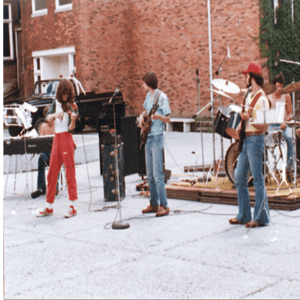
In the deep vaults of American Progressive Rock, Detroit’s October remains one of the most elusive and Atmospheric anomalies of the 1970s. Rather than conforming to the city’s signature Hard Rock and proto-Punk, this eclectic collective carved out a singular Jazz-Prog path, bridging the Symphonic architecture of King Crimson and Yes with the volatile, improvisational energy of Miles Davis’ electric era and the Mahavishnu Orchestra.
Inspired by seasonal transition, Halloween, and an aesthetic that balanced “beauty with unease,” October’s music is highly Cinematic, drawing from modern Classical giants like Igor Stravinsky, Karlheinz Stockhausen, and legendary film composer Bernard Herrmann. Yet, their recorded legacy remained a nearly mythical treasure, with their sophomore effort, “After the Fall,” circulating only in a legendary handful of physical copies.
On September 15, 2026, PQR-Disques will release the first official reissues of both ultra-rare albums. Remastered by the band, these long-hidden gems are finally coming to CD and highly limited, collector-edition vinyl. To mark this historic archival restoration, we sat down with the band to retrace their origins, dissect their avant-garde DNA, and discuss their catalog’s rebirth.
Detroit’s 1970s scene was dominated by raw Rock, Soul, and proto-Punk. Where did a cerebral, avant-garde group like October fit into that environment?
Detroit has always embraced outsiders and weirdos like Iggy Pop, Jack White and the MC5. But that said, in the beginning, the city was a pretty hostile environment for us. It wasn’t easy to get people to book a prog band with two keyboardists, a violin, bass and drums that played mostly original music. Thankfully, we didn’t let that stop us. We self-produced shows at small auditoriums, and a few adventurous Detroit jazz and rock clubs would take pity on us from time to time. We were pretty happy if we could perform once every two or three months. Then we caught a break when a popular Detroit public radio station, WDET, took a liking to us. They began playing our music and booking us for larger shows alongside other adventurous Motor City acts like Griot Galaxy and the Mary Roberts Band. We understood that we’d chosen a complicated path, but our attitude was essentially “go big or go home.” October became a real fire-breathing monster live, particularly after the album was recorded. Whether people actually liked us was another matter, but even those who didn’t quite understand what we were doing generally acknowledged that we were serious musicians playing interesting music. To some degree, that was all we’d ever wanted.
Your name evokes Autumn, Halloween, and seasonal transition. Why was that specific feeling of “beauty and unease” so central to your music?
We liked the idea of giving our music an edge without resorting to something obvious like a distorted guitar. Our strategy was to add a little danger through subtle use of mood, harmony and dissonance. Part of the idea of creating the spooky October vibe was that it would give the audience some context for the dissonance in our music. We figured they could enjoy it as a sort of gothic horror soundtrack. People didn’t seem to mind dissonance when they watch film, because there is a context for it. Although, let me make this clear, we didn’t want to over do it, because that would make it a bit corny. But one example of where it really worked was in the song “Ghosts.” We wanted to experiment with prepared piano, and we felt if we surrounded it with a nice little goth pop song, we might get away with it!
Was your songwriting the result of strict, intellectual design, or did it emerge organically from collective, intuitive jams?
Somebody from the band would usually come in with a structure and parts written out, but there was always a little room for some improvisation, to keep the song fresh and exciting. But occasionally the improvisation would take on a life of its own and inspire a whole new section. For example, we orchestrated Jeff Rozany’s incredible bass solo on “Egyptian Lullaby,” and it became an essential part of the song’s arrangement.
How did you balance the tight, composed discipline of Symphonic Prog with the free-flowing improvisational fire of Miles Davis‘ electric ensembles?
We saw it as tension and release. Most prog rock bands of the day always had moments where they could go a little wild. We were no different. I enjoyed jamming and felt we were good at it, but the keyboardist in our band really loved carefully arranging their parts. They eventually won out and in later editions of the band, we became more rigid. And orchestrated. To be fair, none of us were John Coltrane, and they wanted to play to our strengths.
You cited Igor Stravinsky and Karlheinz Stockhausen. How did their radical ideas on rhythm and dissonance influence your rock compositions?
We were all studying compostion in college, so those ideas were exciting to us. The question was, how do we take a larger audience with us? How do we use those avant-garde ideas and not leave the listener behind?
With Bernard Herrmann as a major influence, did you look at your music as a soundtrack to unmade, psychological films?
That’s a great way of putting it! And yes, that was exactly how we were looking at it. Bernard Herrmann is an excellent example of someone who composed instrumental music with a lot of atmosphere and melancholy beauty. His scores for Taxi Driver, Psycho and The 7th Voyage of Sinbad were important touchstones. So, yes, we saw creating that kind of atmosphere as our main weapon. We wanted to write music that would spark the audience’s imagination, not intimidate them. If we had the technology people have now, we would’ve probably projected images on stage to help them along.
Early synthesizer pioneers Wendy Carlos and Brian Eno were massive touchpoints. Did you treat the synth as a futuristic tool or an organic orchestral substitute?
Both. We loved synthesizers and definitely saw them as the future. At that time, we were a bit bored of guitars, and saw synthesizers as having this unlimited potential. It’s sort of funny how nobody uses them with any real imagination these days. It’s almost shocking. Especially because they are so much easier to use and program than they were back in the Seventies. We had two keyboardists because most synths in the early days were monophonic. We needed two people with four hands to get all the notes we wanted. We almost cried with joy when the polyphonic Prophet 5 came out!
What was the initial creative catalyst behind the track “Egyptian Lullaby”?
That was mostly me. I wanted to compose something harmonically and rhythmically daring, and so I started writing a series of melodic lines in strange time signatures that incorporated these unusual intervallic leaps. I thought it sounded a little Middle Eastern and went from there. Our original keyboardist, David Cowell, help me harmonize the whole thing, so I have to give him some credit. And our other keyboardist, Mark Krench plays a devastating solo on that song. Mark used to play synthesizers in a real physical way. He was exciting to watch. He wasn’t the kind of guy to wear gold lame capes like Rick Wakemant. He wore flannel shirts and loved to make a synthesizer sound like it was being shoved through a wood chipper.
Your second album, “After the Fall,” originally circulated in just a handful of copies. Why was its original release so limited?
The story behind After the Fall goes something like this. Several months after the release of our debut, keyboardist Mark Krench left the band, and Mark Sterling recruited Craig Furkas to take his place. In addition to being a skilled keyboardist, Furkas was a gifted composer whose harmonically dense style can best be heard on “Through the Light of Reason.” With Furkas, October began moving away from the wild improvisations that characterized the first album and toward more focused, highly arranged compositions. Jarvis was excited by the new music and urged us to return to his studio. It was during this period that we began recording the material that eventually became After the Fall. Before we could finish, however, we decided to change direction for both commercial and artistic reasons. The new music was more ambitious than our debut, but musical tastes were shifting rapidly, and we were finding it increasingly difficult to book shows. So, about two-thirds of the way through, we abandoned the sessions and moved on. Jarvis, however, was not to be denied. He loved what we’d recorded and eventually released much of it as a second album, filling out the unfinished material with a lengthy spontaneous studio jam called “Charisma.” Until recently, I hadn’t heard any of this music in decades. Listening to it now is a strange experience. It’s clearly unfinished, and I’d still classify much of it as a work in progress. But some of it is genuinely exciting, and I can hear five young musicians pushing themselves as hard as they knew how, trying to make music that didn’t sound quite like anybody else’s.
Does the title “After the Fall” reflect a seasonal progression, or was it a commentary on the band’s own trajectory?
Ha! That was all our mysterious producer Jon Jarvis, who we haven’t been able to locate!
For “Through The Light Of Reason,” the arrangement feels highly focused. What was the driving concept behind that piece?
That was a great composition by keyboard player, Craig Furkas, who replaced Mark Krench. It was an indication of where we were heading. But as good as it is, and it’s very good, we still had work to do on it. For example, all my violin parts on After The Fall were just scratch takes that I performed in a couple hours.
For decades, your records were mythical rarities. How does it feel to see them officially restored and globally distributed by PQR-Disques?
I’d be lying if I said I wasn’t thrilled. It touched me quite deeply that something we’d worked so hard on as youngsters had somehow survived and that, after all these years, people were still interested in hearing it. Especially since the music was so ambitious and peculiar. PQR-Disques is doing unbelievable work!
PQR-Disques is releasing the debut in three distinct vinyl colors, limited to 100 copies each. How does this physical focus align with your original artistic vision?
That was the label’s idea, and I thought it was fantastic! It is something we certainly would’ve done back in the day.
With your catalog now on Spotify and Bandcamp, what has been the most surprising reaction from modern listeners?
People have been really taken with the romance of the story. They find it astounding that the strange music of five smart, scruffy kids created in an attic in Michigan somehow survived, crossed the ocean, and found an audience we only barely knew existed.
Why do you think audiences in 2026 are still so fascinated by the specific balance of “beauty with unease” in retro Prog?
Music is so predictable these days—and October was anything but predictable. I think our album is bit like stumbling upon some weird artifact left by an alien lifeform. Our music had genuine power and mystery. For example, in “Egyptian Lullaby” during one section we filled a bunch of crystal glasses with water, tuned them to a chord, and rubbed the rims to produce shimmering high harmonics. Things like that created a vibe, and makes the ear go what is that—I’ve never heard anything like that! And there are dozens of examples on the album like that. Mystery is a rare and beautiful commodity in this day and age.
Has this remastering project closed a historical chapter, or has it sparked a desire to create new music together?
I would love to perform live or create some new music with the guys. We’ve stayed on good terms and everybody in the band are still good musicians—actually much better than we were when we were kids. My fantasy would to record the entire album over again with the abilities we have now and see what comes out. I think that would be fascinating. A couple of the players are no longer with us—drummer Pat Carson and keyboardist Craig Furkas—but there are plenty of October alumni to draw from. Find us a promoter!
The official reissue of October’s self-titled debut and “After the Fall” stands as an essential archival triumph for the US Progressive Rock underground. Thanks to the meticulous work of PQR-Disques and the band’s own remastering efforts, these long-lost masterpieces of complex, atmospheric jazz-prog are finally restored to their rightful place in music history. Both albums will be available on September 15, 2026, on CD and highly limited collector’s vinyl—an essential addition for anyone wishing to wander through the beautiful, uneasy, and timeless autumnal landscapes of Detroit’s most elusive sonic pioneers.
Pre-Order via Label Official Website:
Black vinyl (limited to 100 numbered copies)
White vinyl (limited to 100 numbered copies)
Black’n’white color-in-color vinyl (limited to 100 numbered copies)