

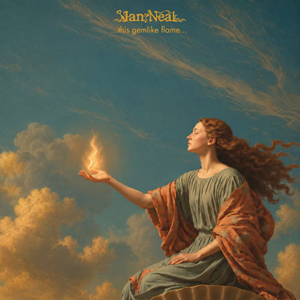
Symphonic Progressive Rock artist Ian Neal is back with “This Gemlike Flame.” The album drops on June 23, 2026 but fans can stream three tracks today. This preview highlights the record’s impressive dynamic range. It pairs the 4-minute track “Late States, Eden’s Gates” with two giant musical suites: the 9-minute opener and the 12-minute masterpiece “Cretan Angel.”
Pre-Order “This Gemlike Flame” and stream the three tracks via the Bandcamp player below:
Ian states:
“Hello everyone,
My new album, “This Gemlike Flame,” is now available for pre-order on Bandcamp — and three tracks are yours to hear right now. The remaining tracks will unlock on 23 June, a date I chose with intention. It marks the anniversary of my father’s passing. He was a musician, and I wanted to dedicate this album to him. A CD edition is also available, with a 12-page booklet containing lyrics, production notes, and artwork — made with the same care as the music itself. Thank you for being here. Independent music survives because of listeners like you, and I don’t take that lightly.” – Ian
Tracklist:
01. How Dreams do Creep (for Souls Asleep): i) The fruit to grow up ii) Into the blushing pear or plum iii) To cakes of ice, or flakes of snow 09:11
02. Late States, Eden’s Gates 04:24
03. Enitharmon’s Dream
04. Cretan Angel: i) Parousia ii) Diaphania iii) Quiescence iv) The Marian Veil 12:51
05. Fresco
06. Of Aether, Rose and Spangling Dew
07. Leonardo: i) Uomo Barbuto ii) Il Diluvio iii) The Prism Flares iv) Misterioso in 11/8 v) To burn always, with this hard gemlike flame
Credits:
Kyle P. Nish / Drums on Track 2
Drum tracks engineered and recorded by Garrett Bills
Evgenia Papamikrouli / Backing vocals on Tracks 1, 2, 6, 7
— This Gemlike Flame —
Close to four years have passed since the release of “Barkston Ash” (2022), and many will have noticed in that album the solidifying of a Progressive Rock aesthetic—one that places the work firmly in the same sonic domain as ‘Classic’ 70s Prog. Certainly, “This Gemlike Flame” follows suit; but there was, this time around, an uncompromising focus on capturing the exact textures of those specific albums from that era that I grew up on and still adore.
That inspiration, it could be argued, is ‘retrogressive’—an anathema to the theoretical characterisation of progressive rock as a genre that ‘must’ always chart new territory. Indeed; yet, fifty years on from that golden era, there is now a deep, universal recognition that the status of such work as permanent ‘art’ is unquestioned, rendering it a perfectly justifiable locus of inspiration for the contemporary composer. As I write these sleeve notes, Prog Magazine (May 2026) leads with a celebration of Genesis’ “A Trick Of The Tail,” proving that fifty years later, we are still analysing, decoding, and drawing life from its canvas.
— On Genesis —
As a teenager discovering Genesis in the mid-1980s, I found myself utterly consumed by the specific, melancholic textures of their 1975–1980 era. Albums like “A Trick Of The tail,” “Wind And Wuthering,” “And Then There Where Three,” and “Duke” soundtracked my youth and have stayed with me ever since.
At the time, we had a Hammond organ at home—the instrument I learned to play on. My music teacher’s earnest attempts to teach me to sight-read Rogers and Hammerstein hits were entirely in vain; instead, I was picking things up by ear, hunched over the stereo’s tape deck, pressing stop and pause to unravel the complex geometry of Tony Banks’ ‘Apocalypse in 9/8’ organ solo. What I discovered through that obsessive listening was the rich harmonic depth underlying the Genesis canon. The solos were fabulous, but for me, the foundational chordal progressions to those solos were just as mesmerising.
Long before the era of definitive CD reissues and curated box sets, I was tracking down obscure vinyl B-sides—‘It’s Yourself,’ ‘The Day the Lights Went Out,’ ‘Naminamu,’ and ‘Submarine’—alongside the cinematic textures of Banks’ solo debut “A Curious Feeling” and Steve Hackett’s early solo masterpieces.
I know I am not alone in this obsession. I notice others immersing themselves in the micro-details of this specific era. We are archaeologists of a sort. Yet, while some choose to re-present this historical work in the form of tribute acts, I prefer to embark on a form of para-compositional continuity. I approach the music as if I am co-habiting that late-70s sonic space—working through it, and with it, simply because, as a composer, its vocabulary is incredibly rich and beautiful to inhabit.
In amongst that archaeology also emerges the figure of David Hentschel and his sonic signature — it was studied closely; and as much as the music has inspired this album, so has a depth of enquiry around his mixes, the 70s analogue sound chain, the recording studios, the Trident Studios console and EQ topology, and so on. It has led to a very careful mix — no brickwall limiting, plenty of dynamic range, analogue width as opposed to digital width – a mix I am very proud of.
In “This Gemlike Flame,” I seek a compositional continuity where the mid-70s Progressive landscape provides the fertile soil, but the fruit is entirely my own. Yet the album is no pastiche. Where one might expect Tony Banks‘ signature Hammond chain to be consistently maintained, my own Hammond-work will often ramp up a heavy Leslie tremolo, partly for the bliss of hearing it slow-braking into a liturgical chorale. That said, there were certain Genesis tracks which operated as perhaps the strongest of beacons — namely, ‘Undertow’ and ‘Snowbound’ from “And Then There Where Three;” ‘Wot Gorilla,’ ‘Unquiet Slumbers for The Sleepers,’ ‘In that Quiet Earth’ from “Wind & Wuthering;” ‘Entangled’ from “A Trick Of The Tail;” and ‘Submarine’ from the “Abacab” sessions. The sound of those Polymoog pitch-sweeps, the Arp 2600 and Pro-Soloist synths, the gentle electric 12-string arpeggios, and of course the Hammond and RS202 string synth sounds, respectively, have pulsed through my veins for forty years—something that just had to re-materialise on my own terms.
— On Aart —
My past academic research into Victorian ‘reverie’ and British painting, which led to a PhD in 2011, naturally immersed me in a ‘British Dreamscape’ where art history and Romantic poetry feed directly into Symphonic progressive rock. My debut album, “All In The Golden Afternoon…” (re-worked, re-mixed 2025), initiated this cocktail; “This Gemlike Flame” crystallises it.
This time, the dreamscape is populated by two distinct literary ghosts. In “How Dreams Do Creep (for Souls Asleep),” and “Of Aether, Rose and Spangling Dew,” Robert Herrick‘s ‘lyrics’ evoke a world of bittersweet longing and melancholic beauty. Conversely, “Enitharmon’s Dream” draws from William Blake’s visionary mythology; its music originating from a classical song I wrote in 1996. The score of that piece became a quiet funerary votive for my father upon his passing that June—making this album’s release, exactly thirty years later, a dedication to him.
At the intersection of Herrick’s sensory beauty and Blake’s spiritual fire lies the album’s ultimate anchor: the newly reworked, 11-minute suite “Leonardo.” While crafting the intricate subtitles for this centrepiece, my research into Walter Pater’s celebrated essay on the “Mona Lisa” resurfaced. This process became a deliberate act of ekphrasis—the ancient Greek practice of translating visual art into a musical medium. It was here that Pater’s famous 1873 lines locked the album’s conceptual architecture into place: “To burn always, with this hard, gemlike flame, to maintain this ecstasy, is success in life.” This became the heartbeat of the Aesthetic Movement—the belief that beauty requires no justification beyond itself.
By obsessing over the micro-details of a specific sonic era, I am seeking that same Paterian ecstasy. This album is a literal manifestation of that inner spark—an attempt to sustain the brilliance of a particular aesthetic landscape simply because the act of dwelling within its beauty is enough. – Ian Neal — June 2026
— About Ian Neal —
Ian Neal constructs analogue-infused symphonic prog rock which reclaims the harmonic depth and pastoral beauty of the 1975–1980 progressive rock golden age. From his Kalamata Studio in Southern Greece, Neal, a PhD in ‘Victorian reverie’ draws on a Romantic vision of a pastoral British dreamscape, melding this to a ’70s-style high-fidelity analogue recording chain inspired by mid-70s Genesis.
Read our Review of “Barkston Ash” here: [Review] Ian Neal – Barkston Ash