

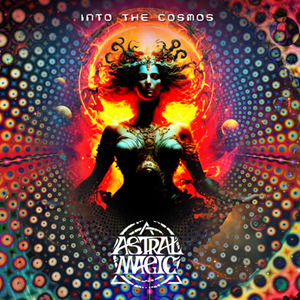
Astral Magic is the project of Finnish multi-instrumentalist Santtu Laakso, and “Into the Cosmos” is the kind of record that does not ask for your attention — it simply takes it. Out on February 06, 2026 via Black Widow Records in a limited CD edition of 300 copies, the album was recorded between 2020 and 2021, mixed and mastered in 2024, and released in 2026. Time well spent, as the final result makes abundantly clear. Laakso has assembled a tight constellation of contributors for the occasion — Fred Laird on guitar, Jonathan Segel handling violin and mastering, Ilya Lipkin, Vince Cory, Neil Whitehead on e-bow, and Perttu Lindberg on drums — and the record moves with the coherence of a band that knows exactly where it is headed. “Into the Cosmos” works squarely within the Space Rock tradition: Kosmische atmospherics, driving rhythmic architecture, analog synthesizer textures, lysergic guitar work, and a vocal sensibility that keeps the whole thing grounded and memorable rather than adrift. “Astral Plane Glider” opens the album with intent and authority. A dense tapestry of Electronic sounds and processed effects gives way to a driving rhythmic section: the drumming is tight and purposeful, the bass lines deep and load-bearing, and the guitar work arrives in refined layers above a dynamic, expressive vocal performance. It is a confident launch sequence — the album announces itself without hesitation, and the listener is already en route before the first minute has passed. “Flying High” links seamlessly to the opener through an astute use of keyboards and spatial effects, building a sonic bridge that feels organic rather than constructed. The choral vocal elements lend the track an epic quality, and the song moves convincingly between rhythmic acceleration and wide, open cosmic passages that nod toward Progressive Rock in their architecture. The interplay between guitar and synthesizer in the second half is particularly compelling: themes develop and evolve over a bedrock bass line before the tempo surges again, returning the listener to those choral voices for the finale. “Replicants” continues the journey with a refined Pop instinct grafted onto a Space Rock skeleton — the vocal hooks, both verses and choruses, are genuinely memorable. The bass lines carry a dense groove, while the drumming is solid and rich in tempo variations. In the instrumental sections, the guitar takes on a heavier edge, the synthesizer contributes spacey textures and effects, and the choral vocals return to envelop the listener as the synths guide the track toward its close. “Transmission Rho” is the album’s shortest piece and its most explicitly conceptual. It opens with Electronic sounds and modulations that consciously invoke the Kosmische Musik tradition — stratified, layered, patient — with processed robotic vocals emerging from within the texture. It functions as a purely electronic intermezzo, a decompression chamber between the album’s two halves, its gradual crescendo serving as the ideal threshold into what follows. “Into the Cosmos,” the title-track and the opening statement of the album’s second side, distills classic Space Rock idioms into something modern and distinctly personal. Laakso‘s vocal here is warm and enveloping, wrapping around the melodies as synthesizer modulations, Electronic textures, and — crucially — Jonathan Segel‘s violin weave together beneath it. The violin is a genuine differentiating element: its presence elevates the track, lending an organic, almost cinematic quality to a sound that could otherwise remain purely Electronic. The vocal has an anthemic, cosmic character, rising over a groove-Heavy rhythmic section while keyboards, violin, and guitar interlock in passages of genuine intensity. “The Nameless Ones,” the longest track on the tracklist at over seven minutes, is the album’s emotional and structural center of gravity. It is the meeting point of Space Rock, Psychedelia, and Progressive Rock — a triangle this record navigates instinctively — and it features another committed vocal performance that pulls the listener toward the deepest reaches of space. Keyboard carpets sustain the background atmosphere, creating the persistent sensation of traveling alongside Laakso and his Cosmonauts through a boundless galactic expanse. The melodic lines of the vocal sections lodge in memory with ease, and the electric guitar contributes refined, measured solo passages that add weight without excess. “Sons of Light” introduces a harder edge. The rhythmic section is more energetic, the guitar has additional bite, and the vocal — processed and effected — alternates with instrumental sections marked by rhythmic surges and layered synthesizer work that achieves a genuine sense of the ethereal. It is one of the more assertive tracks on the record, and it lands precisely where the tracklist needs it. “Return to Solaris” closes the standard edition on a purely instrumental note. A keyboard introduction that balances space rock openness with progressive rock structure sets the tone, before an elaborated rhythmic section — featuring Vince Cory‘s guitar alongside the established keyboard-and-effects framework — carries the track forward. The result is an intense, richly textured piece that brings the journey to a satisfying resolution while leaving the door open: one ends “Return to Solaris” already considering reboarding. The CD edition extends the experience with two bonus tracks that shift the album’s tonal register toward darker territory. “Dark Waves,” at over eight minutes, is the more ambitious of the two: its synthesizer takes the lead melodic role, layering and modulating through the first half of the track as the guitar contributes precise, carefully considered solo work and the rhythm section provides dense, corporeal support. The track develops its central metaphor — dark waves breaking through space — with genuine compositional discipline, building through rhythmic accelerations and tempo changes that are managed with confidence. It is absorbing, immersive, and at its best genuinely transportive. “Riders of Darkness” follows as a shorter companion piece, sustaining the darker Atmospheric palette of its predecessor: dense bass lines, an elaborated rhythmic section, and synthesizer-guitar interplay that distills the alchemical quality that characterizes the album as a whole into just over four minutes of focused Space Rock. “Into the Cosmos” is a disciplined, cohesive Space Rock record that earns its runtime. Laakso knows the genre’s vocabulary well and uses it on his own terms — no pastiche, no detours into self-indulgence. The Cosmonauts contribute as an ensemble rather than as a collection of session parts, and Segel‘s violin remains the record’s most distinctive single element, the touch that sets it apart from the crowd. Three hundred copies. Find one.
Tracklist
01. Astral Plane Glider (05:40)
02. Flying High (06:53)
03. Replicants (05:22)
04. Transmission Rho (03:17)
05. Into the Cosmos (04:49)
06. The Nameless Ones (07:10)
07. Sons of Light (03:50)
08. Return to Solaris (04:48)
09. Dark Waves — CD Bonus (08:17)
10. Riders of Darkness — CD Bonus (04:18)
Lineup
Santtu Laakso / All Music & Lyrics, Vocals, Bass, Synthesizers, Keyboards, Beats, Mixing
Fred Laird / Guitars
Jonathan Segel / Violin (“Into the Cosmos,” “The Nameless Ones“), Mastering
Ilya Lipkin / Guitars (“Flying High“)
Vince Cory / Guitars (“Return to Solaris“)
Neil Whitehead / E-Bow Guitar (“Replicants“)
Perttu Lindberg / Drums (“Into the Cosmos,” “The Nameless Ones“)
Andy Wainwright / Cover Design