

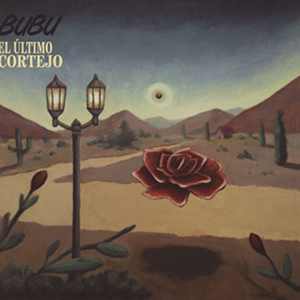
To speak of Bubu in the context of South American and international progressive music is to invoke a name that has carried the weight of a lost generation. Their 1978 debut “Anabelas” established the band as one of the most radical voices in the Avant-Prog canon, earning them a two-album contract with EMI Odeón. That second record—already performed in its entirety at Buenos Aires’ Teatro Astral, was severed from the world by the Argentine military dictatorship and the band’s subsequent exile. Its manuscript lay buried for fifty years. The origin of “El Último Cortejo” is, in the most literal sense, an act of archaeology. The 1976 scores were recovered from the cellar of founder Daniel Andreoli‘s parents, a fact explored in depth in our recent conversation with the band (here). Released by PQR Disques plusqueréel, the album is conceived as a direct dialogue across time: the compositional vision of the twenty-five-year-old Andreoli set against the architectural discipline of the seventy-year-old he has since become. This is not a retrospective exercise, nor a nostalgia product. It is the organic, necessary completion of a trajectory interrupted by politics. The project’s custodianship falls to Ariel Andreoli, Daniel‘s son and the album’s project manager, who assembled a line-up drawn from the current Neo-Prog scene in Buenos Aires: Agustín Ogura on guitars, Dante Fisi on keyboards and synthesizers, Fito Lema on drums, Paula Estefanía Araujo on flute, and Pedro Augusto Camerata on saxophone. Two years of rigorous rehearsal between 2024 and 2025 allowed these younger players to internalise the Avant-Prog and Chamber-Prog vocabulary of the Bubu idiom before contributing their own interpretive voice to what is, by design, the final chapter of the band’s catalogue. The lead single “Camina” opens the album with an immediate declaration of intent: Argentine urban tradition folded into complex metre and odd-time signatures without sacrificing forward momentum or bite. The rhythmic engine is driven by Fito Lema‘s drumming and Daniel Andreoli‘s bass, built upon what the band describes as the deliberate deconstruction of a traditional milonga pulse, its original cadence accelerated and absorbed into the aggressive sonic identity that has defined Bubu since the late seventies. Over this foundation, Agustín Ogura‘s guitar interweavings and Dante Fisi‘s keyboard textures provide a harmonic bed upon which Araujo‘s and Camerata‘s woodwind melodies articulate the band’s characteristic Avant-Prog phrasing. The second half of the track shifts register, unfolding into intricate interplay between woodwinds and keyboards that pushes the piece into the project’s most explicitly Progressive and experimental territory. The longest track on the standard edition and the album’s most overtly ensemble-driven composition, “Ciudad” foregrounds Pedro Augusto Camerata‘s alto saxophone and the architectural ambition of Dante Fisi‘s keyboard writing. A brief harmonic introduction sketches a metropolitan atmosphere before the principal theme enters, transposed through shifting harmonic fields. A first transitional passage gives way to a forceful restatement of the theme, which then leads into a second bridge where the melody is reinterpreted by the alto sax in a distinctly Jazz-Rock register before the track resolves in a sweeping, characteristically Bubu finale. If “Camina” evoked the Atmospheric landscape the band inhabited more than fifty years ago, “Ciudad” is where their present-day compositional and performative command is laid bare: intricate, densely layered, and yet never losing the listener’s attention. It is a synthesis of contrapuntal rigour, Jazz inflection, and the urban narrative of contemporary Buenos Aires rendered with an artistry that feels both contemporary and inevitable. A chamber-scale conversation between Araujo‘s flute, Fisi‘s keyboards, and Ogura‘s arpeggiated guitar, “Adentro Nuestro” is the album’s most introspective statement. Focused on dynamic nuance and timbral subtlety, it occupies the Chamber-Prog end of the Bubu spectrum. The harmonic writing here possesses a rare elegance, Jazzy inflections and Avant-Prog passages with continuous metric shifts are woven together with symphonic refinement. It serves as a necessary counterweight to the metropolitan intensity of the preceding tracks, and it is in these quieter, more elaborately voiced moments that the songwriting and collective musicianship of this new Bubu incarnation, woodwinds in particular, reveal themselves at their most assured. Marking the album’s midpoint, “Originarios” recovers the shamanic, telluric pulse of the carnavalito of northern Argentina (Jujuy), a form intimately tied to Andreoli‘s youth. The introduction evokes the solitude of the Coya indigenous figure; the central section paints communal life and celebration; the finale dissolves into Space Rock textures that, in Andreoli‘s account, represent the elder composer’s gaze toward the cosmos filtered through those ancestral roots. The track extends the album’s Avant-Prog exploration with clearly cosmic and, in certain passages, Heavy Prog inflections, all underpinned by relentless metric disruption and Argentine rhythmic patterns deconstructed and re-contextualised within a more expansive, exploratory harmonic framework. “El Tren De Las Nubes” is the hinge-track of the 1976 manuscripts recovered from Andreoli‘s family cellar, a composition whose architecture was fixed in the composer’s mind half a century before it was ever played by this line-up. Where the seventies favoured free collective improvisation, “El Tren De Las Nubes” channels its group passages through a strict, multi-layered formal structure, evidencing a compositional maturity that sits comfortably alongside the work’s classical harmonic base and its more modern sensibilities. Complex textural passages interlace with moments of near-suspended, dilated time, yet the band’s collective Jazz-Prog solo interplay, featuring all six players, keeps the architecture perpetually in motion. The result is a choral sound of considerable structural ambition, with synthesizer textures adding an additional layer of colour to the more Avant-Garde harmonic interweavings. The title-track is an explicit homage to “El cortejo de un día amarillo” from the 1978 debut. It honours the original’s principal theme and its signature metric shifts, and it culminates in an Avant-Garde saxophone improvisation that directly recalls the spirit of “Anabelas.” In just over six minutes, the album’s conceptual centre of gravity is achieved: fifty years of accumulated musical experience condensed into a statement of pure Avant-Prog. What distinguishes this rendering from mere revival is the band’s capacity to transplant those seventies atmospheres, once the foundation of Bubu‘s standing as a pillar of Argentine Progressive and Avant-Garde music into a sonic context that feels freshly conceived, contemporaneously vital, and structurally uncompromising. “El Último Cortejo” is, at its core, a tridimensional synthesis: Avant-Garde composition, the deconstruction of tango and milonga, the ethnic pulse of the carnavalito, and the expansive reach of Progressive Rock, all held together by a formal discipline that resists easy categorisation. Perhaps most significant is Daniel Andreoli‘s stated intention to close the Bubu project definitively with this record. The decision carries none of the residue of fatigue or sentimental farewell. It reads as the calm, deliberate act of a composer who has completed a fifty-year cycle with full artistic integrity, reclaiming the material the dictatorship took from him, and delivering it to a new generation of musicians who honour the architecture while breathing their own air through its corridors. In doing so, Bubu and their young collaborators have produced what can only be described as an instant classic of world Progressive music: a record capable of standing shoulder to shoulder with “Anabelas,” and a demonstration that South American Progressive Rock remains a living, structurally complex, and deeply original force. The band’s position as one of the indispensable pillars of Argentine Avant-Garde, past and present, is not merely reaffirmed. It is, with this album, permanently secured.
Tracklist
01. Camina (5:41)
02. Ciudad (8:15)
03. Adentro Nuestro (6:58)
04. Originarios (6:45)
05. El Tren De Las Nubes (7:24)
06. El Ultimo Cortejo (6:27)
Lineup
Augustin Ogura / Guitars
Daniel Andreoli / Bass
Paula Estefanía Araujo / Flute
Dante Fisi / Keyboards, Synthesizers
Pedro Augusto Camerata / Sax
Fito Lema / Drums