

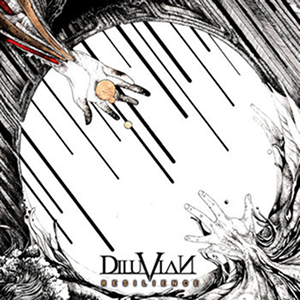
Formed in Liège in 2017, the Belgian quintet Diluvian, Jonathan Renard (vocals), Wolfgang Bormans and Antoine Pernot (guitars), Simon Lhoir (bass), Tom Selmi (drums), return with their second statement, “Resilience,” a five-track EP released on March 18, 2026. Three years separate it from the debut EP “Bivalence” (September 2023), and in that interval the band has had time to consolidate a vocabulary that, while not unprecedented in the broader Modern Metal landscape, is executed here with a coherence and purpose that set it apart from much of its immediate competition. The stylistic axis is clear and deliberately held: the EP orbits the intersection of Progressive Metal, Djent, Technical Metal, and the more vocal-driven territories of Modern Metalcore. Riff work is precise, often angular, threaded through with ambient pads and melodic breathing room; the result is a sound that is neither purely rhythmic nor purely atmospheric, but a hybrid that breathes. What “Resilience” offers is not a reinvention of the form, and to credit it with one would be disingenuous, but a confident, well-calibrated maturation. The production is clean and dynamic, the songcraft is disciplined, and the performances land with conviction. For a young band still within its second chapter, that is a meaningful achievement. The longest composition on the record and its opening statement, “Opaline” performs a dual role: it introduces the band’s sonic territory and establishes the dynamic range within which the EP will operate. The guitar architecture here is technical yet restrained, essential rather than ornamental, laid over a bed of Atmospheric texture that keeps the arrangement from collapsing into pure riff-stacking. What distinguishes the track is the way it negotiates between the rhythmic punch of a Djent-influenced low end and the structural patience of a Progressive composition; the two impulses never fully merge, but they maintain a productive tension throughout. Renard‘s vocal delivery traces this duality directly, shifting between aggressive, Metalcore-leaning delivery and more melodic, open-throated phrasing that tilts the song toward the Prog side of the ledger. The arrangement itself follows a similar arc: heavier, more percussive passages give way to passages that lean into space and harmonic colour, keeping the six-minute runtime from feeling overstuffed. “Opaline” is, in short, the map for the rest of the record, and a map drawn with enough specificity that what follows feels like a natural elaboration rather than a departure. In “Nightmoods” the EP finds one of its most compelling dynamic shifts. Guest guitarist Florestan Durand, better known as the frontman of Novelists, contributes a solo that cuts through the band’s otherwise tightly interlocked rhythmic writing, introducing a degree of melodic individuality and forward momentum that the core lineup, for all its precision, tends to keep in check. The solo doesn’t merely decorate; it disrupts the linearity of the riff structure long enough to remind the listener that there is room for spontaneous expression within this framework. The underlying track is a showcase for the rhythm section: the drumming is dense, riddled with time-signature changes that keep the groove perpetually on the verge of resolving and then redirecting, while the bass and guitar lock into a wall of low-end density that gives the song a distinctly choral, ensemble-driven quality. Renard‘s vocal here is almost uniformly in the aggressive register, anchoring the technical complexity with an emotional directness that prevents the piece from tipping into pure display. “Nightmoods” is where the EP’s ambition and its accessibility come closest to overlapping, and it shows the band at its most cinematically aware. The second and final guest appearance on the record carries a different function in “Supernova.” Where Durand‘s contribution is instrumental and textural, the involvement of Noé Peigneur (Ice Sealed Eyes) as a featured vocalist adds a genuinely new timbral and dramatic dimension. His voice, softer, more ethereal in character, slots into the atmospheric, breathing passages of the arrangement, providing a lyrical counterpoint to Renard‘s more forceful delivery. The interplay between the two vocal approaches is one of the EP’s most effective textural decisions, and it underscores a point that runs through Resilience as a whole: the band’s collaborative openness is not a garnish but a structural element. Musically, “Supernova” is the track where the genre palette is stretched most deliberately. Heavy, tension-saturated passages alternate with more exposed, technically detailed sections, and the central atmospheric passage, the space in which Peigneur‘s vocals reside, acts as a pressure valve before the song re-engages at full intensity. The latter half of the track is where the band’s range as a unit becomes most apparent: Metalcore aggression, Djent-derived rhythmic density, and open Prog phrasing are woven together with a naturalness that suggests the boundaries between these styles are, for Diluvian, less walls than gradients. It is the EP’s most assured statement of identity. Selected as the lead single and supported by an official music video directed by Alice J. Videography, “Labyrinth” is the EP’s most thematically explicit track, dealing with mental isolation, self-imposed imprisonment, and the internal chaos that accompanies both. The musical architecture mirrors those themes: the riffing is articulate and deliberately disorienting, the rhythmic section punctuated by persistent metric shifts that create a sense of a player navigating corridors that refuse to align. The effect is one of controlled unease, technical enough to register as skilled, structurally unstable enough to feel emotionally honest. Renard‘s vocal work here spans the full range the EP demands: extreme, guttural passages sit directly alongside cleaner, more melodic lines, and the juxtaposition serves the lyrical content rather than merely demonstrating range. At nearly five minutes, “Labyrinth” is a dense, continuous argument in sound, no filler, no obvious hook in the commercial sense, and it rewards the listener willing to stay inside its geometry. For a band that has not yet attempted a full-length, the confidence to build a single-track narrative this compact and self-contained is telling. The closing track functions as a summary, not a summary in the reductive sense, but a synthesis. Djent cadences, Metalcore vocal inflection, and more open, darkly coloured Progressive passages all coexist in “Phantom” and, for once, do so without the arrangement feeling like a tour of the band’s influences. The choruses lean catchier, the vocal phrasing adopts a more immediate Modern Metal directness, and the darker, ambient interludes are swept aside with a decisiveness that gives the record a sense of forward motion into its final bar. It is a fitting way to close a five-track document: not with a statement of arrival, but with an open gesture toward whatever comes next. The professional infrastructure behind “Resilience” is worth noting: mixing by Jim Pinder, mastering by Ste Kerry, recording and drum editing handled by Laurent Eyen at Koko Records (Liège), vocal editing by Nicolas Pirlet, and artwork by Charlie P. / Bout de Charbon. It is a clean, well-considered chain that allows the performances to speak without the polish obscuring their character. As a document, the EP is a success within the modest scope it sets for itself. “Resilience” is not a genre-resetting record, and to expect that from a second release by a five-piece operating in a crowded field would be unrealistic. What it does, and does well, is confirm that Diluvian have a coherent, technically fluent voice and a clear sense of where their individual sensibilities intersect with the broader Modern Progressive Metal current. The two guest appearances (“Nightmoods” and “Supernova“) serve as the EP’s expressive peaks, but the three self-contained tracks demonstrate that the core lineup is fully capable of sustaining interest without external impetus, which is the more important test for a band still building its catalogue. The trajectory is legible: “Bivalence” laid the groundwork, “Resilience” refines and extends it, and the next logical step, a full-length, would allow the structural ideas present here, particularly the metric and dynamic complexity of “Labyrinth” and the layered vocal interplay of “Supernova,” the space to breathe at a larger scale. Diluvian are not yet a name to circle in every Modern Metal listener’s notebook, but the work on this EP is honest, skilled, and pointed. In a field that often over-promises and under-delivers, a record that simply works, track by track, choice by choice, earns its place. And “Resilience” does.
Tracklist
01. Opaline (06:10)
02. Nightmoods (ft. Florestan from Novelists) (05:18)
03. Supernova (ft. Noé from Ice Sealed Eyes) (05:50)
04. Labyrinth (04:56)
05. Phantom (04:50)
Lineup
Jonathan Renard / Vocals
Wolfgang Bormans / Guitar
Antoine Pernot / Guitar
Simon Lhoir / Bass
Tom Selmi / Drums
Guests:
Florestan Durand (Novelists) / Guitar Solo on “Nightmoods“
Noé Peigneur (Ice Sealed Eyes) / Vocals on “Supernova“