

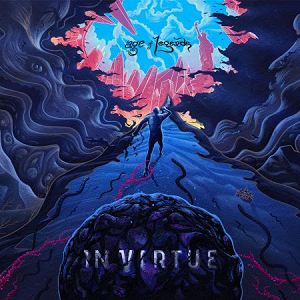
There is a particular ambition inherent to the concept album that separates the merely proficient from the genuinely visionary — the capacity to sustain a coherent narrative arc across an extended tracklist while simultaneously delivering compositional depth, emotional resonance, and instrumental authority at every turn. In Virtue, the Los Angeles-based Progressive Metal outfit led by guitarist and vocalist Trey Xavier, have staked their claim on precisely this territory with “Age of Legends,” released on November 21, 2025 via the band’s own imprint. A fourteen-track, fifty-minute record built around a reimagining of the myth of Sisyphus — his escape from eternal punishment, his confrontation with guilt, his pursuit of redemption — “Age of Legends” is a work that operates simultaneously as personal confession and mythological allegory. It is an uneven record in places, but also a frequently compelling one, driven by strong songwriting instincts, a remarkably varied sonic palette, and a cast of featured guests whose contributions feel genuinely integrated rather than decorative. The band’s biography carries its own narrative weight. Originally formed in 2004 in California’s Bay Area, In Virtue underwent a decisive reinvention in 2015 when Trey Xavier assumed lead vocal duties, relocated to Los Angeles, and rebuilt the lineup entirely. That decision — courageous by any measure — ultimately shaped the album’s conceptual DNA, as a record about shedding guilt and redefining one’s own trajectory carries unmistakable autobiographical undertones. Alongside Xavier, the lineup features keyboardist Alex Nasla (known from The Mourning and Witherfall), guitarist Rami Khalaf, and bassist Jamie Hush, with drum tracks handled by Bruno Valverde during the recording process. The album was produced by Xavier himself, mixed by Mazen Ayoub and Miami Dolphin with additional mixing by Alexander Backlund, and mastered by the formidable team of Jens Bogren and Tony Lindgren at Fascination Street Studios — a pedigree that immediately signals serious intent. Cover art was entrusted to Niklas Sundin, whose visual language is as precisely calibrated as the music it frames. The album opens with “Ascent Glorious,” a brief yet purposeful orchestral prelude that establishes the mythological grandeur of what follows. Strings and brass construct an overture of cinematic weight, functioning less as an independent statement than as a threshold — a formal invitation into the Sisyphean narrative that unfolds across the remaining thirteen tracks. It is a device executed with restraint and taste, avoiding the bombast that often undermines such openings. “Sisyphus Awakening” arrives immediately after and announces the album’s true tonal character without delay. This is Progressive Metal in a muscular, modern register: the riff architecture is dense and carefully layered, the rhythmic pulse relentless but far from monolithic, with the rhythm section carving out a foundation that allows both guitar and keyboard to operate with considerable harmonic freedom. Xavier‘s vocal performance is immediately noteworthy — alternating between clean melodic passages and harsher, more abrasive delivery with a fluency that never feels forced. The track’s structural logic is that of classic Prog, built on a series of distinct instrumental movements that develop, recede, and return in altered form. Trey’s clean vocal during the expansive chorus is particularly effective, its sense of liberation from constraint matching the lyrical image of Sisyphus finally breaking his shackles. “Karma Loop” (ft. Charlotte Wessels), introduces the first of the album’s featured guests, and the choice is inspired. Wessels — whose pedigree spans Delain and an acclaimed solo career — brings a vocal warmth and tonal sophistication that opens the track’s harmonic space considerably. The interplay between her melodic lines and Xavier‘s grittier delivery creates a genuine dynamic tension that drives the song forward through its compact structure. The instrumental architecture beneath them is equally well-constructed: Nasla’s keyboard work traces elegant countermelodies while Khalaf‘s guitar work generates textural depth without overcrowding the arrangement. The track concludes in a controlled crescendo that lands with satisfying finality. “Push That Rock” functions as a deliberate tonal disruption — a Blues Rock interlude built on a slow, deliberate rhythmic pulse that strips the sound back to something rawer and more elemental. Xavier‘s vocal here adopts a rougher, more weathered quality that suits the track’s spare, direct character. The guitar work in the closing passages is particularly effective, unfolding in a measured, bluesy phrase that briefly transforms the album’s sonic register before the Progressive Metal architecture reasserts itself. “Purgatory” is among the album’s most sophisticated compositions. Originally released as a standalone single in earlier form, here it functions as a pivotal structural chapter — the moment at which the narrative’s internal conflict intensifies. The track moves fluidly between passages of considerable aggression, where Xavier‘s harsh vocal sits atop rapid rhythmic accelerations, and more expansive Prog/Power Metal sequences in which melodic clarity and harmonic richness are fully foregrounded. The continuous tempo shifts are handled with precision, and the interplay between guitar and keyboards during the track’s extended instrumental passage is genuinely compelling — two voices in counterpoint, each defining the boundaries of the other’s register. “Exposed” consolidates the album’s Progressive Metal core with some of its most direct writing. The riff construction here is particularly strong — dense without being impenetrable, rhythmically assertive without sacrificing harmonic nuance. Xavier navigates the vocal passages with authority, and the track’s instrumental sections display the compositional confidence of a band operating with full command of its own language. The structural balance between verse-driven forward momentum and more exploratory instrumental passages gives the track a satisfying internal coherence that rewards repeated listening. “Scream” follows in a similar vein, delivering some of the album’s most direct and impactful rhythmic work. Where “Exposed” leans into harmonic complexity, “Scream” prioritizes forward momentum and visceral impact — the riff is granite-heavy, the rhythmic drive relentless, and the vocal passages cut cleanly through the dense instrumental texture. It is one of the album’s more immediate compositions, and its placement at this midpoint of the sequence gives the listener a necessary moment of concentrated energy before the tracklist diversifies again. “Where The Edges Meet” broadens the sonic vocabulary, introducing a stronger Power Metal influence alongside melodic choruses of genuine catchiness. The structural interplay between technically demanding instrumental passages and openly anthemic vocal sections is executed with skill; what might in lesser hands feel like stylistic incoherence becomes here a productive tension. The track serves as a kind of thematic hinge, its lyrical content — explicitly referencing the album’s title — giving it a conceptual weight that elevates it beyond its compact duration. “Gunslingers of the New American Desert” is one of the record’s most distinctive and rewarding tracks. Opening with a brief Western-inflected passage — sparse, cinematic, almost theatrical in its evocation of a scorched landscape — the track rapidly expands into one of the album’s most powerful rhythmic statements. The bass and drum foundation is immovable, yet the texture above it is anything but static: Nasla‘s synthesizer lines trace atmospheric arcs across the heavy riff work, and the vocal delivery is among Xavier‘s strongest on the record. The track builds through a series of ascending structural phases toward a conclusion of genuine epic scope, sustaining its ambition across its near-five-minute duration without ever losing compositional focus. “Desolation Throne” returns to direct, uncompromising Progressive Metal with no concession to ornamentation. The rhythmic section evolves continuously through the track’s compact duration, navigating a series of tempo shifts and metric modulations with fluency, while the vocal performance alternates between melodic restraint and raw intensity. The track accelerates in its second half, incorporating Power Metal-adjacent acceleration and an exchange between guitar and synthesizer that functions as a miniature cadenza before the final resolution. “Thoughts in Freefall” (ft. Dave Davidson), marks one of the album’s clearest shifts toward traditional Power Metal territory. Davidson — of Revocation, whose technical pedigree speaks for itself — contributes a guest guitar solo of considerable virtuosity, bringing a distinct melodic sensibility that enriches the track’s harmonic palette and raises its technical ceiling substantially. The composition builds through verses of sustained tension toward a chorus of full-throated melodic power, recalling the ambitious arrangements of late-1990s European Power Metal while remaining firmly contemporary in its production aesthetics. Davidson‘s presence is not merely decorative — it genuinely transforms the track’s character in its final movements. “The River” provides the album’s most intimate and emotionally unguarded moment: piano and voice, reduced to their simplest elements, tracing a lyrical arc of exhaustion and suspended resignation. The brevity is precisely calibrated — had the track extended itself further, it risks overstating its emotional weight. As it stands, it functions as both structural interlude and genuine emotional statement, providing the listener with the necessary pause before the album’s most ambitious composition. “Tempus Fugue” (ft. Chaney Crabb) is the album’s culminating statement — its most extended, most structurally complex, and, ultimately, its most rewarding track. Opening with acoustic guitar and solo voice in a passage of genuine melodic beauty, the composition builds incrementally through a series of structural phases that collectively encompass Progressive Metal, Power Metal, and passages of sophisticated harmonic exploration before arriving at a resolution whose emotional force has been carefully earned across the preceding eight minutes. Chaney Crabb — vocalist of Entheos — contributes a performance of remarkable intensity, her tonal range and dynamic control providing a counterweight to Xavier’s own delivery that creates some of the album’s most arresting vocal interplay. The instrumental passages in the track’s extended central section are the most technically demanding on the record, showcasing the band’s full compositional scope. The final return of the recurring lyrical motif, recontextualized after all that has preceded it, lands with the weight of genuine narrative closure. The album concludes with “Descent Limitless,” an orchestral outro that mirrors the album’s opening prelude and completes the conceptual arc with appropriate formal symmetry. A solo guitar line traces its phrase across a bed of orchestral strings — a figure that feels less like triumph than earned quietude, a Sisyphus who has not conquered his boulder so much as understood, finally, its meaning. “Age of Legends” is not a flawless record. Its ambition occasionally exceeds its execution in places, and the sheer density of stylistic reference — Power Metal, Progressive Death, Blues Rock, cinematic orchestration — can at times feel more eclectic than organically unified. Yet it is precisely this willingness to range widely, to refuse the comfort of a narrower genre definition, that gives the album its distinctive character. The guest contributions are handled with real care, Charlotte Wessels and Dave Davidson and Chaney Crabb each enriching the compositions they inhabit rather than merely decorating them. The production — Fascination Street‘s mastering ensures clarity and weight in equal measure — does full justice to the compositional ambition. Above all, Xavier and his bandmates have delivered a record with genuine conceptual backbone: an album that earns its mythological premise through the quality of its music rather than simply the ambition of its concept. In the contemporary Progressive Metal landscape, that is no small achievement.
Tracklist
01. Ascent Glorious (00:35)
02. Sisyphus Awakening (04:54)
03. Karma Loop (ft. Charlotte Wessels) (03:34)
04. Push That Rock (02:46)
05. Purgatory (04:38)
06. Exposed (03:27)
07. Scream (03:40)
08. Where The Edges Meet (03:16)
09. Gunslingers of the New American Desert (04:42)
10. Desolation Throne (03:02)
11. Thoughts in Freefall (ft. Dave Davidson) (04:10)
12. The River (02:24)
13. Tempus Fugue (ft. Chaney Crabb) (08:05)
14. Descent Limitless (01:22)
Lineup
Trey Xavier / Vocals, Guitar
Rami Khalaf / Guitar
Alex Nasla / Keyboards
Jamie Hush / Bass
Bruno Valverde / Drums (Recording)
Guests:
Charlotte Wessels / Vocals on “Karma Loop“
Dave Davidson (Revocation) / Guitar on “Thoughts in Freefall“
Chaney Crabb (Entheos) / Vocals on “Tempus Fugue“
[…] In Virtue – Age of Legends:A fourteen-track Progressive Metal concept album built around the myth of Sisyphus, led by Trey Xavier and featuring Charlotte Wessels, Dave Davidson (Revocation), and Chaney Crabb (Entheos). Mastered at Fascination Street Studios. Ambitious, uneven in places, and frequently compelling. [Read here] […]