

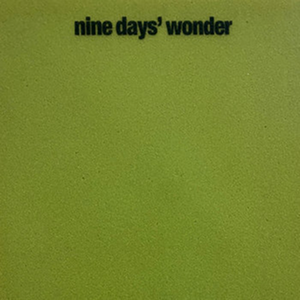
In 1966, a young percussionist named Walter Seyffer gathered a handful of like-minded musicians in Mannheim and called them The Graves. By February 1970, the project had shed its initial name and re-emerged as Nine Days’ Wonder — a five-piece whose ambitions stretched well beyond the genre conventions of West German Krautrock. Where contemporaries such as Can and Faust embraced the unscripted, cyclical drift of extended Psychedelic improvisation, Seyffer pursued something far more deliberate: a tightly rehearsed, multi-genre architecture in which Heavy Progressive Rock, Free Jazz, and Theatrical Avant-Garde Experimentation coexisted under a single, unified vision. The group’s most immediately striking feature was its geography. Alongside Seyffer (lead vocals, drums, percussion, effects) and fellow German Rolf Henning (guitar, piano), the lineup included Irish multi-instrumentalist John “Irish” Earle (vocals, tenor and soprano saxophone, flute, guitar), Austrian bassist Karl Mutschlechner, and British drummer Martin Roscoe. Four nationalities, one instrument per member as a minimum, and a collective ear tuned to the full spectrum of British and continental innovation. The self-titled debut was recorded in January 1971 at Dierks Studios in Cologne-Stommeln, engineered by Dieter Dierks and produced by Peter Hauke for Bacillus Records. Its sonic palette draws simultaneously on Frank Zappa & The Mothers of Invention, King Crimson, Van der Graaf Generator, Soft Machine, Traffic, Jethro Tull, and Deep Purple — not as pastiche, but as raw material folded into a syntax entirely its own. The original German pressing earned a quasi-religious following in part for its physical artefact: a textured, green foam-rubber gatefold sleeve designed by Seyffer himself. The UK edition, issued via Harvest, swapped the foam for a dead-fish cover by Hipgnosis. The 2026 Bacillus Records Bandcamp archive release preserves both the original four-part track sequence and the classic artwork, delivering one of the era’s most audacious underground records to a new generation of listeners with the fidelity and context it deserves. A crushing, heavily distorted guitar chord slams the door open. Delicate flute lines and sparse piano figures slip beneath it, and within moments a full-bodied Heavy Rock groove is roaring. The title movement, “Fermillon,” is immediately a statement of intent: raw, interlocking guitar riffs and a bassline that throbs with sustained, almost physical pulse, framed by Earle‘s incandescent sax motifs and Seyffer‘s vocal delivery, which shifts without warning from baritone menace to operatic absurdity. Around the four-to-five-minute mark the structure fractures. The groove dissolves into a hypnotic, Avant-Garde electronic wash — pulsating bass tones, scattered percussive accents, a soundscape that owes more to Dierks‘ studio treatments than to any single genre. It is the band’s clearest assertion that conventional form is a suggestion, not a law. When the Heavy texture reasserts itself, guitar and sax lock into a rapid-fire, Jazz-Fusion interplay that feels less composed than negotiated in real time. Near the eleven-minute mark, the piece lurches into spoken-word passages drenched in reverb, punctuated by comical, Monty Python-style vocal pitch shifts that undercut the preceding intensity with a sharp, theatrical smile. The final “Fermillon Himself” movement detonates in a thunderous Heavy-Prog coda, and sixteen minutes close with a sense of controlled demolition. If the opener is a cathedral, “Moss Had Come” is the lightning strike outside its doors. A concise three-and-a-half-minute burst of Hard-Rocking Psychedelic Krautrock with a brass edge, driven by thick, saturated guitar chords and Seyffer’s urgent, almost shouted vocal lines. Then, at roughly the ninety-second mark, the violence simply stops. A gentle acoustic guitar strum takes over, Earle‘s voice softens into a laid-back, pastoral register, and the track exhales into a brief, sunlit stillness. The recovery is abrupt and violent: soaring saxophone runs, driving double-time drum patterns, a sudden surging of the full ensemble. In under four minutes, the band delivers a complete emotional arc — assault, repose, eruption — without a single note of wasted momentum. Here the group’s most knotty, Zappa-esque compositional instincts come fully to the fore. A brief, saxophone-draped introductory figure gives way to a rapid acceleration into an uptempo instrumental passage of genuine rhythmic complexity. Henning‘s lead guitar work is the track’s engine: blistering, angular runs traded back and forth with Earle‘s wind instruments over a rhythm section that shifts metric terrain with alarming frequency. Seyffer’s vocals track every twist — manic, sardonic, then suddenly aggressive and gritted — matching the track’s polyrhythmic density and hard-prog intensity without ever losing the satirical edge that distinguishes Zappa‘s influence from mere technical display. Six minutes and forty-five seconds of sustained, head-spinning craftsmanship, and not one moment of filler. The closing suite is where Nine Days’ Wonder‘s eccentricities are permitted to run at full throttle. An instrumental prelude sets the tone: Henning‘s lead guitar engages in a literal call-and-response dialogue with Seyffer‘s vocalizations, the voice treated as another instrument, pitched and timbrally shaped rather than merely melodic. Fluttering flute melodies enter around the four-minute mark and steer the piece into a grooving jazz-rock register, threaded with classical-influenced interludes and proto-fusion saxophone solos that swing between free-jazz intensity and Traffic-like melodic warmth. As the suite progresses through “Stomach’s Choice” and the second “Monotony” into the “Interlude” and final “Dilemma” movement, the textures grow more spatial and atmospheric. Eerie, suspended harmonies build a slow-burning suspense. Seyffer, in the closing passage, delivers an unhinged, dramatically heightened vocal performance that channels the confrontational pathos of Peter Hammill at his most extreme. The album’s boundary-pushing climax is less a resolution than a deliberate, sustained tension, a door thrown wide and left open. In the broader map of early European Progressive Rock, the 1971 self-titled debut remains a genuine anomaly. The band managed to bridge the calculated, brass-driven complexity of the British Progressive tradition with Krautrock’s restless experimental instinct and a Zappa-esque satirical sensibility, and in doing so produced a record that feels, in several passages, genuinely ahead of its moment. The post-recording history is brief and, in part, tragic. After an intensive stretch of live work across Germany, Austria, Switzerland, and Yugoslavia, including appearances at Hamburg’s storied Star Club, the original lineup dissolved in 1972. Earle relocated to the UK, where he contributed saxophone and flute to Gnidrolog‘s “Lady Lake” and went on to sit in as a sought-after session player on recordings by Thin Lizzy (Dancing in the Moonlight), Motörhead, and The Clash (London Calling). Roscoe played with 2066 & Then and AERA, Seyffer briefly joined Medusa before reforming Nine Days’ Wonder in various later configurations. John Earle died in 2008, Rolf Henning in 2010, and Martin Roscoe in 2018. For the readership of the Journal, the 2026 Bacillus Records archive release is not a mere reissue. It is a corrective. It restores, in high fidelity and with the original sequence intact, a record that has long circulated in small pressings and bootleg reprints, and it hands it back to the scene that first made it. For listeners steeped in King Crimson, Van der Graaf Generator, Frank Zappa, and the heavier strand of early seventies Progressive music, Nine Days’ Wonder is an essential listen, a document of five musicians from four countries who, in a single January in a Cologne studio, proved that Rock could be as structurally audacious and theatrically alive as anything the era produced.
Tracklist
01. Fermillion (15:48)
02. Moss Had Come (3:27)
03. Apple Tree (6:45)
04. Drag Dilemma (12:47)
Lineup
Walter Seyffer / Vocals, Drums, Percussion, Effects
John Earle / Vocals, Tenor and Soprano Sax, Flute, Guitar
Rolf Henning / Guitar, Piano
Karl Mutschlechner / Bass
Martin Roscoe / Drums