

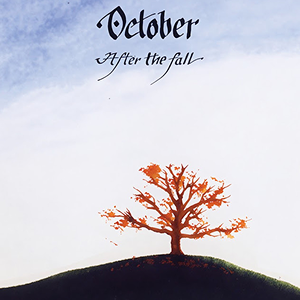
Emerging from late-1970s Detroit, a scene dominated by Hard Rock, Soul, and Proto-Punk, October stood as a starkly cerebral and atmospheric anomaly. Distancing themselves from the Motor City’s expressive norms, the band cultivated an original proposition that fused the symphonic architectures of King Crimson and Yes with the improvisational energy of the Mahavishnu Orchestra and Miles Davis’ electric period. Their compositional rigor drew further from the works of Igor Stravinsky, Karlheinz Stockhausen, and film composer Bernard Herrmann. The band’s very name evokes autumnal melancholy, seasonal transition, and Halloween-tinged suggestions, seeking a constant equilibrium between “beauty and unease” through the use of dissonance as a soundtrack for Gothic Horror. Discographically, their 1979 self-titled debut (previously reviewed by PRJ) presented a pastoral Symphonic Prog characterized by defined song structures and the frequent vocal presence of Jeff Rozany. With their second effort, “After the Fall” (recorded in 1980 at Jon Jarvis’ Dearborn Studios), the band underwent a profound metamorphosis. The departure of keyboardist Mark Krench and the arrival of Craig Furkas steered the writing toward denser harmonies, marking a shift toward a darker, more abstract, and instrumental Chamber Jazz-Rock. The history of this album is complex: due to shifting musical tastes and difficulties securing live engagements, the sessions were abandoned before completion. Producer Jon Jarvis assembled the recorded material, adding a long, extemporaneous studio jam (“Charisma”), and pressed a minuscule run with hand-painted covers. For decades, the work remained nearly unobtainable or circulated only as bootlegs of varying quality. The 2026 official reissue by PQR Disques, remastered directly by the band members, finally restores clarity and dynamic depth to the interplay between analog keyboards and Brad Tolinski’s electric violin. In line with their current metamorphosis, the band offers no promotional rhetoric; instead, they present an album that stands as a testament to a mature group abandoning the song form for the fluid suite, accepting the partially unfinished nature of a work suspended between analytical rigor and the dimension of a “work in progress.” The opening, “Intro,” is a suspended, highly atmospheric piece that sketches a twilight landscape. The track immediately defines the album’s melancholic, autumnal signature, eschewing guitar riffs or commercial hooks in favor of enveloping synthetic layering. “October Suite” represents one of the album’s compositional peaks, developing a classically derived theme through continuous time changes. Here, Krench’s acoustic piano intertwines with Tolinski’s sinuous violin lines and Carson’s sudden rhythmic accelerations. The piece highlights the balance between neoclassical lyricism and rhythmic tension. It immerses the listener immediately in the band’s new sonic palette, diverging sharply from their debut and concluding with an incursion into more intricate Jazz Rock. “Earth” is the episode where the influence of the Mahavishnu Orchestra and American-rooted Jazz Rock emerges most prominently. Rozany’s bass supports a central section rich in dynamic tension and virtuosity, alternating with airy melodic openings that demonstrate the ensemble’s growing cohesion. Here, the band explores electronic textures that blend with the Jazz Fusion patterns of the rhythm section, creating a mixture of Avant-Prog, Kosmische Musik, and Jazz Fusion. The track marks the peak of their musical trajectory, finding the perfect intersection between the synth’s cosmic sonorities, intricate Jazz textures, and that Fusion/Avant-Prog touch that exalts the band’s compositional and executive technique. Violin solo inserts elevate the piece, set against an intricate structure executed masterfully by the drums and bass, while the electronic components and more elaborate Jazzistic traits blend and evolve the theme with refined textures where keyboards and violin intertwine in solo interventions and chamber-like openings. “Through the Light of Reason” is emblematic of the new, harmonically dense direction imposed by Furkas. Synthetic textures envelop the interventions of violin and recorder in a measured and elegant crescendo. From an analytical standpoint, a crucial executive detail must be highlighted: the violin parts recorded by Tolinski on this track, and throughout the album, were originally simple “scratch takes,” provisionally recorded in a couple of hours during the sessions that were later left incomplete. Nevertheless, the piece displays remarkable structural firmness. “Shining” is a collected, reflective moment that serves as an intermediate passage toward the album’s finale. The writing prioritizes timbral exploration and the delicacy of harmonic interlocks over technical ostentation, highlighting the more intimate side of the group’s aesthetic. It is also worth noting the first appearance of sung parts within the album, which recall the style of the previous record. The album concludes with a suite of over twelve minutes titled “Charisma,” named after the Dearborn recording studio run by producer Jon Jarvis. Born as a long, extemporaneous jam to complete the album after the main sessions were abandoned, it constitutes the artistic manifesto of October. The track synthesizes the group’s various souls, moving between imposing symphonic openings, spatial digressions guided by the Moog linked to European Kosmische Musik, high-tension fusion improvisations, and a finale of deep emotional impact. In this episode, the boundaries between rigorous composition and free improvisation blur definitively. “After the Fall” testifies to October’s evolution from the pastoral Symphonic Prog of their beginnings (1979) toward a Chamber Jazz-Rock that is twilight-like in nature (1980). The band’s aesthetic is defined around the concept of “beauty and unease,” replacing the customary formulas of American prog with a timbral research founded on dissonance and the interplay between analog electronics and electric violin. The restoration work carried out by PQR Disques in 2026 restores the historical value of a work that remained hidden for a long time. Despite carrying the traces of an unfinished work assembled between interrupted sessions, provisional takes, and extemporaneous jams, the album emerges as a proof of notable formal maturity and executive cohesion. This review concludes with an analytical balance that recognizes the peculiarity of an atypical and courageous disc within the American Progressive landscape of the 70s/80s.
Tracklist
01. Intro (3:10)
02. October Suite (4:59)
03. Earth (5:33)
04. Through the Light of Reason (4:39)
05. Shining (3:35)
06. Charisma (12:24)
Lineup
Mark Krench / Acoustic and Electric Piano
Mark Sterling / Mini-Moog, Micro-Moog, Moog Sonic Six, Elka Strings, ARP Omni, ARP Strings
Brad Tolinski / Acoustic and Electric Violin
Jeff Rozany / Vocals, Acoustic and Electric Bass
Pat Carson / Drums
Read our Review of their self-titled debut album here: [Review] October – October (PQR 2026 Edition)
Read our Exclusive Interview with October here: [Interview] From Detroit’s Vaults to PQR-Disques: Interview with October