

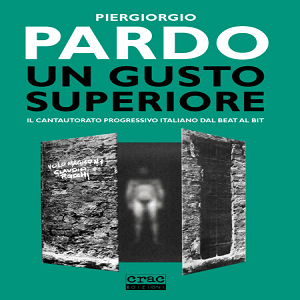
Crac Edizioni publishes the new book by Piergiorgio Pardo, over 200 albums and interviews with Morgan, Eugenio Finardi, Colapesce, Ivan Cattaneo, Iosonouncane and many other experimenters between Song and Progressive.
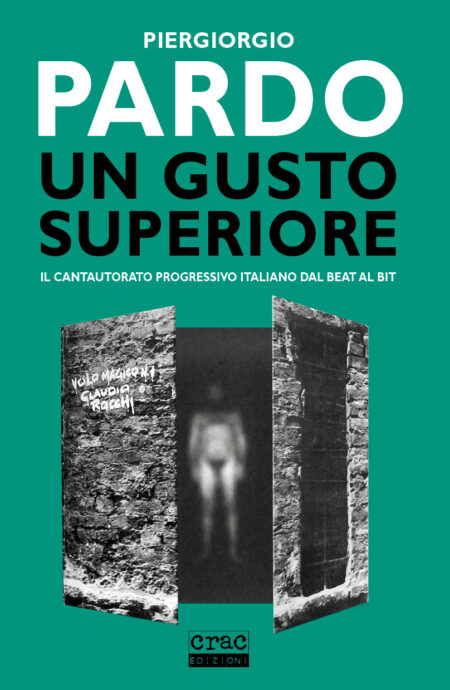
A superior taste: a survey of Italian Progressive Songwriting.
Purchase the book here: http://edizionicrac.blogspot.com/
“A strange book, which is not about songwriting or even progressive music. It’s all about their meeting point and the renunciations and conquests that the two of them have gone to, in order to do something beautiful together, without arguing all the time.”
Morgan, Eugenio Finardi, Iosonouncane, Ivan Cattaneo, Colapesce, Amerigo Verardi: these are just a small part of the names that populate “Un Gusto Superiore: Il Cantautorato Progressivo Italiano Dal Beat Al Bit,” the new book by Piergiorgio Pardo published by Crac Edizioni – introduction by Guido Bellachioma, director of PROG Italia; afterword by Giulia Cavaliere, journalist for Corriere della Sera, Rolling Stone Italia and Esquire.
An impassioned and in-depth text in which the Milanese author explores the relationship between Progressive Rock and Singer-Songwriter song, two apparently opposing worlds that have instead found many opportunities for encounter, dialogue and fusion over almost half a century. The title “Un Gusto Superiore” pays homage to the 1980 mystical album of the same name by Claudio Rocchi and Paolo Tofani, the subtitle “Dal Beat Al Bit” evokes the embrace between two different eras, from the revolutions of the ’60s and ’70s to the Experimentations of the new millennium. The result is an all-round investigation into the unique phenomenon of its kind, of “Progressive Songwriting” in our country: “In its intentions it is a book against classifications and in favour of curiosity. It mixes musicians from the past present and future, famous and unknown, loved, hated, or simply snubbed by critics, of all ages.”
Piergiorgio Pardo writes for Billboard Italia, is part of the music editorial staff of Radio Popolare
Network, as well as creator and host of programmes and podcasts for Radio Raheem Milano. He has collaborated with L’Essenziale and Blow Up, has published several titles on music and youth culture cultures such as “Conoscere le Controculture Giovanili” (1997), “Le Video Generation” (2000), “Il Cyberpunk” (2001), “A Young Person’s Guide To King Crimson 2.0” (2017). In this new book he puts
together two areas he has studied over the years, trying to emphasise the transversality experiment: “If we replaced the word ‘cantautore’ with ‘Songwriter’ and the word “Progressive’ with ‘Ambition’, the names and records mentioned in the book would remain the same. But would not go into the equation between Progressive and dinosaurs and instead it seems to me fun to try to do so. So think, on the one hand, of the many Italian singer-songwriters who are also great musicians, or know how to use them, and on the other hand, of the Progressive as a transversal concept, which Psychedelia, Art Rock, Experimentation and all the other devilry, baptised or not by critics by critics, that over the decades have been able to force the limits of the song form.”
The artists addressed by Pardo are many, over 200 records of popular but also esoteric names: from Lucio Battisti to Gino D’Eliso, from Franco Battiato to Mario Barbaja, from Alan Sorrenti to Mauro Pelosi. All united by an “other” vision of song, between political themes, visionary languages,
existential narratives daughters of their times. “The book contains interviews that I will never ever forget, not least because of the times in which they happened. There is Iosonouncane in the only interview given during the period of the pandemic, when IRA was still a secret. There is all the lucidity of Amerigo Verardi and the humanity of Eugenio Finardi, ready to tell and tell himself with his wonderful humanity. There is a Morgan in great form who amiably discusses song of songwriting, there is the last interview in life of a splendid Maurizio Monti, there are the stories of Jenny Sorrenti, Ivan Cattaneo, Gino D’Eliso, Fabio Zuffanti, Colapesce‘s statements on Enzo Carella, the Tuscan stories of Alessandro Fiori and the reserved and stateless ones of Andrea Laszlo De Simone. These are just a few names that come to mind, but leafing through the book all these encounters, together with the others from which so many of his pages have sprung, come to life again and I hope it will be the same for the reader.”