

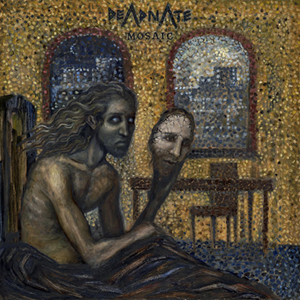
Danish Progressive Metal band Deadnate return with “Mosaic,” out March 27th, 2026 via DeadRecords — and the distance between this record and its predecessor “The North Sea” (2022) is not simply a matter of creative growth. It is a matter of direction. Where that debut oriented itself outward — toward nature, environment, the friction between the human and the elemental — “Mosaic” pulls the focus inward, toward the city, its people, and the psychological texture of living among them. Grief, anger, empathy and its systematic failures: the band works with these materials across eight tracks, and does so without the comfort of moral resolution or thematic tidiness. The title carries its own argument. Each person, each experience addressed across the record, is understood as a fragment — incomplete in itself, meaningful only within a configuration it cannot fully perceive. Deadnate build their music on the same principle: Progressive complexity, Extreme aggression, Post-Metal atmosphere, and passages of unexpected directness assembled not as contrast for its own sake, but as components of something that holds together precisely because of its internal tensions. “He Who Pays” opens the record without preamble or introductory gesture, arriving with the kind of self-assurance that announces a band fully inhabiting its own language. The rhythmic architecture here is dense and restless — a wall of sound that shifts beneath its own weight through a sequence of time changes navigated with precision rather than spectacle. The riff work carries genuine mass, the kind that registers physically before it registers intellectually, and the rhythm section operates as a single integrated mechanism: locked, propulsive, technically assured without advertising itself as such. Vocally, the performance moves between aggressive delivery and passages of a more choral, layered character, a dynamic that already suggests the wider expressive range the album intends to explore. As an opening statement, it is deliberately forceful — a declaration of intent from a band that has refined its command of Progressive Metal’s more Extreme registers without sacrificing compositional clarity. “Guilt & Sorrow” extends the runtime considerably and uses that space with discipline. The guitar work is heavy and deliberately articulated, with riff structures that carry clear Post-Metal influence without collapsing into its more diffuse tendencies. The bass lines throughout are among the track’s most distinctive features: low, resonant, melodically purposeful, providing both harmonic grounding and rhythmic momentum in equal measure. The vocal performance maintains the incisive, at times abrasive quality established in the opener, but the track’s real development happens in its second half, where the rhythmic approach shifts markedly. The double bass drumming drives with considerable force, underpinning a passage that is heavier and more aggressive than anything preceding it before the time signature opens into something more expansive, closer to the Post-Prog end of the band’s spectrum. The track does not resolve so much as exhaust its own tension — a structural choice that reads as intentional and dramatically effective. “Funeral Cortège” is the album’s most concentrated exercise in extreme weight. The tempo is aggressive, the rhythmic delivery percussive and unrelenting, and the vocal approach shifts decisively toward a harsh register that sits at the boundary between Progressive Metal and the more Extreme adjacent territories — there are moments here that carry the structural DNA of Technical Death Metal, though the compositional intelligence that governs them remains squarely Progressive. The technical execution is rigorous throughout: the interplay between guitar and rhythm section is tight, the transitions between registers handled with a fluidity that speaks to the ensemble’s collective discipline. References to the compositional logic of Mastodon at their most technically demanding are not unreasonable, but Deadnate operate with their own distinct vocabulary — the extremity here is not decorative, it is load-bearing. Acoustic and electric guitar in dialogue open “Two Tongues” — a moment of deliberate restraint that functions as both contrast and preparation. When the full ensemble enters, it does so with considerable force: the bass line has an almost physical authority, and the drumming manages the unusual feat of being simultaneously technical and viscerally direct. The vocal performance is aggressive and fully committed, adding a layer of rawness to a track that balances that rawness against its more atmospheric inclinations with notable skill. Time changes are frequent and structurally integral rather than performative, and the track uses its seven-minute duration intelligently — the extended central instrumental section, with the guitar occupying the foreground over a more traditionally Progressive Metal framework, represents one of the record’s most satisfying passages: assured, melodically inventive, technically accomplished without becoming clinical. The dynamics here — between aggression and atmosphere, between rhythmic complexity and open space — are handled with the kind of compositional maturity that takes time and self-knowledge to develop. The title-track, “Mosaic,” functions as the album’s thematic centre and operates accordingly. Progressive Metal and a more direct, aggressive approach alternate within a structure that carries a genuinely dark atmospheric quality — not gothic in any theatrical sense, but weighted, inward, shaped by a mood that the music sustains rather than merely evokes. The time changes are well-constructed throughout, and the track’s heavier passages represent some of the most intense material on the record. The closing section is particularly effective: the vocal lines carry the final bars with a sense of accumulated weight, as if the lyrical and emotional content of the entire record has been concentrated into those last moments, and the density of what has come before gives them a resonance they could not generate alone. “Neon Burner” pushes furthest toward the extreme end of Deadnate‘s range. The rhythmic approach is relentless and technically demanding, operating in territory that borders on Technical Death Metal without fully crossing into it — the Progressive sensibility remains present in the structural logic, even when the surface is at its most aggressive. The riff work is Heavy and direct, the vocal performance at its harshest, and the track sustains a level of intensity that would be exhausting if not for the compositional intelligence governing it. What prevents the piece from becoming monolithic is its central atmospheric passage — a section of genuine restraint and textural depth, with a dark, melancholic quality that registers as more than strategic contrast. It is emotionally coherent within the track’s larger arc, and it makes the final return to aggressive material — interlocking guitar lines, frantic time changes — feel like resolution rather than repetition. The closing instrumental sequence carries that same dark atmospheric weight, and the track ends on it rather than escalating further: a confident structural decision. “The Lie We Can Trust” enters from a different angle entirely. The tempo is slower, the atmosphere darker and more sustained, and the electric guitar work carries a quality that is at once abrasive and melodically direct — a combination that gives the track a distinctive character within the album’s sequence. The build is gradual and deliberate, the eventual arrival of the aggressive vocal delivery functioning as the culmination of accumulated tension rather than an immediate statement. What follows navigates familiar terrain — time changes, Extreme and Progressive registers in productive tension, incisive vocal passages — but the framing here is more contemplative at its foundation, and that difference inflects everything. The final guitar-led instrumental section has a clarity and directness that feels earned, and the track’s closing acceleration is genuinely destabilising after what has preceded it: the kind of ending that forces a reassessment of where the piece began. “Morass” closes the record as it should: without conciliation. An opening passage of intricate guitar work — technically demanding, melodically purposeful — establishes the track’s character immediately, with the bass line anchoring the harmonic structure beneath it with quiet authority. When the aggressive vocal enters, the full ensemble locks into the kind of rhythmic complexity that has defined the record throughout, though here the architecture feels particularly compressed and deliberate: continuous time changes, abrupt transitions between Extreme and more conventionally Heavy Metal registers, and a central section where the alternation between those poles becomes the compositional subject itself. The rhythm section — and Ole Frank‘s drumming in particular — demonstrates a genuinely uncommon ability to move between Progressive Metal, Thrash-adjacent intensity, and Technical precision without any sense of stylistic discontinuity; the transitions feel inevitable rather than engineered. Frederik Fammé‘s bass work throughout the track sustains its role as both rhythmic foundation and melodic voice, while the dual guitar contribution of Simon Juul and Kenneth Kejlstrup generates a web of interlocking lines and accelerating figures that builds toward a conclusion of considerable density. The vocal interplay between the two — aggressive, layered, at moments almost conversational in its internal dynamic — adds a dimension to the closing track that retrospectively enriches the entire record’s thematic content. “Mosaic” ends not with resolution but with momentum still accumulating, the final bars arriving before the music seems prepared to surrender. It is the right note on which to end. “Mosaic” is a record of genuine ambition and, crucially, genuine execution. Deadnate have produced a second album that does not simply confirm the promise of the first but complicates and deepens it — a body of work that operates at the intersection of Progressive Metal’s compositional intelligence and its more Extreme affiliates, managing that intersection with structural seriousness that the genre, at its best, demands. The thematic content — grief, anger, the difficulty of empathy, the recognition that every individual is a fragment of something larger — is handled with honesty and without sentimentality, and the music reflects that in its refusal of easy resolutions or ornamental complexity. This is a band working with real focus and real conviction, and Mosaic is the fullest evidence of that yet.
Purchase “Mosaic” here: https://deadnate.bigcartel.com/
Tracklist
01. He Who Pays (04:05)
02. Guilt & Sorrow (05:57)
03. Funeral Cortège (04:26)
04. Two Tongues (07:07)
05. Mosaic (04:22)
06. Neon Burner (04:24)
07. The Lie We Can Trust (05:13)
08. Morass (05:53)
Lineup
Simon Juul / Lead Vocals & Guitar
Kenneth Kejlstrup / Lead Vocals & Guitar
Ole Frank / Drums
Frederik Fammé / Bass