

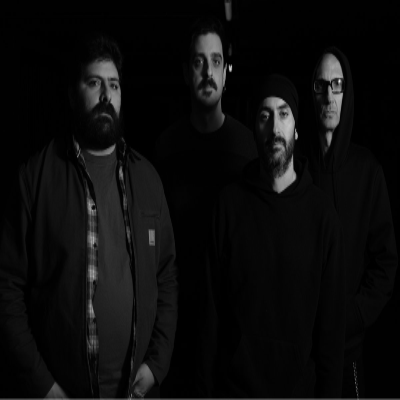
“The Grotesque Within,” the fourth full-length by La Spezia’s Oreyeon, is one of those records that arrive quietly and settle under your skin before you even realize what happened. Released on February 13th, 2026 via Heavy Psych Sounds Records, it is not merely a new chapter for the band — it is, arguably, their most uncompromising statement to date: a seven-track descent into existential dread, monolithic riffage, and Psychedelic shadow, all filtered through the literary horror of Thomas Ligotti.
We had the opportunity to review “The Grotesque Within” here on PRJ — and the album left a mark deep enough to demand a conversation. From the crushing opener “Echoes of Old Nightmares” to the bleak, slow-burning closer “Dead Puppet Eyes,” Oreyeon demonstrate a compositional maturity and a sonic identity that few bands in the European Heavy underground can match right now. The fact that this is also their first fully self-produced album makes it all the more remarkable.
We sat down with the band to talk origins, evolution, literary obsessions, studio craft, and what it means to build a world of Heavy Music in Italy in 2026.
Oreyeon was founded in 2014 in La Spezia, building on the experience of previous projects like Mexican Bud and Woodwall, and initially under the name Orion. Looking back at that founding moment — what was the original vision, and how much of it still survives today in your music?
The original idea came from Andrea and Peo, mostly as an excuse to just jam together for a bit. At first we wanted to play stoner rock, but when Matteo and Richard joined, it became clear pretty quickly that—even though we all had different ideas—we could come up with something really interesting. We still have that same drive to experiment and develop new ideas that we had in the beginning. The chemistry has always been there when we play together, but over time we’ve also built a really great friendship.
The name change from Orion to Oreyeon came alongside a clear sonic evolution. What triggered that shift, and does the new name carry a specific meaning or intention for the band?
We changed the name because it was already pretty overused in the metal scene—something we didn’t really think about when we first came up with it. We still wanted to keep the same pronunciation, so we just tweaked the spelling, even though that sometimes ends up confusing people a bit when they try to say it.
Your debut, “Builders of Cosmos” (2016), established you firmly in the Heavy Rock/Stoner space with a raw, monolithic approach. When you listen to it now, what do you recognize in that record — and what feels like it belongs to a different band entirely?
Builders of Cosmos is an album that, looking back, we’d probably enjoy even more if it had been produced and mastered differently… but hey, that’s part of the game, haha. The songs are definitely simpler and less arranged, but also more direct, with a real sense of urgency. It’s a very different record compared to who Oreyeon are today, but it still represents an important step in our journey. Unfortunately, all the issues we ran into during the recording process ended up affecting the final result—we were kind of in a rush to finish it after months of delays and general bad luck.
“Ode to Oblivion” (2019) marked a move toward more elaborate arrangements and richer vocal harmonies, while “Equations for the Useless” (2022) introduced a more Psychedelic and Progressive dimension, largely recorded live. How conscious was each of these evolutionary steps — and was there ever a risk of losing your identity in the process?
O.T.O. is a record we’re really proud of, also because it marked the beginning of our collaboration with HPS Records. After it came out, we started playing live a lot more, and it’s also the album through which a lot of people discovered us for the first time. Even though it’s more elaborate than the first one, the writing process was pretty much the same—we just focused more on the arrangements in the studio. With E.F.T.U., on the other hand, we tried to experiment a bit more with our prog/psych influences right from the writing stage. But then, during production, the pandemic forced us to wrap things up pretty quickly, dealing with restrictions and all that. In normal conditions, we probably would’ve been even happier with the final result. Overall, though, we’ve never really planned things too much or sat down to decide on a specific direction—we’ve always done everything pretty naturally, without overthinking it.
The Doom Sessions split with Lord Elephant in 2023 also included a cover of Slo Burn‘s “Wheel Fall.” Covering a John Garcia project is a very specific statement of allegiance — what does that track and that lineage mean to Oreyeon?
Kyuss, Slo Burn, and Unida were our first reference points—the bands that inspired us when we started the project. We chose an unreleased Slo Burn track specifically to give some recognition to a lesser-known song that we think is actually really solid.
Remarkably, Oreyeon has maintained the same lineup for over a decade — Pietro Virgilio on drums, Richard Silvaggio on bass and vocals, Andrea Ricci and Matteo Signanini on guitars. In a scene where lineup changes are constant, what’s the secret? And how does that stability translate into your creative process?
We all share the same approach to music, the same vision, and above all, the same passion. Before being four musicians, we’re four big music listeners. Our influences might be different, but they blend together and feed into each other. There’s no ego or power struggle within the band, in any aspect—especially when it comes to writing. We all contribute ideas, and sometimes it’s just a matter of choosing which ones to develop, but it always happens in a really natural way. At the core of it all, I think there’s a strong personal connection between us, and that’s what makes everything so much easier.
“The Grotesque Within” is described as your first truly self-produced album, recorded between Outside Inside Studio in Treviso and your own home studio. What was the decision behind taking full control of production this time — and how did working between two different environments shape the final sound?
This time we only recorded drums and bass at Outside Inside Studio because it has a room that’s really ideal for recording drums. Everything else, on the other hand, was recorded at his place, in his personal studio. Unlike O.T.O. and B.O.C., which were done in Matteo’s old studio, this time he also handled the mixing. We had more time to really focus on the production, and you can definitely hear it. From a songwriting perspective, we also approached things differently than in the past: nothing was left to chance. We paid close attention to the arrangements, and Matteo also worked on the transitions between tracks to help build the album’s overall dark, slightly grotesque narrative.
The album is deeply rooted in the literary world of Thomas Ligotti — the existential horror, the sense of reality unraveling, the uncanny bleeding into the everyday. How did you first encounter Ligotti‘s work, and how did his writing become the conceptual core of this record?
While rewatching the first season of True Detective, Richard became intrigued by the deeper philosophical ideas woven into the story. He soon discovered that parts of the series had been influenced by Thomas Ligotti’s work, particularly The Conspiracy Against the Human Race. In this book, Ligotti explores a stark and unsettling philosophy of pessimism, arguing that human consciousness is not a gift but a burden—one that traps individuals in a cycle of awareness, suffering, and illusion. He questions the value of existence itself, suggesting that life is driven more by blind, mechanical forces than by purpose or meaning, and that much of what people consider “reality” is sustained by comforting self-deceptions. After reading the book, Richard’s interest deepened. He went on to explore Ligotti’s biography and literary work more broadly, eventually drawing inspiration from the author’s bleak, introspective themes. He began adapting elements from Ligotti’s short stories into lyrics, channeling their haunting atmosphere and philosophical weight into his own creative expression.
“Echoes of Old Nightmares,” the album opener, is described as a return to your hardcore roots reshaped into something more atmospheric. It functions almost as a manifesto — fuzz-fueled aggression coexisting with haunting introspection. Can you walk us through the birth of that track, both musically and lyrically?
This track is a reworking of an old song from our very first album—we wanted to do justice to a good piece by giving it a darker interpretation.
“Nothing But Impurities” is split into two parts — essentially a two-movement suite within the album. What led you to structure it this way? Was this a compositional decision made in the writing phase, or did it emerge naturally in the studio?
It all came together pretty spontaneously in the rehearsal room, and by the time we recorded the track we already had a clear idea of how to connect the two parts. The sections feel like two sides of the same coin, with the second half spiraling downward into the abyss.
The title track “The Grotesque Within” sits at the center of the record, acting as its thematic and sonic fulcrum. What does the title mean to you personally — and how does the track itself embody the Ligotti-inspired concept?
The title track has always stood at the core of the entire album. We wanted it to embody the very essence of the word “grotesque,” not just lyrically but sonically—translating its meaning into something visceral and unsettling. It ended up being the most demanding piece to complete, largely because we were rarely satisfied with how it was taking shape, constantly reworking it until it felt right.The riffs move in a delicate tension between dissonance and melody, mirroring a fractured, almost schizophrenic sensibility—the kind that perceives beauty within decay, elegance within ruin. That contrast became the defining thread of the track, shaping its identity as something both disturbing and strangely compelling.
“Something Over There” is described by several listeners as the most Psychedelic and expansive piece on the record — some even hearing Pink Floyd-esque guitar textures alongside the crushing Doom foundation. Was that contrast intentional, and what were the sonic references or moods guiding you during its creation?
“Something Over There” was initially inspired by Godflesh, even though we tend to avoid drawing from bands within our own genre. During the writing process, we began layering in ideas influenced by various death metal acts, letting those textures reshape the track organically. The central riff was conceived to echo a relentless, industrial repetition—something hypnotic and unyielding, like a machine that never quite stops. As with all of our songs, we begin with a loose starting point and allow the piece to evolve without a fixed destination. There’s very little that’s consciously imposed. Instead, we follow the natural flow of the material, gradually compressing and merging riffs into heavier, monolithic tempos wherever they feel most at home.
The album closes with “Dead Puppet Eyes” — a track that begins with a measured psychedelic introduction before settling into a monolithic, deliberate groove. Without giving too much away, what is “Dead Puppet Eyes” about — and why did you choose it as the final statement of this record?
“Dead Puppet Eyes,” like the rest of the material, is a free interpretation of the short stories of Thomas Ligotti. One of the intentions behind the lyrics is to nudge listeners to recognize fragments and perhaps trace them back to the original story that inspired them.At its core, the song unfolds as a series of absurd, almost dreamlike situations set in a desolate, vacant town. That sense of absurdity reflects a broader idea running through the piece: existence itself as something imposed, unfolding without consent, detached from meaning. Musically, the track ended up closing the album—not by design at first, but because its weight and atmosphere naturally felt like the final point of impact, balancing the overall flow of the record.
Matteo Signanini handled the mixing at TSG Studio, while the mastering was entrusted to James Plotkin — a legendary figure in Experimental and Heavy music. How did Plotkin’s contribution shape the final sonic character of the record? Was there a clear brief you gave him, or did you let him interpret the material freely?
We had already worked with James in the past on Ode To Oblivion, and Matteo often collaborates with him on other productions. We know James’s style well, and when we sent him the first mixed tracks, he immediately understood the mood the master needed to aim for. So we trusted his expert hands, and we’re very satisfied with the result.
Self-producing an album involves wearing many hats simultaneously. What was the biggest challenge of that dual role, and are there things you would approach differently on a future self-produced record?
I’d say this experience, especially in terms of production, was a lot of fun and, above all, very satisfying. It was definitely a longer process, but precisely because of that, compared to our previous productions—where limited studio time didn’t really allow us to properly experiment with different arrangements or variations—it felt like we finally untied a knot and opened the door to a new way of approaching production. Overall, it was a fantastic experience, and we’ll definitely repeat it for the next project. Being able to sit calmly in Matteo’s studio and take all the time we needed to record everything without constantly watching the clock made a huge difference, and we believe the whole album benefits from it—it’s our most mature work, also thanks to this approach. Looking ahead, we already have many ideas on how to approach things, especially pre-production, which will become an integral part of the process.
Heavy Psych Sounds Records has been your home for several releases now. How has that relationship evolved over time, and what does the label bring to Oreyeon beyond distribution — artistically, strategically, in terms of community?
Our relationship with HPS has been great from the very beginning. They showed trust in us with Ode to Oblivion and have always followed with genuine interest the direction we’ve taken over time. We’ve also witnessed the label’s exponential growth, and it’s amazing to be surrounded by so many bands in the scene that we truly respect. The guys at the label are growing a lot and adapting to these modern times shaped by social media, which unfortunately everyone has to deal with. I say “unfortunately” because we’re not big fans of social networks—we’re more like old-school guys who grew up in the ’90s, going to concerts, hanging out in record stores, and reading print magazines. But nowadays, music doesn’t primarily travel through those channels anymore.
Live performance is a fundamental dimension of Oreyeon‘s identity. Can you share a live experience that marked you — a show, a tour, a festival that felt like a turning point — and how does “The Grotesque Within” translate to the stage? What can audiences expect when you perform this material live?
The new songs work really well live, and even though they’re quite layered in the studio, the wall of sound actually amplifies their impact. Our latest shows have been really intense, mainly because we can finally take these songs on the road after months of hard work—and the crowd reaction has been amazing. One show I remember especially well was at the Tube Cult Festival in Pescara: we played in a tiny, packed room, with no distance at all between us and the audience, at absolutely insane volume levels—a very raw, hardcore kind of situation.
The European Heavy underground is a rich and constantly evolving scene — from the Italian Doom and Psych landscape to the broader international Heavy Psych circuit. Where do you see Oreyeon within that ecosystem in 2026, and what are the live plans and next steps for the band in the months ahead?
We’ll definitely try to play as much as possible, both abroad and in Italy. We already have a few shows lined up for the fall that we’ll be announcing soon.
“The Grotesque Within” is the kind of record that rewards patience and punishes distraction. It is Heavy without being gratuitous, Psychedelic without losing its anchor, and conceptually cohesive in a way that few Heavy albums manage to be. Oreyeon have spent over a decade quietly building something substantial — album by album, riff by riff — and this fourth chapter feels like the moment when all the pieces finally lock into place with undeniable force.
We at PRJ have been following the band’s trajectory closely, and this conversation only deepens our admiration for what they are creating. “The Grotesque Within” is out now on Heavy Psych Sounds Records, available on limited vinyl editions, CD, and digital. Do yourself a favor: turn it up, let Ligotti‘s shadow fall across your room, and descend.
Purchase “The Grotesque Within” on Bandcamp: https://heavypsychsoundsrecords.bandcamp.com/album/oreyeon-the-grotesque-within
Read our Review of “The Grotesque Within” here: [Review] Oreyeon – The Grotesque Within