

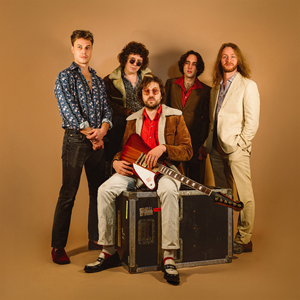
Brass Camel have spent the better part of a decade quietly and methodically building one of the most distinctive voices in contemporary Progressive Rock. The Canadian quartet — guitarist and vocalist Daniel Sveinson, bassist Curtis Arsenault, keyboardist Aubrey Ellefson, and drummer Wyatt Gilson — have now completed what they consider a defining trilogy with their self-titled third album, released April 15, 2026, co-produced by Kevin Comeau and mixed by Rush production legend Terry Brown. “Brass Camel” is the first record written entirely by the current lineup, and it shows: tighter, more lyrically dense, and more compositionally assured than anything theyhave put their name to before. We sat down with the band to talk origins, evolution, and the record that finally, in their own words, sounds like them.
Brass Camel has been described as reaching a fully formed identity with this third album. But where does the
story actually begin — how did the band come together, and what was the original musical vision?
This might be a rather long series of paragraphs, so here goes…the story begins back in 2017 I was 24 years old and had been performing in bands from the age of 10. I had spent years as a hired guitar player, playing with various original artists and cover bands but there came a time when I realised that wasn’t terribly fulfilling. A great friend of mine, who was the singer in a group I was in for many years, passed away and that really pushed me to start singing myself. At that time I recorded a solo album of what I called ‘prog-funk’ and worked on getting a band together. I had known Curtis for years but at the time he wasn’t itching to join a band – however he did attend that first solo show. We played our 50 minute headline set and the crowd wanted to hear more, but we were fully tapped out of material. All of a sudden we see Curtis barrel to the front of the stage and asks to jump on the bass. Without any planning or rehearsal, myself, Curtis and the drummer (Cole George) played all nine minutes of “La Villa Strangiato” and it seems that was enough to have Curtis onboard. He was on bass at the next show. The group operated as “Daniel James’ Brass Camel” for the next two years, going through a variety of incarnations – sometimes streamlined 4 piece, other times a 12-piece funky band with horns and backup singers and everything. We had a revolving door of different players coming and going and never quite settled on exactly “what we were” in those days. Towards the tail end of 2019 we had decided that operating as a five piece group would be the ideal way forward, and we dropped my name from the official band name, but we still didn’t have a solid lineup of committed players. It was Curtis, myself and a good friend of ours (Wes Brightman) on guitar but we were still relying on hired players to see the lineup through and as a result it was tough to get our feet off the ground. Cue the pandemic – a live music hiatus for everyone and a chance to think about how to move forward when normal life could resume. We didn’t see eachother much but I was doing a lot of writing (that would form the bulk of the first Brass Camel album Brass) and when it became possible to do so, we auditioned a number of drummers until we came across the talented and exuberant Wyatt Gilson. Once he joined, instantly we knew that things were different. We recorded the debut album within a few months of his joining, but still weren’t playing much live. Hard to get out and hit the road when you don’t have a keyboard player! Then in the span of a few months in late 2022 we brought our good friend Dylan Lammie (Wes Brightman had started a family and the touring musician’s life wasn’t going to work) aboard and met keyboardist Aubrey Ellefson on New Years’ Eve. With that we realised we could get out and play and that’s exactly what we did. We played three shows in 2022, then 45 in 2023 and almost 80 in 2024. At last we could get out and hit the road and we haven’t looked back since.
The current lineup has been together through “Camel” and now this record. How did the chemistry between the four of you develop, and at what point did you feel the band had genuinely found its collective voice?
I think there was a point on our 2024 tour where we noticed that, listening back to audience clips, we were sounding less like five guys up there who just happened to play music together and more like a band. When your stage-hours start to accumulate, you really learn how each member plays the instrument and it allows the whole unit to operate with a different sort of chemistry. We don’t play to a click or tracks or anything live so it’s very much a living, breathing thing onstage and music mind-melding doesn’t always happen overnight. I should mention as well (this will be address later on while talking about the new album’s recording process) that we are a five piece band. Dylan Lammie was absent for most of the recording process for this record as he had to take a break to deal with a family emergency – he we the one who implored us to go ahead and finish the record as we were on a tight timeline – but he’s very much still part of the band so it’s a five-person chemistry while playing live!
Your sound draws on a broad but very specific lineage — Progressive Rock, Heavy Rock, Funk, Art Rock — yet it never reads as pastiche. How conscious is that balance, and how did you arrive at it?
Personally speaking, I grew up wearing out VHS tapes of all sorts of classic artists. The Surrey (BC) public library system was great in that regard. As a 5 year old, with YouTube still a few years away, I was able to kickstart my music obsession and never looked back. I loved Rush and Zeppelin and Yes but also groups like Parliament and Sly Stone and Herbie Hancock. I never understood why there would be a mutual exclusivity between a band being proggy and a band being funky. A lot of jazz fusion groups toe that line (for instance Al di Meola’s Casino is a great example to me) well but oftentimes in rock it’s one or the other. For us it bleeds naturally into the music because we love both types of music. The writing has never felt forced, or like much of a conscious decision to make proggy music that’s also funky. It just sort of happens!
Which artists or records were formative in shaping the direction of Brass Camel — not necessarily as direct influences, but as reference points for what you were reaching toward?
My favourites are Little Feat, Genesis (Gabriel years mostly), Return to Forever, Jeff Beck, Parliament, Rush, 10cc, Yes, Benny Goodman’s sextet era, Stevie Wonder. Most of the compositional similarities one might hear in our music are coincidental, more of an inevitability as a result of influence rather than a decision to pursue that type of music. However from a mixing/production standpoint, I’d say the sound of Rush, Jeff Beck’s Blow by Blow, Gino Vanilli’s Brother to Brother and Al di Meola’s Casino were the reference points in mind for an ideal mix.
Looking back at the trajectory from your debut through “Camel” to this record, where do you hear the most significant shift — compositionally, sonically, or in terms of how the band operates in the studio?
“Camel” might be the most significant shift in that it’s the first record with Aubrey and Dylan on there. I played all the keyboards on Brass so were were still essentially operating as a trio at that moment. When we made the second album, each person had more of a defined role. That said, the third album was made with more purpose – we recorded the vast bulk of it, over 7 days split across two weeks with a few weekend shows in between), mid-tour which meant we had to get into the studio and play like we really meant it. We were excited to have this very fresh batch of songs and such a beautiful, pastoral place to record them; it was a very excited process.
You’ve described this album as the closing chapter of a loose trilogy, with the titles “Brass,” “Camel,” and “Brass Camel” forming a deliberate arc. Was that structure planned from the beginning, or did it become apparent as the project evolved?
The name Camel was suggested to us by a fan while playing in Toronto in August 2024. The album had already been recorded but we didn’t have the name yet. Initially we sort of laughed it off, but two things happened… firstly, the more we thought about the LP spines lined up in a record collection, the more we liked the idea. Secondly, we had thought for a while that the third album would likely be self-titled. I find a lot of the bands I love really “find their sound” by the third album so it could be appropriate to go that route for the album that possibly cements our sound. We pretty quickly decided that would be the way to go. I wrote “This is Goodbye” shortly after and I quite like how the first album starts with “First Contact” and this one concludes with “This is Goodbye”. It’s as if to say, “here’s your introduction to the band…anything that comes after will build upon this foundation.”
This is the first record built entirely from material conceived by the current lineup. What did that mean in practice — did the writing process feel fundamentally different from the previous albums?
I still did the bulk of the writing (excitingly for us, Aubrey and I have begun co-writing more and the first example of this is Everybody Loves a Scandal) but the writing process was informed by knowing how we all play together and what our collective strengths and weaknesses are.
Lyrically, this album is noticeably more ambitious — a dramatic narration of the Titan submersible disaster, the legend of the Jersey Devil, the question of AI and creative authorship. How did the decision to put lyrical content at the centre of the creative process come about, and how did it affect the music?
This could double as an answer to the previous question, if not a better one. The biggest different with the writing process here was a lyrics-first approach rather than a music-first approach as done in the past. There were a few examples of songs whose lyrics came first on our previous albums (King for a Day on Brass or Another Day on Camel, for example) but they usually started out as instrumentals with vocals being added later. I really struggled to find words while completing Camel and thought “this isn’t good enough – if we’re putting our lives on hold to pursue the prog-funk limelight then I’m we’ll simply need to be more productive”. So I hit the studio each and every day and tried to write a song a day. I’d choose a topic that interested me, or that I’d read about in the news, or that a bandmate suggested digging into, and just run with it. Before long I was having a blast with this process, and I was finding that once the lyrics were fleshed out the musical side of things just came along effortlessly. Having the words in place, sometimes with unconventional phrasing made it almost like a musical fill-in-the-blanks.
With that level of conceptual weight in the lyrics, how do you ensure the music and the words are genuinely working together rather than operating in parallel?
Whether they genuinely work together or not, that’s for the audience to decide! There were definitely times where tweaks would be made from the original demos but for the most part these arrangements came together very quickly and without too much overthinking. I was enjoying the writing and all over us were enjoying the arrangement tweaking and performance of the songs; there are times when we’re overly analytical and sweat the small stuff, but for this round of composition it just sort of happened.
Terry Brown mixing this record is not a minor footnote — this is someone whose work is embedded in the history of the genre. How did that collaboration come about, and what did he bring to the material that you couldn’t have arrived at on your own?
Terry and Kevin (Comeau) have worked together in the past and at some point in the process Kevin suggested we see whether Terry might be interested in working on the mix for this record. He was quite busy with Rush projects so there was a bit of back and forth before he could commit but eventually jumped on board and how cool to have such a legend – not to mention an absolute gentleman and impeccable humorist throughout the project – onboard! Our number one desire with the mix was to have more of an old-school, breathable mix than our first two records. I think Ben Kaplan did a great job at making the previous record sound like a killer modern pro production but there’s a certain amount of 21st century post-production that we weren’t able to get away from. We told Terry that we wanted to avoid pitch correction on the vocals, timing correction on the drums or other exceptions of a modern rock/prog mix and I knew Terry was the right guy when he said “good news – my job isn’t to fix it, it’s to mix it”.
The album was recorded at Chalet Studios in Uxbridge and co-produced by Kevin Comeau. How did the studio environment and the production relationship shape the final sound?
The studio environment was wonderful – I can’t count how many studios I’ve recorded in over the years and this was the first time tracking with natural light. It’s a beautiful, pastoral location and that really does create a great headspace. Although we were told we fired up the sauna too often. Sorry about the power bill, Chalet! Kevin was a calming presence in the control room, and a great sounding board for any spur-of-the-moment ideas we were having. He had some great suggestions for little tweaks or additions and we fully trusted him knowing that we both come of similar places of inspiration.
Are there specific moments on the record — a take, a session, an arrangement decision — that stand out as turning points or unexpected discoveries in the studio?
A couple stand out for me, maybe not so much turning points as memorable experiences – Last Call was tracked very quickly on day two. We’d be tracking for about 10 hours and had maybe 15 minutes left on the clock. We thought we’d get set up so we could tackle that one and Careful What You Wish For the next morning. Once we brought the session up on protools we challenged ourselves to get it done in one go. We took one pass to set the levels and then the second take (drums/guitar/bass beds) is the one you hear on the record. There’s a video of us recording it and Wyatt is beating the drums like they owe him money – his headphones start falling off and it’s a miracle they stayed on long enough to allow us to finish the take. On a personal level, I get a kick out of the Why Bother solo being a one-take which wasn’t even intended to be a proper kick at the can. There’s a video where we go right from doing harmonies on Scandal to giving the Why Bother solo a go and Kevin says “just give it a pass while I check our levels” and I played the solo as heard on the album right then. Asked if we should try a few more but we kept the warm up take!
“Catch Us If You Can” is the album’s most extended and structurally ambitious track. How was that piece built — did it develop organically or was the architecture mapped out from the start?
The bulk of this song was written in a single improvised demoing session, and the last 2 minutes or so (from where it get into the lower dynamic tremolo-picking part before it kicks back in for the conclusion of the mid section) were hashed out in the rehearsal space right before hitting the road for the Camel tour. For a long time we did a couple short bits of Gino Vanelli’s Brother to Brother and Rush’s La Villa Strangiato in our set, and we felt it was time to retire those bits for some new covers. I kind of thought, let’s see if we can cook up something that purposefully shreds harder than we have previously so that we don’t have to rely on a cover song to get that fix. Come to think of it, this is the only one on the record where the musical portion was completed before the lyrics.
“Careful What You Wish For” feels like the emotional centrepiece of the record. What is the story behind that track specifically?
I was reading about the folk tale of the Jersey/Leeds devil and thought it was horrifying, visceral imagery to think of a human baby transforming into a winged, wailing demon. It inspired the line “priest in the corner trembled and clutched his chest as this paragon of evil, reared of human flesh, confronted the indignities of infancy by rising to his feet” and
from there couldn’t stop until we had a demon song completed. Musically I wrote this one on a wurlitzer electric piano. One production decision that we chose on this one was to not use any crash cymbals during the main riff while recording the drum part. They were run through a flanger and dubbed in after which I like the texture of.
Cat Madden contributes vocals on “What Are You Going to Do” and Dylan Lammie plays Leslie guitar on several tracks. How did those collaborations come together, and what did they add to the finished record?
As mentioned earlier, Dylan is a member of Brass Camel but was absent from the sessions due to a family emergency. He had recorded a few parts at the Chalet and planned to complete his parts when we returned home from the tour be life intervened. He suggested that we continue steamrolling ahead given the tight timeline to get things off to Terry for mix so we obliged and finished the record the following week. Cat Madden is possibly the greatest undiscovered talent I know. She had folders and folders of incredible, unique songs just itching to be heard at Royal Albert Hall. And she absolutely wails. We are great friends and thought that having her on that track would add something special to it so we gave her a ring out of the blue and asked if she could come to the studio right away. She show up an hour later and just knocked it out of the park.
You have live dates planned in support of the album, including a European run later this year. How do you approach translating this material to the stage — particularly the more compositionally layered tracks?
Because we don’t play with tracks, and don’t plan to, we do our best to come up with a live arrangement that makes the most of our five man live-band arsenal. There’s a lot more than one guitar on Achille’s Last Stand but Zep still rocked it live and that’s kind of where we are at – we all do our best to pull our weight onstage and sometimes we’ll go a slightly
heavier, more bombastic approach than what’s on record.
What have been the defining live experiences for Brass Camel so far — the shows or tours that have shaped how you perform and how you think about the relationship between the studio and the stage?
To me the most inspiring live moments have been the first shows in Montreal and Toronto (4000 kilometres from our home in Vancouver, BC) where we arrived and people knew the songs and were singing or air drumming along. Given that we had rather low online metrics it feels really special that there is a growing group of die hards out there that really care about what we’re doing. It’s pretty wild to us and incredibly energising. The industry is so tough and makes it easy to be jaded so when we experience moments like that, it really amps you up and make you want to work harder than ever and giving it our best shot. The stage and stage are inextricably tied together, of course, but both inspire in different ways. In the studio it’s a joy to work on creating textures and feel more like you’re sonically painting on a canvas. Onstage you get to let it all out and feel the ping-pong of energy back and forth from the crowd. In a perfect world, I’d be on a stage for 200 days of the year and in the studio for 100 days which would leave a nice 65 days to get out and ride my Ducati.
The Progressive Rock scene in 2026 is broader and more internationally dispersed than at any point in its history. Where do you see Brass Camel within that landscape, and where do you see the genre itself heading?
That’s a tough one. While I think we’re uncompromising with our music in that we do make whatever the hell we want to, the proggy-but-funky nature can land us in a middle zone where the die-hard prog-with-a-capital-P fans find us a little too straightforward and yet the average modern rock fan finds us all sorts of weird. I think the only way forward is to keep being ourselves and not think too much about the genre labels, people will make up their mind about what we are and aren’t, and the only thing I can promise is that we will make music with few guardrails. That could mean a sidelong suite on the next album or it could mean quite the opposite, we’ll find out in good time! Where the genre is heading? Not sure – I don’t listen to much prog outside of the classic 70s output. I try and try to get into modern prog and there’s loads of terrifically impressive stuff but I find 95% of is either too polished, too metal-adjacent or sounds like video-game music. For me it’s the sonic aesthetic of classic era Yes/Genesis/King Crimson/Rush that makes me love progressive rock. Funnily when a band plays in that style now (not to throw stones from a glass house, we’re surely in this boat too at times) it’s hardly progressing rock, so I sort of see prog as two things; there’s truly progressive rock and then there’s prog rock: the genre. Now the question was slightly rephrased to where I’d like to see prog headed, I think that authenticity is the number one thing I crave. Particularly in this era of AI-music, which has barely reared it’s ugly head, humans demonstrating their humanity has never been more important to me. Give me real vocal takes and live-off-floor-beds and shows without backing tracks and midi-synced light shows. Give me good old human progand I’ll be happy.
Brass Camel have earned this moment. “Brass Camel” is not a record that announces a potential — it is one that delivers on it, fully and without qualification. With Terry Brown‘s mix giving the album the analogue weight it deserves and a band operating with a cohesion that only years of shared stages and studio sessions can produce, this is the record that closes the trilogy and opens the next chapter. The live shows this year — and the European run to follow — will be worth every effort to attend.
Purchase “Brass Camel” on Bandcamp: https://brasscamelband.bandcamp.com/album/brass-camel
Read our Review of the album here: [Review] Brass Camel – Brass Camel
[…] Brass Camel – “Catch Us If You Can”: Canadian quartet Brass Camel — guitarist and vocalist Daniel Sveinson, bassist Curtis Arsenault, keyboardist Aubrey Ellefson, and drummer Wyatt Gilson — have completed what they consider a defining trilogy with their self-titled third album (April 15, 2026), co-produced with Kevin Comeau and mixed by Rush production legend Terry Brown. The first record written entirely by the current lineup: tighter, more lyrically dense, and more compositionally assured than ever. We sat down with them for an exclusive in-depth conversation. [Read More] […]