

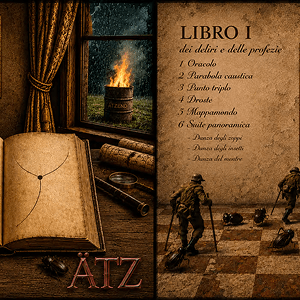
ÄTZ is the independent solo project of Giuseppe Atzori, a multi-instrumentalist based in Cagliari, Sardinia. The name “Libri” (Books) signals a broader architectural ambition: a series of volumes that gather visions, observations, and sonic journeys within a single, continuously unfolding narrative universe. “LIBRO I: dei deliri e delle profezie” is the inaugural installment, and it lands squarely in the tradition of contemporary Italian Progressive Rock while carving out a distinctly personal register. The record carries pronounced Post-Rock textures, stretches of meticulously constructed instrumental writing, and a singer-songwriter sensibility that grounds its more expansive passages. What distinguishes the project is not merely its allegiance to the classic era but the manner in which Atzori re-contextualises those sonic and conceptual tools within a modern, introspective framework, one that feels earned rather than nostalgic. Two further details merit attention before the listening begins. First, the album is entirely self-produced. Atzori composed, arranged, recorded, mixed, and mastered every element in his home studio across 2024 and 2025, laying down electric and acoustic guitars, bass, keyboards, vocals, and all virtual-instrument programming himself. Second, the artwork, generated through AI tools and subsequently selected, edited, and shaped by Atzori, lends the package a graphic identity that is unmistakably contemporary yet deliberately recalls the typographic and visual idioms of the Prog canon. It is a small but telling choice, one that frames the music as both inheritance and reinvention. An imposing opening statement that sets the album’s stylistic compass from the first bars, “Oracolo.” The piece moves through articulated, dynamically shifting Progressive structures over which Atzori layers a lyric that reads as a pointed critique of the instant-information age. The text addresses a hypothetical digital Oracle, a modern divinity acclaimed by an eager crowd chanting “Spettacolo! Miracolo!” to which we surrender in order to justify what the lyric calls “comfortable conspiracy-theorising” and the armchair epistemologies of the keyboard. The interwoven musical arrangement underscores the gulf between the illusion of revelation and the superficiality of copy-and-paste thought, untethered from any scientific or historical rigour. It is a demanding opening: eight-and-a-half minutes that refuse to announce themselves gently. Riding the momentum of the first track, “Parabola Caustica” pushes beyond seven minutes into more intricate, Avant-Prog territory in its opening section. The musical flow traces a genuine inner metamorphosis, almost chemical in its pacing. The lyrics describe an urgent flight “Evaporato all’aria / Sono scappato in fretta” and a visceral process of purication, while the composition mirrors skin that opens and a substance that corrodes down to the bone: “Lo scheletro nell’armadio che si assottiglia.” The trajectory carries the listener toward a moment of neutralisation and subsequent re-dissolution back into the air, unfolding across elaborate guitar and keyboard patterns underpinned by an articulate, programmed rhythmic bed. The vocal delivery here is notably warm and intimate, bending to the piece’s atmosphere rather than standing above it, and it sits comfortably within the harmonic currents the instrumentation generates. A fully instrumental five-minute passage that functions as an alchemical hinge at the centre of the album’s first block. The title, “Punto Triplo,” invokes the thermodynamic triple point, the precise condition under which solid, liquid, and gaseous states coexist in perfect equilibrium, and the composition honours that reference through a balanced, almost dialectical dialogue between guitars and keyboards. It serves as a narrative breath before the subsequent material, yet it is far from passive: the melodic and solo interplay between the two instrument families, coupled with well-constructed tempo shifts, produces a Camel-like intensity in which technical passages interlock with genuine lyricism. A compact, precisely engineered interlude. A near-ten-minute epic, “Droste,” inspired by the Drostefeld effect of infinite visual recursiveness, the track unfolds through a Progressive structure that accumulates in successive layers, mirroring the alienation and automated conformity laid bare in the text: “Quasi Uguale Replica / Mimica Identico Robotico.” The lyrics dissect the artificial filter of modernity, from “autoscatti colorati sugli sfondi disegnati” to the frozen surrogates offered to those who have lost the capacity to remember autonomously. The composition is tightly built, its tension rising in stages, with the vocal line elevating the material as the intricate musical architecture evolves in tandem with the dense lyrical content. Atzori‘s compositional and performing technique reaches, in this writer’s considered view, one of the album’s stylistic summits here. The instrumental passages that carry the piece forward, solo inserts, guitar-and-keyboard interlacing, produce a blend that threads technical precision with a classic Progressive sensibility without ever tipping into either extreme. A track of enveloping atmospheres and continuous sonic motion, “Mappamondo” reveals a more acoustic register in Atzori’s palette. The lyric confronts the mirage of civilisation, a stone rolling, swept along by a liquid horde and a generalised mediocrity. The Mappamondo of the title illuminates and displays its own diversity in a grotesque, harlequin-like fashion, masking what the text calls a “geographical lottery” and a hysterical mass. Musically, the piece evokes a nostalgia for a past in which light and colour expressed themselves timidly but freely. Though predominantly acoustic in texture, it develops elaborate patterns that straddle Progressive and Avant-Garde/Experimental territory, with the vocal weaving through in a manner that carries the listener toward the album’s final epic with a distinctly late-Sixties Acid-Folk and Experimental aftertaste. The album’s true monolith and conceptual fulcrum, “Suite Panoramica.” Over twenty-five minutes, divided into three movements, this is where “LIBRO I” stakes its fullest claim. “i. Danza degli zoppi” is an instrumental opening that introduces the irregular, lopsided rhythmic figures around which the entire suite revolves. The phrasing is deliberately off-kilter; the groove is there, but it stutters, leans, refuses symmetry. It is a figure of gait more than a beat, and it establishes the suite’s physical vocabulary. “ii. Danza degli insetti” where the voice enters, guiding the listener into a circular, obsessive path. The lyrics depict an humanity moving in single file along curved lines, mistaking the bars of its own enclosure for the only walkable road: “Lungo la linea curva / Al punto di partenza / Tu vedi una prigione / Ma le sbarre sono le mie strade.” The repetition is structural as much as thematic; the music circles without quite closing, the way a process does. “iii. Danza del mentre“is the concluding movement drives the composition toward its expressive and conceptual climax. Between fragments of a dissolving society and the liquid crystals of screens, the music presses the rhythm forward while the text watches the collective stumble and implode: “Tocca lo schermo e vedrai / Il ritmo seguirai / Mentre si zoppica / Mentre si imploderà.” The suite seals with a sustained charge of emotional and intellectual tension that, given its duration, feels less like an ending than like a held breath released at the last possible moment. “LIBRO I: dei deliri e delle profezie” is an ambitious, densely layered work that asks a great deal of its listener and, crucially, does not soften the demand. What is most striking is the degree to which Giuseppe Atzori has carried the full weight of this concept, composition, arrangement, performance, production, entirely on his own, within a home studio, across two years of work. The result is a record that slots naturally into the Italian Progressive Rock tradition while speaking in a personal, contemporary idiom. It is a debut that reads less like a starting point and more like the first chapter of a book already well in hand — and one that rewards repeated, attentive listening far more than a casual first pass would suggest.
Tracklist
01. Oracolo (08:36)
02. Parabola Caustica (07:06)
03. Punto Triplo (05:04)
04. Droste (09:54)
05. Mappamondo (06:12)
06. Suite Panoramica (25:14)
Lineup
ÄTZ (Giuseppe Atzori) / Electric & Acoustic Guitars, Bass, Keyboards, Vocals, Virtual Instruments, Programming