

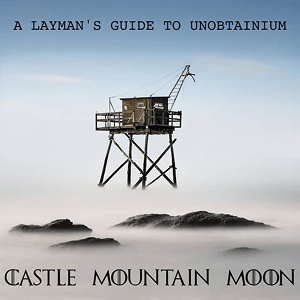
There is a particular kind of alchemy in Progressive Rock that occurs when discipline meets narrative ambition, and Castle Mountain Moon have refined it to a point that distinguishes them within the current European scene. Hailing from Cologne, the duo pairs Ropp Köhler (keyboards) with Dirk Krause (vocals, guitars, bass), a pairing whose origins are as unusual as the music they produce: two software engineers who, in their own words, traded compiled code for composed melody. The result is a brand of Symphonic, story-driven progressive rock that never sacrifices architectural rigor for accessibility, nor vice versa. Following the well-received critical response to their 2024 debut “Six Tales of Perception,” an album that examined the architecture of perception itself, the pair return on September 04, 2026 with a second studio effort that shifts its lens decisively. Where the debut interrogated how we see, “A Layman’s Guide to Unobtainium” concerns what we cannot hold. The eleven tracks are threaded together by the motif of maps—some faithful guides, others deliberate fictions—all charted in pursuit of the Unobtainium, that element defined by its own absence. As Krause articulates the premise: “We wrote about something that, by definition, only exists when you don’t have it. And yet we keep chasing it—so someone had to write a beginner’s manual and hide it inside the music, right in front of us.” With drums supplied by guest Gerry Wassong, the duo has constructed a record that balances extended Symphonic passages with tighter Neo-Prog momentum, all anchored by a lyrical concept that never tips into didacticism. It is, in the most literal sense, a manual for the layman. The title-track functions as an audible instruction manual, and it sets the tonal contract for everything that follows. An interplay of guitars and keyboards establishes a suspended, quasi-Symphonic atmosphere before the vocal enters with an almost conspiratorial warmth, inviting the listener into the manual and promising to reveal the secrets of how to drill, extract, and distill happiness without shedding a single tear. The music moves between Symphonic Prog textures and Neo-Prog momentum, with Krause‘s vocal carrying the narrative over a rhythmic foundation that—thanks to Wazzong‘s presence—permits intriguing metric shifts. It is a track that feels both invitation and warning: the thing you seek may dissolve the instant you name it. The momentum tightens. “Real?” channels a more modern, Crossover-tinged Neo-Prog pulse, and the lyrical subject shifts to the alienation of urban routine: overheard conversations among strangers, men in tie and jacket, the absurd feed of radio news, the creeping sense that time is slipping through one’s fingers. The refrain “Is this really real?” distills that urban estrangement into a single, effective question. Köhler‘s synth melodies intertwine with harder, leathered guitar riffs, the vocal growing more incisive as the arrangement opens into Symphonic swells that provide counterweight to the rhythmic drive. It is a well-honed compromise between the past and the present. The first of the album’s two dedicated map-movements, “Maps Pt.1.” The music flows in an enveloping, almost liquid register, mirroring a lyric that follows a river winding through mist toward a road that leads to forgotten places. Instrumental threads carry the listener into deep caves and along paths in constant transformation. The tone here is exploratory, the arrangements open-ended, inviting the ear to orient itself without the certainty of a fixed destination. “Valley of the Deep” is the album’s central suite and its most unambiguously Classic Prog statement. Across ten minutes, the track builds a hypnotic, conspiratorial atmosphere. The lyric describes a solitary march through desert “eight miles behind me, seven still to go” while, beneath the silence, beneath the surface, something begins to move. The dramatic tension is sustained through long instrumental passages and evolving vocal sections that trace the full breadth of the band’s palette: moments with a distinctly Rush-inspired drive, pastoral Symphonic swells that recall Genesis at their most expansive, and passages of pure Neo-Prog reflection. All of it passes through the duo’s unmistakable personal filter. It is, without qualification, one of the album’s peaks. A reprise and development of the suite’s conceptual thread, “Maps Pt.2.” Here the music turns more reflective and epically scaled, underpinning a lyric that confronts the value of illusion: when reality disappoints, one chooses to “pretend the map is real” in order to fill the void and keep hope alive. The piece opens slowly, Krause‘s warm, expressive vocal set against piano and a enveloping, close-miked sound. Intensity builds over the minutes as solid guitar riffs enter, and the arrangement crescendos into full Symphonic Prog territory, rich keyboard tapestries, a rhythmic section that multiplies its tempo changes and accelerations, vocal and instrumental passages trading places, Symphonic openings that develop and restate the track’s central theme. “Sadness” is a long, emotionally direct movement built around melancholic tonality. The lyric moves through rain on the road, fog in the mind, grief met by dancing or laughter. Despite a persistent sense of isolation within a crowd, the track resolves into an intimate resilience conveyed through words spoken, not sung, in the quiet. More enveloping and personal in register than its predecessors, Sadness nonetheless retains a strong Progressive underpinning, rich guitar-keyboard interplay, an elaborately patterned rhythm section, and a vocal interpretation that remains the track’s gravitational centre. A vital breathing space, “Before My Eyes.” The track foregrounds the instrumental dialogue between Köhler‘s synthesizers and Krause‘s guitar textures, functioning as a sonic bridge into the second half of the record. Its sensibility draws on the Melodic sensibility of early-’70s Prog, and one hears an echo of PFM in their most approachable, Melodic period. It is a compact, well-judged pivot that reminds the listener how much expressive economy the duo can muster. A brilliant, bitter track, “Exit Right,” that lays bare the fragility of human programming. The imagery is precise and unsentimental: a spilled coffee, a missed train, a tie that cuts too tight, code with a bug, star maps falling out of alignment. The narrative follows a “king for a day” who elects to abdicate. Musically, the track builds a carefully constructed interplay between delicate vocal passages and more massive, Heavy-Prog-adjacent openings, before unfolding into synth-led instrumental threads. A steady intensifying crescendo carries the listener through metric shifts and alternating sung and instrumental sections from start to finish. The album’s second extended statement, “Scene of a Crime,” and perhaps its darkest. An intimate, dramatic narrative set in a house marked by fracture lines, portraits with frightened eyes, a children’s room that has gone silent. The musical climax detonates at the moment the lyric reveals that once the silences and the lies are exhausted, the world surrounding the protagonist is revealed to be the scene of a crime. Guitar riffs and synthesizer lead the argument in a continuous dialogue, underpinned by a solid rhythmic section that alternates with Symphonic passages steeped in gloom created by the keyboards. The weight of the track is considerable, and it does not release its grip easily. “Dreamers” ias an intense, empathic ballad. The music supports a lyric addressed to those whose dreams have shattered and whose life-threads have frayed. The central message is one of mending and of faith: “I believe in dreamers.” The rhythm and melodies soften, become more accessible; the vocal leans into Melodic warmth. It is a gentle, deliberate hand guiding the listener toward the album’s close. A brief, deliberate coda, “Reprise,” restates the album’s thematic material in miniature, closing the conceptual circle and leaving the listener with the sense of an operation completed—a manual read, one final time, from beginning to end. “A Layman’s Guide to Unobtainium” confirms the compositional maturity the Köhler/Krause duo demonstrated on “Six Tales of Perception,” and it does so without repeating itself. The equilibrium between Symphonic/Neo-Prog complexity and structural listenability is more assured here, and the lyrical concept, deep, elegantly sustained, never tipping into the merely clever, gives the eleven tracks a coherence that rewards repeated, attentive listening.We would encourage our readers to sit down with this manual, as one would with any text worth absorbing slowly. It is a record recommended in particular to listeners whose affections lie with European melodistic Progressive Rock and Neo-Prog, with an ear for both the long-form architectural statements and the more immediately accessible moments. There is a personal signature here that the broader Prog ecosystem will recognise as both rooted and forward-looking, and the Unobtainium, for what it is worth, is hiding in plain sight.
Tracklist
01. A Layman’s Guide to Unobtainium (05:02)
02. Real? (04:58)
03. Maps Pt.1 (05:58)
04. Valley of the Deep (10:00)
05. Maps Pt.2 (06:31)
06. Sadness (07:20)
07. Before My Eyes (04:28)
08. Exit Right (04:58)
09. Scene of a Crime (08:23)
10. Dreamers (05:25)
11. Reprise (01:43)
Lineup
Dirk Krause / Vocals, Guitars, Bass
Ropp Köhler / Keyboards, Production
Gerry Wassong / Drums (Guest)
Read our Review of their previous album here: [Review] Castle Mountain Moon – Six Tales Of Perception