

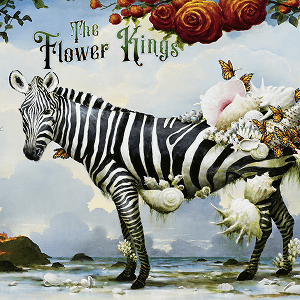
More than three decades after their inception in Sweden, The Flower Kings, long regarded as the architects of Scandinavian Progressive Rock, return with “HOPE,” their eighteenth studio album, released on October 23, 2026 via InsideOut Music. Positioned as the ideal twin to the preceding “LOVE” (2025), the new record diverges in a telling way: where its predecessor sought a different synthesis within a more contained format, “HOPE” raises the register decisively, granting itself the full spatial and temporal latitude its architecture demands. The band stakes a bold claim for the return of the side-long epic, deploying two monumental compositions of eighteen and nearly thirty minutes across the tracklist. In 2026, to compose and perform at that scale with genuine freshness, without surrendering to the gravity of retrospective pastiche or nostalgic self-pastiche, remains the distinguishing signature of a living legend. As Roine Stolt has stated, the group has reached a point in its artistic trajectory where external commercial calculus no longer governs decisions. The aim is singular: to build a grand sonic adventure that the band itself finds compelling. That conviction is audible from the first bar. The production benefits from a refined, immersive audio treatment, enhanced, for the first time in the band’s catalogue, by Dolby Atmos and 5.1 Surround Sound mixes engineered by Rich Mouser. The visual identity is carried by cover artwork by Kevin Sloan, a carefully realised design whose graphic weight gives the record a striking physical presence. The album opens with an ambition that immediately signals a compositional sensibility sharper, more angular, and technically adventurous than the band’s recent output, “World Spinning – The Final Curtain.” Composed by keyboardist Lalle Larsson, with lyrics penned jointly by Hasse Fröberg and Roine Stolt, the suite unfolds across five conceptually linked sections. Larsson commands the keyboard foreground with a virtuosism that never overwhelms: vintage Mellotron washes give way to Hammond organ swells, which in turn yield to refined piano passages carrying a distinctly classical colour. The interplay between Roine Stolt‘s six- and twelve-string guitars (electric and acoustic) and Fröberg‘s lead work favours single-note phrasing in the lineage of Howe and May over simple chordal strumming, a choice that lends the harmonic texture an almost orchestral clarity. In the rhythm section, Michael Stolt‘s bass delivers a biting, growling tone (aided by his Moog bass) that recalls Chris Squire‘s low-end presence, while Mirko DeMaio layers grooves rich with Jazz-Fusion inflection. By the time the arrangement reaches “Pt. 4 & 5,” the instrumental interplay peaks at a level of execution that evokes, not without reason, a hypothetical jam session between Yes and Genesis at the height of their collective powers. The vocal lines, shared between Fröberg and Stolt, are warm and expressive, alternating with the elaborate musical architecture in a balance that showcases the band’s command of both classical and contemporary Progressive idioms. The solo passages elevate the piece further, revealing a chemistry among the members whose technical facility is always in service of a collective sound rather than individual display. Lyrically, the text grapples with a world in turbulent transformation, an existential evolution, anchored to the evocative title phrase, “World Spinning – The Final Curtain.” The result is a demonstration, sustained across nearly nineteen minutes, that The Flower Kings can still stretch a composition to epic duration without diluting its narrative arc or instrumental cohesion. Selected as the album’s lead single and accompanied by an official music video, “In a World of Fools” features guest vocalist Jannica Lund, whose voice weaves through the harmonies of Fröberg and Stolt. Here The Flower Kings trade grandeur for concision: the writing is tighter, more rhythmic, more directly hook-driven. DeMaio‘s drums drive with a technically assured groove that underpins the arrangement, while the guitars deliver compact riffs punctuated by incisive solo passages. Thematically, the song is a pointed, contemporaneous reflection on a society marked by division, the erosion of empathy, and collective madness. Yet it does not dwell in despair, it functions as a lyrical counterpoint, offering compassion and empathy as the singular viable path toward rekindling genuine human connection. In the broader context of the album, it serves as a vital breathing space between the two suites, a concentrated distillation of the record’s moral core. The album’s shortest track, “Mars & Minerva” is predominantly instrumental. It begins in a subdued, almost Atmospheric register, allowing the dense interplay of guitar and keyboard textures to breathe over a solid yet intricately articulated rhythm section. The Melodic development is unhurried, the solo insertions highlighting the interplay between the two lead instruments with a distinctly classical-Progressive sensibility. However, the tension escalates markedly in the final quarter of the track, where the band deploys complex, sophisticated chord changes and a brilliant synthesizer solo from Larsson that propels the piece to a dramatic close. Titled after the Roman deities of war (Mars) and wisdom/strategy (Minerva), the track operates as an emotional and instrumental prelude to the suite that follows, introducing the dynamics of conflict and intellect that will dominate the album’s latter half. “The Gods of Rome” is the album’s beating heart. A seven-part suite exceeding twenty-eight minutes in duration, “The Gods of Rome” was conceived from orchestral ideas that Roine Stolt had been developing for over a decade, at one point evaluated for the Anderson & Stolt project, before being entirely re-arranged, as a collective effort, for The Flower Kings‘ five-piece formation. The recording benefits from the essential presence of Aliaksandr Yasinski on harmonica/accordion and Juraj Stieranka on solo violin, instruments that lend the suite a Cinematic, acoustic dimension and a kind of storybook warmth that no amount of electronic instrumentation could replicate. In the physical editions (CD/LP), the suite unfolds as a single continuous musical flow, free of artificial breaks, in the digital version, it is segmented into its seven sections. Compositional details throughout the suite are arresting: unusual Melodic intervals, allusions to Middle Eastern musical modes, and piano passages that carry the weight of Rachmaninoff‘s late Romanticism. The interplay between sung and instrumental sections is fluid, each reinforcing the other across the nearly thirty-minute span, evolving the central theme without ever repeating it. “Pt. 2,” released as the album’s second single with an accompanying video, represents one of the most energetic and heavy moments in the band’s recent discography – powerful guitar riffs set against a backdrop of Symphonic grandeur. The suite concludes with “Pt. 7,” which dissolves in a dreamlike, evocative fashion, leaving behind that almost magical residue characteristic of the great ’70s Prog classics and of The Flower Kings‘ own historical productions. Stolt‘s lyrical framework is explicit: ancient Rome serves as a clear metaphor for the power struggles, unbridled ambition, and imperialism that characterise modern politics. In his words: “Every nation and every leader/president want to shine and be remembered as the greatest – expansive dreams often tend to implode however.” What the suite ultimately demonstrates is the band’s ability to exploit the full span of its duration to evolve a single thematic idea, producing a Progressive Rock sound that contains within it every refined nuance of their identity, complex and Symphonic where the architecture demands, intimate and vocal where the narrative requires, without ever losing the distinctive touch that has placed them among the cornerstone acts of the European modern Progressive movement. “HOPE” is not merely the worthy continuation of “LOVE,” it is that album’s maximal, monumental expression. By restoring the primacy of the twenty-to-thirty-minute suite to their compositional vocabulary, The Flower Kings display a coherence and clarity of inspiration that listeners have not encountered with such force since the Banks of Eden era. Thirty-seven years after Stolt declared: “This is the band I will be in for the rest of my days,” to release an album of this scope and conviction in 2026 is irrefutable evidence of giants at work. “HOPE” is exhilarating, organic, magnificent. It confirms that Scandinavian Symphonic Progressive Rock is not a preserved artefact but a living, evolving art form, and that in The Flower Kings it retains one of its most vital and consequential voices in the modern musical landscape.
Tracklist
01.World Spinning – The Final Curtain (18:45)
02.In a World of Fools (5:35)
03.Mars & Minerva (4:40)
04.The Gods Of Rome (28:15)
Lineup
Mirko DeMaio / Drums & Percussion
Hasse Fröberg / Vocals, Electric & Acoustic Guitars
Lalle Larsson / Piano & Electric Keyboards
Michael Stolt / Bass Guitar, Vocals & Moog Bass
Roine Stolt / Vocals, Electric 6 and 12-string Acoustic Guitars, Additional Keyboards & Percussion