

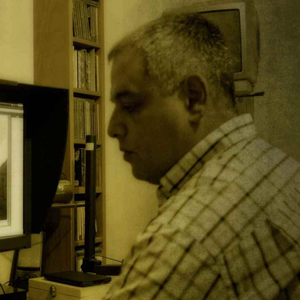
Palestinian-born artist Hisham Zreiq, based in Germany since 2001, is widely known for his multidisciplinary artistic path spanning visual art, film and, more recently, music. His musical work emerged as a powerful extension of his storytelling language, transforming deeply emotional narratives into intimate and often heartbreaking compositions.
Through a series of singles released on Bandcamp — including “I Feel Helpless,” “I Am Afraid, Mother” “Fighting the Sadness,” “I Miss You Mother,” “Children’s Voices Of Palestine,” and other pieces exploring loss, fear and hope — Zreiq approaches music as a direct emotional testimony, often told from the perspective of children affected by war.
His compositions move in a delicate space between storytelling, minimal arrangement and powerful lyrical imagery, frequently addressing the human consequences of conflict and displacement. In this interview we explore the origins of his musical journey, the relationship between his film work and his compositions, and the meaning behind his
recent singles.
Your artistic journey spans visual art, filmmaking and now music. Can you tell us how your creative path began and what first drew you toward artistic expression?
My artistic journey began in childhood; I started drawing at a very early age. I have always felt a need to express myself through art, which I currently do using digital visual art, film, animation, poetry, and music. My drawings were very similar in style to my digital visual art. In fact, my first digital artwork was a colorful recreation of a drawing I did that same year. Between traditional drawing and digital art, however, there were two crucial milestones. Poetry was the first. After finishing school, I began writing poems—though I don’t recall the exact year, as I didn’t document my work back then. Later, I integrated that poetry from the 90s into my digital art and films. The second milestone was animation. In 1990, I co-founded a computer animation company with friends. We created animations for local commercials during an era when the medium was still in its infancy; even in Hollywood, most animation was still hand-drawn. This phase was vital to my career; after the company closed, I began using that same animation software to create single frames, which marked the true beginning of my work as a digital artist.
You began creating visual art in the 1990s and later moved into filmmaking before starting to release music more recently. What motivated you to expand your artistic language into music?
I have always loved music. In my childhood, I listened to Arabic and classical music, but when I turned 14, I was exposed to western pop music, heavy metal, and 80s progressive rock—bands like Yes, Marillion, and Genesis. Later, I discovered the world of 70s progressive rock. In the early 90s, some friends and I tried to start a band; we even wrote a song based on one of my poems. Music was always in my blood, but it needed a trigger. That trigger was the difficulty and high cost of licensing music for my films. For my short film, Just Another Day, I was unable to publish it outside of film festivals due to copyright limitations imposed by the record labels. To solve this, I decided to compose my own music. I discovered that I loved the process, and that was just the beginning. When the genocide in Gaza began, I felt an even deeper need to express myself. This moved me to start writing and composing songs as a way to share that experience.
As a multidisciplinary artist, do you perceive music as a continuation of your Cinematic storytelling, or does it represent a completely different creative space for you?
I would say yes, it is. My cinematic storytelling in both my short animation Don’t Cry and my short films are a continuation of my digital art storytelling; they are moving artworks with dialogue, background sounds, and sometimes music. All my creations have the same spirit and are full of a kind of symbolism and have a message to say. With my music published under the name Goddess Asherah, I try to express feelings with the music; with the music I created using my name, I am trying to send a message, exactly like with my art and films—even the creation process is similar.
Growing up with a Palestinian cultural background and later moving to Germany, how have these different environments influenced your artistic perspective?
No, not really; what changed is my perspective. I was inside the conflict back home, and moving to Germany made me see the conflict from the outside, but this is not connected to the culture. There is something important to know about Palestine: Palestine is a multi-cultural environment. We have a lot of religions in Palestine—Christianity (all denominations), Islam, Druze, Bahai, Ahmadiyya, and Samaritans—and in Israel, you can add Judaism. Besides, there are many ethnicities, like Arabs, Armenians, and Circassians. And visitors residing in Palestine from Christian countries, like Europe and the USA, add to all of this Jewish people with all their ethnicities. So, in short, if you live in Palestine, you are familiar with many cultures and religions.
Your songs often carry strong emotional and narrative elements. Which musical traditions or artists have influenced the way you approach composition?
Hard to say; one of my biggest music heroes is Ludwig van Beethoven. I have listened to Beethoven’s music since an early age and read his biography at the age of 10. But I grew up in an Arabic environment, and this has some influence on me. Later (in the early 1990s), I started listening to progressive rock, but I listened to a lot of music besides that, like heavy metal and Indian music. So I really don’t know—probably all of it—but for sure, bands and musicians like Van der Graaf Generator, Peter Hammill, King Crimson, Rush, 70s Genesis, and even Nik Kershaw (from the music I heard in the 80s) have a strong influence on my music.
Your music frequently focuses on minimal yet expressive arrangements. How do you approach instrumentation when composing such emotionally charged material?
It depends on the subject. For example, the song “I Am Afraid, Mother”, which tells the story of a child trapped under rubble after an air strike. I tried to portray loneliness, fear and sadness. Therefore, the music was slow and minimalistic, and I tried to create the percussion emulating a sledgehammer beating the rubble, the last voice the child heard before passing away. It is hard to explain my creation process, because it comes from my visual art creation. It is usually formed of 3 stages; the main idea, the filling and what I call cosmetics. After finishing the main idea, I start giving it volume with what I call fillers, and finish the last touches with the cosmetics stage. So the first stage defines the creation, and the second and third makes it work beter. So, with music, the first stage is the main melody/chords and lyrics and the second and third form the arrangement of the song.
In your view, what role should music play when addressing themes such as war, memory and human suffering?
Music should play a dominant role in war, memory, and human suffering. During wars, music should sound its voice loud—but not only during war, for human suffering has a lot of causes like poverty, social injustice, and other factors. Music played a bigger role in such topics in the 70s and 80s, but unfortunately, the music industry changed that.
Your new single “Wake Up (Expanded Edition),” delivers a strong anti-war message and calls for awareness about the suffering caused by conflict. What inspired you to revisit and expand this track, and what message do you hope listeners will take from it?
Actually, from the beginning, I wanted the version to be long, but the urgency of the issue made me release it in its short version. Later, I received feedback from people who wished it had been longer, which motivated me to revisit the song.
The message is simple: wake up and be human. People are dying in huge numbers in wars, and most people do nothing!
The single “I Feel Helpless” carries a powerful emotional message. What inspired the creation of this track, and what story did you want to convey through it?
Seeing people, especially children, dying in huge numbers, and later dying from hunger, made me frustrated and helpless. Before composing and writing the song, I created an artwork with the same title and about the same topic; later, I used a cropped version of it as the cover for the song that I composed at a later time to express my helplessness and feelings.
One of your most striking songs is “I Am Afraid, Mother (English Version),” which tells the story of a child trapped under rubble after an air strike. What led you to choose such an intimate and tragic narrative perspective for the song?
During the horrifying genocide that happened and is still happening in Palestine, we watched the news every day for hours, and we saw children being pulled from the rubble—some dead, others alive. We saw the fear in the eyes of the living children. One girl asked the rescue man if this was real or if she was dreaming; another boy asked if he was alive. Others described how their family members died slowly around them under the rubble. This left a huge scar in our hearts and an enormous emotional weight. This led me to compose the song and write the lyrics in Arabic, and later translate it into English to make people feel the suffering of children—especially children stuck under the rubble for many hours, while not all are lucky enough to survive this. I encourage you and your readers to watch the simple video (available on YouTube) I made for the Arabic version (with subtitle), because I think it is much more powerful than the English version.
The lyrics of that song are extremely direct and raw, portraying fear, loneliness and the silence surrounding tragedy. How difficult was it emotionally to write such a piece?
It was written in one of the most difficult times I have ever lived; seeing children dying in unimaginable numbers on a daily basis was really hard, and the song was written from this emotional state. It was very difficult emotionally, and that was reflected by the feedback I got; many people told me they cried when they heard the song. In an exhibition I had in the Netherlands, I saw people cry after hearing the song and watching the video I screened during the exhibition.
Another deeply moving piece is “I Miss You Mother,” an anti-war song sung from the perspective of a child who has lost their mother in war. What message were you hoping listeners would take away from this composition?
Again, I want people to understand what Palestinian children go through on a daily basis, and to share what I saw daily and heard daily from children in Palestine, especially in Gaza. I lost my mother when I was 13 years old, and I know how difficult it is, but I cannot imagine how difficult it is in a war zone, because you cannot go back to some kind of normality in that case.
Some of your songs exist in both English and Arabic versions. What does the choice of language mean to you when telling these stories?
The main reason is to reach a wider audience, but I was disappointed with the Arab nation’s passivity and did not write in Arabic. Arabic is a very poetic language; it is actually easier to express ideas with it than the
three other languages I speak, including English.
Tracks such as “Children’s Voices from Palestine” and “Hope in the Sea of Sadness” suggest a broader emotional and conceptual narrative within your music. Do you see these songs as part of a larger thematic cycle?
Sure; actually, “Children’s Voices from Palestine” is the first composition about this topic. Currently, I am working on a complex instrumental composition.
The presence of collaborators such as clarinetist Gilad Atzmon on “I Miss You Mother” adds a distinct instrumental color to the music. How do you approach collaborations when developing these compositions?
Gilad Atzmon offered to play in my works after listening to “I Am Afraid, Mother”, and to be honest, that was a boost in my confidence concerning music creation, because Gilad is a great musician who has played on albums by Pink Floyd and Robert Wyatt and many others. Another collaboration with the singer Enas Al-Said (the Arabic songs) that boosted my confidence. She is a wonderful singer who worked with the great musician Duncan Patterson (former member of Anathema). Gilad Atzmon offered to play in my works after listening to “I Am Afraid, Mother” and to be honest, that was a boost in my confidence concerning music creation; Gilad is a great musician who has played on albums by Pink Floyd, Robert Wyatt, and many others. Another collaboration—with the singer Enas Al-Said on the Arabic songs—also boosted my confidence. She is a wonderful singer who worked with the great musician Duncan Patterson (a former member of Anathema).
As an award-winning filmmaker, you are deeply familiar with the relationship between sound and visual storytelling. How does your experience in cinema influence the way you compose music?
I am a visual person, so for me, everything is visual and formed of images. My music is no exception. In some songs, there is a cinematic feel; it is like I am writing music for a video clip or a film. It always goes back to the fact that I am a visual artist. My films developed from that, and music followed. I always describe an image, no matter what technique I use to create, including poetry and music.
When you write a song, do you imagine images and scenes in the same way you would when directing a film?
Yes, I do. I always see an image or images and describe them using visual art, poetry, film, and music.
Do you see your music as something that could eventually evolve into a larger audiovisual project combining film and sound?
Yes, I do. I started by writing music for my short film “Just Another Day,” and I create videos for some of my songs; so, if I get the budget, I would love to do such a project.
Have you ever performed your music live, or do you see your compositions primarily as recorded storytelling pieces?
No, I have never performed or had my music performed live, but if I got a budget for that, I would.
If you were to present these songs in a live setting, how would you imagine translating their emotional intensity to the stage?
I have never thought about it, but I would probably use video projection. I noticed that in the exhibition I had in the Netherlands, it worked much more strongly emotionally when I screened the videos of the songs. The videos are very simple: one of them is a slideshow of some of my visual art, and another is a slideshow of photos of children from Palestine. Recently, I created an AI video for “I Miss You, Mother.” It is a budget problem, unfortunately.
Your recent singles suggest a growing musical catalogue. Are you currently considering the possibility of developing a full-length album in the future?
Sure; the plan is to create a concept album about the suffering of children during wars. The singles I have released will be a part of that album. I am only a few tracks away from finishing the album.
How do you view the current landscape for independent artists who create music dealing with social and humanitarian themes?
Very difficult! Especially when it is connected to Palestine, sometimes I get blocked on social media, and it is hard to reach an audience. It seems to be the algorithms are hiding us from the public. Sometimes, when I hear a mainstream pop song by chance, I get sad and frustrated because of the decline in the quality and themes they sing about, especially when
comparing it with 80s pop/rock. In 80s pop/rock, there were a lot of anti-war songs and even full albums, like Jackson Browne’s Lives in the Balance—which destroyed his career—and songs like “I Won’t Let the Sun Go Down on Me” by Nik Kershaw, “The Lebanon” by The Human League, and many others.
As a Palestinian artist living in Europe, how do you reflect on the current situation in Palestine, and how does it influence your artistic expression today?
Living in Germany is difficult for a Palestinian. As is well known, the German government, establishments, and the media are extremely pro-Israel, and this makes it hard emotionally. During the genocide, while Palestinians were killed in the hundreds every day, it was difficult to see official government buildings in Germany hanging huge Israeli flags. This drove me to create more about the subject. During the genocide, I created many songs and visual art about Palestine and the suffering of Palestinians. If you look at my art from before, you will notice that most of my visual art was about philosophical topics, like life and death or social issues; but since October 2023, it has been 100% about the suffering of Palestinians. With my films, it was different, because I noticed the ignorance of many Europeans regarding the Palestinian issue. Almost all my films are about the topic. Of course, knowledge about the Palestinian issue has changed in the last three years. To be fair, during the genocide, I felt better visiting Italy and the Netherlands and seeing the support for Palestine—especially when talking to people or seeing the Palestinian flag hanging on private and even public buildings.
Looking ahead, what projects are you currently working on, both musically and in your film career?
I am, as I said before, trying to finish the album, and hopping to start a second album after that. I am trying to reach more audiences with my visual art and am aiming to exhibit more. I am encouraged because, during my exhibition in the Netherlands in 2025, I had about 1,800 visitors, and the feedback I received was really great. You can feel that the tide is
finally changing in favor of the Palestinian side. Furthermore, I am trying to fund a short film I wrote in 2011, but it is really hard. I hope to manage to fund and film it. Likewise, I am trying to finish a long version of my documentary, The Sons of Eilaboun; again, I have the same problem with funding. I started writing a book of short stories, but currently, I am not finding the time for it. Between my day job as a software engineer and my art activities, it is hard to find the
time.
We would like to thank Hisham Zreiq for sharing his thoughts and artistic vision with us. His work stands as a powerful reminder of how music can serve not only as artistic expression but also as a voice for human stories that must not be forgotten. For our readers interested in exploring his work further, his music is available through his
official Bandcamp page.
Purchase Hisham Zreiq‘s new music on Bandcamp: https://hishamzreiq.bandcamp.com/