

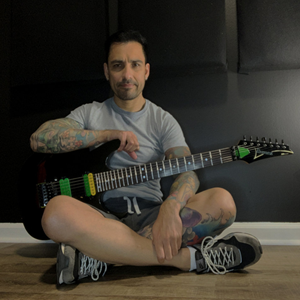
Seven tracks. One protagonist. A solitary creative vision realized without compromise across every discipline — composition, performance, production, and visual identity. “Imago Chapter I: Time Before Memory,”released February 27, 2026, is the second full-length from the Miguel Donneys Project: a Progressive Metal work of genuine conceptual ambition, built around a single female character navigating the darkest corridors of her own past. We spoke with Miguel Donneys about the origins of this project, the evolution of his sound since his debut, and the artistic thinking that gave shape to “Imago.”
Let’s begin at the foundation. What were the formative musical experiences that first ignited your passion for music — and more specifically, what drew you toward the more complex, structurally demanding traditions within Rock and Metal?
First, I wanted to thank you for all your work, I mean, independent music (Metal particularly) struggles to thrive among main platforms. I started playing music when I was a kid. Fortunately, my school had a bunch of music and arts programs. I was 14 years old when I had my first acoustic guitar. I listened to Iron Maiden and that was it for me. This was 1994.
I belonged to many bands through the years and that shaped my taste for more complex music. I think it is challenging because it takes you out of your comfort zone, either playing someone else’s music or trying to come up with your own material. Also, in the genre you can tell stories easily since you have already all the music nuances that help the narrative. That is something I like about complex music, it always tells you a story. Take for example Antonio Vivaldi and his 4 seasons.
At what point did that passion evolve into a compositional ambition? Was there a defining moment when you understood that music was not simply something you consumed, but something you needed to construct entirely on your own terms?
I love art in general, and I think I’m obsessed with what a human mind can do, so the natural response for me was to try my own ideas and see if they make sense outside of my brain as they do inside. Also, as I said before, taking challenges and risks puts you out of your comfort zone. So, to answer your question, there wasn’t an exact moment, it was more like a need always there in the back of my head.
The Miguel Donneys Project carries your name as a statement of singular authorship. What does that choice signify to you — artistically and personally — and what was the genesis of the project as a distinct creative identity?
Very good question, I do this because I love music, I don’t pretend anything besides sharing my music with people, what I mean is I’m a John Doe at home making music, so I share this with relatives and close friends and that is it. I put my name because they would know it is me, not a band that they are not familiar with, I was trying to create the notion of a regular individual telling a story, I mean a guy with a face and name, not someone trying to sell something. Even when I really don’t sell my music. It is free.
Your sound synthesizes Progressive Rock, Progressive Metal, and Math Rock into something that feels cohesive rather than eclectic. How did these traditions converge in your musical thinking, and which artists or albums have most profoundly shaped your compositional sensibility?
One of my hobbies (like you) is scouting for new music, and I have 2 categories of music I collect, the music I just want to sit and listen to and never play it, and the music I would like to feel with my own fingers while I play it. I go from classical composers, 80’s pop music, obscure metal bands from north Europe to modern metal. If it gives me a vibe, it obviously will be (maybe unconsciously) part of my influences on future songs. Part of my biggest influence is the prog metal, power metal from the 90’s, Symphony X, Rhapsody (from your country), siege’s even, Edguy, Etc, however, I love new bands like Monuments from England, Jinger from Ukraine, Archenemy etc., you can see the pattern, big riffs and memorable melodies.
“Imago Chapter I: Time Before Memory” is your second record. How do you perceive the distance — compositionally, sonically, and conceptually — between this album and your debut? What has fundamentally changed in your approach, and what has deepened?
Oh a lot, my first record was just an experiment, I took old songs and I used them to learn how to mix, master and produce. I’m not a sound engineer and I’m not pretending to be one, but I wanted to do it myself to see if I was capable of doing it. You can hear the sound better with this second album, and the content. My first album has songs from different stages of my life, so they feel different from each other. I like my first one because I learned a lot from my own mistakes; it makes you appreciate your progress. The new album is a story I wanted to tell, so everything has its place and time.
This album introduces a clearly defined narrative framework — a dark journey through the past of a central female protagonist. Was this move toward explicit conceptual storytelling a deliberate evolution from your previous work, or did it emerge organically from the material itself?
A long time ago, I wrote a book about a dream I had, since then I always try to put something like that into music. I’m also a graphic designer and for me the concept of any project is crucial to send the correct message, so that is always part of my composition as a musician. Even my previous songs tell you a story or they are trying to send a message. So, when I started this new album, I had already the story behind and the psyche of the main character.
The word “Imago” carries profound symbolic resonance — in Jungian psychology it denotes an unconscious idealized representation that shapes perception from within, while in biology it describes the final stage of an organism’s metamorphosis. How consciously did you engage with these layered meanings when constructing the album’s
conceptual architecture?
Hey, you checked it out! Yes, it has to do with the perception we have about ourselves; the word IMAGO also means image. A long time ago, I read about the psychological impact of body dysmorphia or the alteration of your own features, like plastic surgery. People see their faces in the mirror and have problems trying to recognize their faces. In fact, the second track of the album is called “Imago Lacan” it has to do with that. So, this main character relays into her past to find out where to go in the future. So, she must accept she is not the same while facing challenges from outside.
“Chapter I” positions this record as the opening installment of a larger arc. How fully realized is the broader narrative at this stage — and can you offer any sense of the emotional or thematic territory the subsequent chapters will inhabit?
It was the last moment’s decision; I mean the title. I was going to tell only a brief story, but after listening to it many times, I was wondering what else happens after this?… So again, I wanted to be out of my comfort zone, so I decided to expand the story. This first part introduces the main character, she being the one narrating the story, also describes some situations as statements and some other characters, the initial elements of any story. The main premise is that the main character finds someone is after her, but she doesn’t know why. She discovers she was someone else, with a different appearance and different life, now she needs to remember who she was to understand the whole situation. She deleted some memories and changed her appearance to protect herself, now somebody has found her secret.
“Afterlife Madness” opens the record with considerable force. What role does this track play in establishing the psychological and sonic coordinates of the world the listener is entering — and what does “afterlife madness” represent within the context of the protagonist’s story?
Although the songs are not strictly place in chronological order (story wise) Afterlife Madness represents the searching of answers even beyond life. The main character is looking for herself in a previous life she didn’t know she had, and as it sounds, it can be crazy to try to talk to an old version of yourself to get the answers you need.
“Imago Lacan” is the album’s longest and most theoretically charged piece, explicitly invoking Lacan’s mirror stage and his theorization of identity formation through misrecognition. How did you navigate the challenge of translating that level of conceptual abstraction into musical and narrative terms without sacrificing emotional immediacy?
This track describes the struggle of the main character looking at herself in the mirror and not being able to recognize or reconciliate the image of her present self vs the old version of herself. I used the duality of a slow verse against a more energetic chorus to describe the issue the main character has, I also use the heavy bridge in the middle of the song to describe a transition. When I wrote the lyrics, I try to fill the shoes of the person that is giving the message.
“World Without Moon” and “Unseen Proximity” share a quality of suspended, interior tension — an engagement with absence and the imperceptible. How consciously did you map the emotional trajectory across the seven tracks, and was the album’s sequencing determined early in the compositional process or refined at a later stage?
Very good question, I had the summary of the story, so it was easy to fit riffs and musical arrangements to sections of it. I’m not going to lie, some of the songs were rewritten, and I made some changes (musically speaking) to make them fit better with the whole album, so yes, some songs were modified. As a guitar player, I have my “go to riffs” so I used them, but I had to modify them later.
“Voice Within” and “Individual Zero” suggest almost opposing states of being — one turned inward toward solitary reflection, the other gesturing toward collective dissolution or anonymity. Was this dialectical tension a deliberate structural choice within the protagonist’s arc?
The voice within represents that insecurity and/or courage that hits us every day. The main character deals with the voice inside of her telling her what to do based on what she finds throughout her journey. While the individual zero, is a character she meets who represents the chaos of society, a broken mind the main character will use it as a sample of what not to do.
“Crystal Head” closes the album. Does its position as the final statement represent a form of resolution for the character — or something more suspended, more ambiguous, deliberately left open for what follows in Chapter II?
It is more suspended or open like you said; this is the vision the main character has of that person that is chasing her. She only feels someone track her down and the only clue she has is the vision of a crystal head.
You handled every dimension of this production in complete autonomy — composition, performance, recording, mixing, mastering, and visual identity. What does that degree of total creative control afford you, and what particular demands does it place on you across such an extended and solitary process?
Complex question to answer. Having control of everything gives you the freedom of experimenting with all the variables, even improvizing during the process. That makes the whole project more organic and natural, something very honest from inside of me. On the other hand, it takes a lot of time to have everything ready. It gives you frustration but also satisfaction. I mean, there are parts of the process I didn’t know how to complete, so that needs to be handled by pausing it and “go back to school” to learn what you need to finish it. If you have a band, maybe someone would help you with that.
Are there sonic or compositional decisions on “Imago” that you believe would have been unlikely or simply impossible within a more conventional collaborative or studio framework?
Yes, the time I take for every decision, I have an 8 to 5 job, so sometimes I have to pause the project for a while. Sounds like an issue but that also gives me the advantage of separating myself from the project and being able to identify aspect of the music I need to change when you listen to it a while after. Having all that at home gives me the freedom of taking the time I need to match what I have in mind. Also, even when I had the songs all done, I mean recorded, sometimes I had to rerecord and basically start over since there were some details that didn’t go along with the concept. Imagine doing that in a private studio.
Has the Miguel Donneys Project ever existed in a live performance context — even informally? And is bringing this material to a live dimension something you envision or actively pursue for the future?
No, I mean, I used to tour with my old band, that was very fun, but I’m 45 years old now with a regular job. Also, one of the reasons I do this all by myself is because I couldn’t find the time to find band mates. I have to admit having a band is like being in a polygamous relationship; you will agree or disagree with the other band members all the time. I have other life projects also currently running, so a live performance is not part of the plan.
Looking at the contemporary Progressive Metal and Math Rock landscape — particularly from your vantage point in the United States — what do you find genuinely vital and forward-looking in the current scene, and where do you feel the genre still has uncharted territory to explore?
The good thing about metal is that it doesn’t have limits. Young people are exploring and growing new branches of metal very fast nowadays. That is good, I think. The only thing I would change, in my humble opinion, is that somehow, there is this tendency of bands sounding similar to each other and over produced. But again, that can be me, I’m from the 80’s maybe some kid reads this and would think I’m an old fart.
One track from “Imago” has been selected for inclusion in the Progressive Rock Journal Compilation Vol. X — a series dedicated to mapping the international underground. How does it feel to have your work situated within that broader curatorial context, and what does visibility within the international Prog community mean to you at this stage of the project?
It feels great, again, I don’t do this to have views or likes, usually I share my music with friends only. So, all this is very encouraging, it makes me feel like I need to practice more to keep up with the new generation’s guitar players. I’m not going to lie, it makes me feel insecure about my own project as well, I’m my worse critic.
We extend our sincere thanks to Miguel Donneys for this conversation. “Imago Chapter I: Time Before Memory” is a second record of rare intentionality — one that marks a decisive step forward in both conceptual ambition and compositional maturity. A full review will follow shortly on PRJ.
Thank you again, Jacopo! Cheers from the other side of the ocean.
Purchase “Imago Chapter I: Time Before Memory” on Bandcamp: https://migueldonneysproject.bandcamp.com/album/imago-chapter-i-time-before-memory