
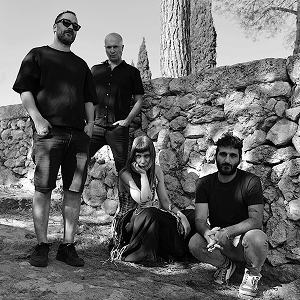
Formed in 2020 by musicians with roots in distinct underground projects, Italian quartet Bosco Sacro create an immersive convergence of Ambient Doom, Slowcore, Trip-Hop, and Dreamgaze. Following their 2023 debut LP “Gem” and the Atmospheric 2025 release “Live At Chiesa Armena,” the band returns with their second full-length album, “Inhabit,” released via Supernatural Cat Records. Built around concepts of ego dissolution and sonic existentialism, Inhabit stands as a profound exploration of human biology and cosmic space. Ahead of the album’s official release and their upcoming European tour dates, we caught up with the band to discuss their evolution, their rehearsal-room songwriting process, working in the Tuscan hills with Lorenzo Stecconi, and the philosophy behind their sound.
Bosco Sacro was brought together in 2020 by musicians with backgrounds in diverse projects like The Star Pillow, Daimon, Julinko, Tristan da Cunha, and Altaj. When you first joined forces, how did these different musical backgrounds align around the shared vision of music as a liberating and restorative force?
Francesco: “It actually started because I had the idea of forming the band after collaborating separately with Paolo and Giulia at different times. I shared a few initial tracks featuring guitar and Luca’s drums with them, and from there we began imagining the project together without tying ourselves to any particular background, but rather letting our different musical influences become deeply interconnected.“
Paolo: “It wasn’t something planned or calculated; simply, our backgrounds, even though different at times, are part of us and contributed to bringing our distinct personalities into Bosco Sacro sound.“
Your 2023 debut album, “Gem,” introduced listeners to your unique blend of slow rhythms and dreamlike atmospheres. Looking back at that first record, how do you evaluate your stylistic evolution leading up to ”Inhabit”?
Paolo: “Gem was born as a creative vortex from an initial spark by Francesco that we all then followed and it was recorded just in a weekend, after working remotely by sending each other our own parts. For Inhabit, we worked by composing together in the same rehearsal room, gathering the natural evolution of the sound and the inputs brought by these years of touring, concerts and playing together and being connected as human beings with bodies and souls and food! So it was a natural process, matured over time and slow, that too, like everything that defines us 🙂“
In 2025, following an artistic residency at Villa Albrizzi Marini, you released Live At Chiesa Armena, recorded inside a 17th-century church. How did performing and recording in such a sacred acoustic space impact your relationship with reverb, resonance, and sound dynamics?
Luca: “First of all, I remember the way I used to play the drums: it was a perfect balance between playing loud and assertive and bringing out the dynamics of the drum kit in the song, especially on the cymbals.
I only had a short time during the soundcheck to adapt my drumming to the church environment.“
Paolo: “It was rather the desire to live together for 3 days in that wonderful location which is Villa Albrizzi Marini, which also houses the small Armenian Church. Living the experience together, playing, letting things emerge and flow, and capturing what the sound and the soul of that place brought, turning them into sound. This was also thanks to the wonderful organizing team of Max and Olga from Go Down Records and the legendary Daniel Greco who recorded and mixed the concert.“
Over the past few years, you have toured across Europe and performed at festivals such as Brutal Assault, A Colossal Weekend, Frantic Fest, Curtarock, and Bear Stone. From your perspective, how is the contemporary European underground scene responding to slow, ritualistic music?
Paolo: “The underground is alive and well, it’s just changing very quickly, just like the rest of the world. I’ve been part of the experimental and drone scene for over twenty years with various projects and compared to the past, today I can see a greater and growing focus on ritualism in general and on the use of sound not just for performance, but for more introspective purposes and personal transformation.“
Unlike “Gem,” your new album “Inhabit“ was written entirely live and in person within the shared physical space of your rehearsal room. How did this collective, face-to-face songwriting dynamic alter the tension and spontaneous energy of the music?
Paolo: “Radically. It took time to try out many different paths, turn them upside down and sometimes go right back to square one. We really stripped away everything superfluous and kept only what best represents us and the sound we’re pursuing. It’s genuinely the four of us playing together and in fact, many of the tracks were recorded live in the studio in a single take.“
You spent seven days recording at Daniele Onori’s AMM Monteggiori Studio in the Tuscan hills with producer Lorenzo Stecconi. Having worked with Lorenzo previously, what specific sonic approach did he bring to capturing your raw energy during tracking and mixing?
Paolo: “Lorenzo is the fifth member of Bosco Sacro. His vast experience and magic in the studio lie in knowing our sound inside out and not trying to change it, but rather bringing out the very best in it and simply capturing a snapshot of it.“
“Inhabit“ is released through Supernatural Cat Records, the label run by members of Ufomammut and the Malleus Rock Art Collective. How did this partnership come about, and what does it mean for Bosco Sacro to join their catalog?
Luca: “The members of the Supernatural Cat label—and therefore of Ufomammut and Malleus Rock Art Lab—came to our live shows several times, most notably at Brutal Assault Fest 2024 (where they played as Ufomammut), and I think they really liked us.”
Paolo: “Thinking about that, we even saw them in the crowd at one of our very first gigs in truly DIY spaces and, for me, that was overwhelming. Ufomammut have always been a point of reference for me, ever since i saw them live as a kid together with Morkobot or Zu, i don’t remember. Having them not only as our label, but above all as great friends, is the true magic that only music can make happen.“
Stylistically, Inhabit spans from Heavy Doom and Slowcore to Ambient Drones, Dreamgaze, and Trip-Hop rhythms. How do you manage the balance between crushing low-end weight and weightless, expansive space without losing narrative cohesion?
Luca: “I think that this way of playing with tension and release comes naturally to us, so once the structure of the song is arranged, the song is born.“
Paolo: “I agree with Luca, this way of playing that alternates between tension and release is truly part of who we are and of our narrative. Just like the oppressive wall of sound coexisting with moments of ambient ecstasy, I think it acts like a breath that also gives a clear rhythm to Giulia’s voice and words.“
Giulia: “I think this alternation of densities reflects the movement of life—its macro-rhythms, as well as the ephemerality of the substance of time. We all know how much weight one single, intangible emotion can have. So when you play and express yourself through music, allowing yourself to let go, everything becomes more direct and maximized. There’s no need for coherence—only for a sincere, truthful flow.“
Thematically, the album champions the mantra “inhabit no self” and acts as a ritual of ego dissolution. What inspired this philosophical direction and the dialogue between internal biology and cosmic vastness?
Paolo: “Giulia managed to put into words a direction that all of us pursue through sound one that actually has more to do with contemplation and with themes that recur more often in meditative practice than in music. In fact, our music is truly a moment of transcendence and while we play it, it carries us away.“
Giulia: I’ve been practicing Vipassana meditation over the last few years. It has been a profound experience—if not THE experience—that radically changed the relationship I have with my body and emotions; it’s a process of refining your perception, based on observing the so called “doctrine of impermanence”. The lyrics to the song ‘Inhabit’ speak about this, and ‘Silence Dances’ speaks about it in an even more direct way.“
The opening title-track, “Inhabit,” grew out of a repetitive guitar loop and a mystical vocal melody. How did that initial minimalist loop evolve into the full track that sets the conceptual tone for the entire album?
Luca: “I can only say that the drumming for the song came to mind one night after watching a documentary about The Velvet Underground, so I was inspired by their minimalist rhythm.“
Giulia: “‘Inhabit’ was born from a guitar mantra played by Francesco. We all felt it resonated deeply with us—it had a dense, solid, evocative, mystical force, while remaining so celestial and airy. We started repeating this mantra over and over, exploring different directions. We felt very much at ease in those dimensions, running the risk of staying on the old, comfortable ground that defined our first album, GEM. But we wanted to go further. We tried and retried different paths without forcing anything, simply trying to be patient and stay within the mantra until the right direction emerged. Then a crucial turning point came when Luca introduced the specific rhythm and drum palette you can hear now… and took it further.“
Francesco: “‘Inhabit’ is actually my favorite track on the album. It is built around a loop that plays with a slow, measured tempo and subtle slides across semitones. The initial idea came from a body of guitar sketches I had been working on, which Luca and I later had the chance to refine together until it took shape as a full piece we could bring to Giulia and Paolo to explore as a band.“
The title-track is accompanied by a somber official video directed by Michele Canevari. How does the visual narrative reflect the song’s exploration of human attachment and dissolving into the present moment?
Francesco: “Michele is a dear friend of ours who has collaborated with us as a videomaker both for Bosco Sacro and for Tristan da Cunha. His visual style—tactile, mysterious, and above all deeply human—has always felt like the perfect medium to express, each time in its own specific shade, the poetics behind our projects. For “Inhabit,” he built a distinct, enigmatic, and tragic narrative“
On the single “Silence Dances,” you described a synesthetic structure transitioning from a physical, tumbao-like rhythm into an expansive, horizontal second half. How did this contrast between physical pulse and open space come together?
Paolo: “The track, especially its first part, originated from a motif that Francesco and Luca used to jam on often during soundchecks and we worked hard to make it more rhythmic, off-kilter, hypnotic and physical. With the tempo change, we wanted to give it a straighter, more post-punk/wave feel.“
The lyrics of “Silence Dances” evoke vivid biological imagery, such as “the silent life of your cells” and “the hidden beats of your heart.” Giulia, how do you approach crafting lyrics that bridge physical bodily sensations with metaphysical reflections?
Giulia: “I’ve been writing poetry with a metaphysical and existential edge for years, often exploring the physical, sensual side of experience as well. When I got into Vipassana meditation and its philosophy of impermanence, I developed a much sharper awareness of the sensations moving through my body—perceiving it as a whole made up of tiny, hidden, invisible parts. As a result, my language became both richer and more essential, simply because I tapped into a kind of awareness that rarely gets trained, at least in the Western world. In those lines you quoted from ‘Silence Dances’—and even in the title itself—I play with a form of synesthesia that can feel almost oxymoronic, pairing elements you wouldn’t normally associate, like sound and biological imagery. I think that’s why it resonates: it creates a sort of sensory cacophony, a poetic nonsense.“
“Inhabit“ consists of eight interconnected tracks, including shorter pieces like “Gift From The Fog.” How did you approach the sequencing of the record to create a continuous, ritualistic listening experience?
Luca: The room where we composed the album is in a little country house between the fields and two rivers, so in November (the month we wrote the song) it is always shrouded in fog. We thought it was the perfect continuation of ‘Inhabit’ (the song).“
Paolo: “Exactly, the progression started as an outro to Inhabit that Francesco and I naturally kept playing and then shaped into this very foggy, Low-style atmosphere. The rest came together in really short time and, personally, I love this song for being both so fragile and so powerful.“
The cover art features Testa di Terra (Head of Earth), a raw clay sculpture by artist Roberta Busato photographed by Giuseppe Gradella. How does this meditating clay figure incarnate the album’s concept of stepping out of everyday noise?
Giulia: “The face you see on the cover is fragile, broken, but still detached. It is made of earth and sleeps on an earthy pillow, yet you could say it is dreaming or existing in a higher dimension. These dualities are deeply explored throughout ‘Habit’, both sonically and lyrically.“
The physical release includes a special limited edition with concentric die-cut inserts designed by Malleus, allowing each copy to look slightly different. How important is the tactile, unearthing aspect of physical music formats to Bosco Sacro?
Luca: “I collect a lot of things, but music albums (CDs, vinyl, and tapes) are my biggest collection. For me, it’s very important to have a physical copy of the music I want to listen to. Putting the disc into the device is a ritual in itself.“
Your live performances are frequently praised for their cathartic, ritualistic, and immersive nature. How are you translating the complex ambient layers and studio production of “Inhabit“ into your live setup?
Paolo: “It’s not complex at all, what we recorded is literally what we play live. We only use our instruments and a few pedals to shape our sound. The rest is volume and whatever we conjure up every night we step in to a stage.“
You have upcoming European tour dates scheduled in Vienna, Hradec Králové, Budapest, and Nuremberg. What can audiences expect when encountering Inhabit performed live in these venues and sacred spaces?
Paolo: “No time, no space (cit. Franco Battiato). Just four friends giving everything they are and they have to unleash a storm of sound and sweep everyone away with them.“
Looking back at the band’s journey from your formation in 2020 through the recording sessions in Tuscany, is there a particular live memory or studio anecdote that captures the true essence of Bosco Sacro?
Paolo: “Not just one, but one of them is definitely the cooking battles between Chef Monti (Paolo) and Chef Spuka (Luca). Zappa’s Mothers used to say “We’re Only in It for the Money” we can say “We’re Only in It for the Risotto!” 🙂“
“Inhabit“ is out on November 6th via Supernatural Cat Records on LP, CD, Limited Edition LP+CD, and digital formats. Be sure to catch Bosco Sacro live on their upcoming European tour, and stay tuned to Progressive Rock Journal for our upcoming review of the album.
Purchase “Inhabit” on Bandcamp: https://boscosacro.bandcamp.com/album/inhabit
Lineup:
Paolo Monti / Guitar
Giulia Parin Zecchin / Vocals, Lyrics
Francesco Vara / Guitar
Luca Scotti / Drums