

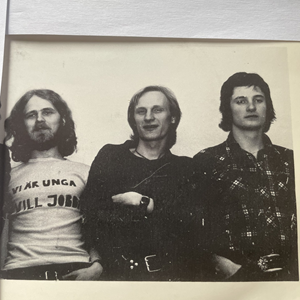
Tierp, a quiet village between Gävle and Uppsala, is not the kind of place that appears in music history books. Yet it was here, in the early 1970s, that a loose circle of musicians began a decade-long creative journey that would eventually produce one of the most sought-after albums in the Swedish underground — a record so rarely heard that
most collectors know it only by name. Kontinuerlig Drift, meaning “continuous operation,” was never a band in the
conventional sense: no fixed lineup, no ambition for exposure, no career plan. Just years of improvisation, Folk traditions, Blues roots, and Psychedelic exploration, documented in two raw days at a Gävle studio in late 1977. PQR-Disques plusqueréel is now giving that document its first ever proper reissue — and for the first time, the story behind it can be told.
The band’s story begins in the early 1970s in Tierp — a quiet village with no particular connection to any established
music scene. What was it actually like trying to play this kind of music in that environment, and where did the initial
impulse come from?
It all came from what we listened to on records. First, we were all hooked on blues, especially British blues from the late 60s with bands like John Mayalls Bluesbreakers, Fleetwood Mac and others. Blues was also pretty easy to learn, mostly only three chords and the blues scale. But we also listened to other stuff, the late 60s and early 70s was a great time to explore music. There were a lot of different styles, blues, soul, psychedelia, folk music and straightforward rock was blended in the music scene without any strict borders between the genres and you could listen to everything without being pigeonholed.
The first formation, Hallsbandet, was already drawing from a wide palette — Blues, British Psychedelia, Folk,
Improvisation. How conscious was that eclecticism at the time, or was it simply a reflection of what you were
listening to and absorbing?
So, we gladly played everything we liked, blues, pop songs, folk music etcetera. It is true that Tierp wasn’t the music centre in the world, but distances to larger cities like Gävle, Uppsala and Stockholm weren’t that great, and we often went to concerts there.
The transition from Hallsbandet through Hela Havet Stormar to what eventually became Kontinuerlig Drift
involved a series of mergers, relocations, and lineup shifts. Looking back, was there a single moment where you felt
the musical identity truly crystallized?
I think it was more of a process, involving every new member that joined the group. Hela Havet Stormar had three guitarists which meant that the music had to be more structured although we still jammed a lot. This was also a period when Swedish folk music started to be an ingredient in our music. Kebnekaise was the first to play folk melodies on electric guitars and it became an inspiration and it also suited us well since the guitars could play in harmonies. At this point we also started to write our own material which was an important reason to make an album later.
The name Kontinuerlig Drift — continuous operation — was chosen to describe an uninterrupted creative
momentum rooted in improvisation and collective jam sessions. How accurately did that name reflect the actual
working method, and was there ever a tension between that spontaneous approach and the desire to produce
something more structured?
Not really, as soon as we decided to record an album we started to rehearse the songs properly and I think we had the sound picture clear from the beginning, The rehearsals sounded very much like the final result on the record so there were no major discussions what I can recall.
The move to Uppsala and the basement rehearsal studio set up by Kent Wahlbeck seems to have been a turning
point — a stable space that allowed the collective to evolve. How did that physical environment change the music?
It meant we could rehearse more often and also in a lot of different constellations. That also meant that you could try new stuff or just play for fun. The final track on the album, Skookian is a good example when we just did the latter. Alf, a multi-instrumentalist, is also playing a great guitar here.
The press material draws a line between Flasket Brinner‘s Ethnoprog sensibility and Mecki Mark Men‘s drifting
Psychedelia as the two poles closest to your sound. Were those bands part of your active listening at the time, or is
that a framework that emerged only later?
Mecki Mark Men was a little earlier so I can’t say that they had much influence, but Fläsket Brinner was contemporary, but I think they were more structured than us. If you want to find a band in some way similar musically, I will mention Levande Livet, who had the same eclectic approach. But I also think we were quite unique in mixing Swedish folk music with blues, I don’t think anyone else did it, at least not in the 70s.
Swedish and English Folk traditions both fed into the album — tracks like “Gånglåt från vettet” and “Liksom en
herdinna” carry a very specific Nordic character, while other moments lean into something rawer and more
psychedelic. How did you navigate between those two worlds without it feeling forced?
I think we approached all tunes with open minds so there was nothing strange going between genres. As long as the music was real without any commersial interests it was something we could relate to. Alf was our musical anthopologist, he had a lot of knowledge about all kinds of music, jazz, classical music, folk music and more and he led us into those worlds. So we listened to a lot of different music and simply took the best out of every genre.
The decision to record the album was Alf‘s idea — to document not just the music but the entire collective artistic
journey accumulated over years of playing together. Was there any hesitation about committing that to a fixed form,
given how much the music had always relied on being alive and in-the-moment?
No, not really. The music wasn’t that spontaneous; the shorter songs had its blues or pop song form, and the longer ones also developed into a fixed form although we tried to keep the jamming atmosphere. As I can remember, all the rehearsals sounded almost like the final versions of the album.
The recording at Leif Walter’s studio in Gävle took only two days, and the approach was deliberately raw — the band
performing live with minimal overdubs. Was that a philosophical choice or a practical one, and do you feel it
captured what Kontinuerlig Drift actually sounded like?
It was a bit of both, I think. There was limited time to do the recording, so we had to play live in the studio and I don’t think spending longer time would have enhanced the result. There are some flaws that maybe could have been avoided if we had more time, but it also makes it sound more ‘authentic.’ It was the studio’s first recording, and none of us in the band were experienced with studio work so with that in mind it still came out well.
The mixing was shared between Alf and Bo Anders. How did that division of responsibilities work in practice, and
were there any significant disagreements about how the final record should sound?
I think most of it went rather smoothly. None of them were very familiar with mixing so there were some errors but in general the idea was to keep it simple.
“Se Men Inte Röra” is noted for a thematic resemblance to Iggy Pop‘s The Passenger — a striking coincidence given
the timeline. Was that connection intentional, a shared influence, or something that only became apparent much
later?
The Passenger came out the same autumn (1977), but Bo Anders wrote this song a couple of years before, so there were no influences from Iggy. The riff is however pretty much standard; I guess it could relate to a handful of songs.
The album cover was designed by Ola Claesson from Gävle, later known for his work with Tomas DiLeva. How did
that collaboration come about, and how much input did the band have in the visual concept?
Ola Claesson was a friend of Bo Anders from when they both lived in Gävle. He was given free hands, and we all thought he caught the idea of the concept Kontinuerlig Drift perfectly. The plan was to have the picture on both sides of the cover, but it became too expensive. Eventually there are a couple of the album with the picture on both sides so they might be rarities.
Kontinuerlig Drift was described as a project conceived solely for this album — yet the musicians behind it had been
playing together in various forms for years. Did the band ever perform under this specific name before or after the
recording, and if not, why not?
The members on the album never performed live together, but Alf, Leif and Håkan had played together for many years. Kontinuerlig Drift never existed as a band in that sense but was merely a concept for making an album. We all went different ways right after the album was finished, but there was a continuation when some of the people who used to jam frequently started a band called just Driften. They also did a lot of live gigs although the music was notreally the same as the record, it was more straightforward rock.
Hela Havet Stormar, one of the preceding formations, was limited to festival appearances and alternative venues
partly due to the difficulty of finding a drummer. How much did that constraint shape the way you approached live
performance in general — and the music itself?
It was both ways really. Without a drummer, you had to get all others to focus on the rhythm, which led us to the static drone sound. On the other hand, playing live was a challenge since the audience expected a drummer. The drummers that joined us in our live gigs did a great job but sometimes the original mood from how the songs were created was lost.
The piece “Gånglåt från vettet” had already become something of an anthem for the broader collective before it
ever appeared on record. What is the history of that song specifically — where did it come from, and what did it mean
to the people around the band?
Alf wrote that piece in the days when Hela Havet Stormar existed, and it is based on a style in Swedish folk music, gånglåtar which means ‘walking songs’, tunes you could whistle or hum when you are walking. Från vettet means ‘going out of one’s mind‘ and refers to the improvisational part in the middle. The song was as you say, an anthem in the HHS repertoire, so it was only natural that it was included in the album. The melody itself was easy to play in harmonies; in HHS we had three guitars doing that but in KD violin and saxophone was added which gave the song even more a Swedish folklore flavor.
This is the first official reissue of the album — nearly five decades after its original release. How did contact with
PQR-Disques plusqueréel come about, and what was your reaction when a label expressed serious interest in
bringing it back?
The contact was made by Danne Olsson, owner of record shop Open Mind in Uppsala, who I believe has a lot of contacts in the prog music world. It came as a real surprise even though we had noticed some interest in the record on Youtube. We had almost forgotten about it, personally I hadn’t listened for nearly twenty years, so it became a quite nostalgic trip to listen to it again and it also became an opportunity to reconnect with some of the old friends.
The reissue includes a bonus CD of ultra-rare and previously unreleased material. What can you tell us about what’s
on it — where does that material come from, and how was it selected?
These are all tracks from Hela Havet Stormar, both live recordings and from rehearsals. This might give a more nuanced picture of where we came from musically. The selection was done to fit in with the album; there are more tracks, but they are straight blues and rock, and the sound quality is not too good. To point one track out, I think Lanna-Villes schottis is a fine example of the mixture of Swedish folk music and blues that in a way defined our unique style. That concert was also without a drummer, so we had a ‘drone’ tone which is typical for much folk music.
Remastering an album you made almost fifty years ago is an unusual experience. Did returning to those recordings
change how you hear them, or how you think about that period of your life?
First of all, we were all very young when the album so it’s a strange feeling returning fifty years back so there are a lot of memories coming back, both good and bad. We were not professional musicians, although music played a big part in our lives, we all struggled with work or studies when we were not playing, which took up most of our energy. We were also self-learned, learning from records and from each other, which may have disappeared nowadays when music education is more common. It might have increased the skills level among the younger generation but maybe something else is lost. The playing on the records may have its flaws, but the energy and commitment are absolutely there.
After Kontinuerlig Drift dissolved, several members continued under the name Driften — but the music had shifted
toward standard Rock, and the prog dimension disappeared. What was lost in that transition, and was it a conscious
decision or simply the direction things naturally moved?
I think it depended only on the members of that band and what they wanted to do musically. None of the original members participated in Driften so in a way it was a new band although some of the members were part of the jamming community. But there were no personal differences; we all stayed in contact and occasionally played together in other constellations.
The members of Kontinuerlig Drift went on to remarkably different paths — academia, folk bands, studio work,
teaching. Is there anything in the music you made together that you feel none of those later projects could replicate?
The originality of Kontinuerlig Drift and its predecessors were something unique, and I don’t think any of us
experienced that later although maybe we became more experienced in our musicianship. It may be the general
development of the musical landscape, but it seems that music that goes over genre boundaries becomes rarer.
The Swedish underground of the 1970s produced a considerable body of work that remains largely unknown outside
specialist collector circles. Are there contemporaries from that scene — bands or recordings — that you feel deserve
the same kind of attention this reissue represents?
I don’t have a complete overview of the records produced in that period, but I am sure that there are some that deserve attention. One record that went under the radar was Strömmens pärla by Levande Livet. It is not maybe typically prog musically but the lyrics from Einar Hecksher are astonishing although you must be Swedish to understand them.
For someone hearing Kontinuerlig Drift for the very first time in 2026 — what do you hope they actually feel when the needle drops?
Listen with an open mind and perhaps you will discover something new.
We thank the members of Kontinuerlig Drift for their time. The self-titled album is released May 01, 2026 via PQR-Disques plusqueréel — available in four limited vinyl editions with bonus CD, each numbered to 100 copies.
Available on May 01, 226 PQR Direct Webstore:
LP+Bonus CD, lim. to 100 copies in yellow and red on trans blue splatter vinyl: https://pqrdirect.my-online.store/product/kontinuerlig-drift-kontinuerlig-driftyellowredblue
LP+Bonus CD, lim. to 100 copies in trans green vinyl: https://pqrdirect.my-online.store/product/kontinuerlig-drift-kontinuerlig-drift-lpbonus-cd-lim-to-100-copies-in-trans-green-vinyl
LP+Bonus CD, lim. to 100 copies in red on clear splatter vinyl: https://pqrdirect.my-online.store/product/kontinuerlig-drift-kontinuerlig-drift-lpbonus-cd-lim-to-100-copies-in-red-on-clear-splatter-vi
LP+Bonus CD, lim. to 100 copies in purple vinyl: https://pqrdirect.my-online.store/product/kontinuerlig-drift-kontinuerlig-drift-lpbonus-cd-lim-to-100-copies-in-purple-vinyl