

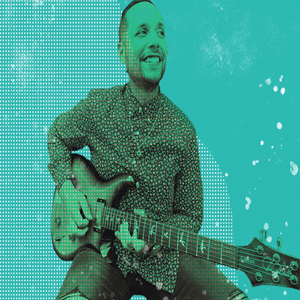
With “Parasite,” MANUEL consolidates a distinctive artistic identity that merges Progressive Metal intensity, culturally rooted rhythmic elements, and a sharp socio-political narrative into a cohesive and uncompromising sonic statement. Led by Manuel Urgiles, the band operates in a space where technical precision, conceptual depth, and emotional urgency coexist, resulting in a work that is as intellectually charged as it is sonically visceral. In this interview, we explore the genesis of the project, the compositional and thematic core of “Parasite,” its structural and conceptual architecture, the live dimension, and the band’s positioning within today’s Progressive and Extreme Metal landscape.
To begin, how did MANUEL originally come to life as a project, and at what point did you realize it needed to evolve into a full band rather than a solo artistic outlet?
I’ve been playing guitar for over twenty years—session work, supporting roles, different bands. It was always fulfilling, but during the pandemic something shifted. When my daughter Lucia was born, I felt a profound recalibration. Seeing her made me ask: Am I truly being myself in my art? I knew music would always be part of my life, but I wanted it to reflect me fully—my heritage, my anger, my joy, my truth. So I began composing without compromise. The result was the most honest and emotionally satisfying music I had ever written. When I realized these songs demanded to be experienced live, the project naturally expanded. Finding musicians like Thomas Hiscock, Jason Ingalls, DJKTF, and Ryan Cummings—artists who understood the vision and elevated it—transformed MANUEL from a personal outlet into a living, breathing band. Playing this music together is incredibly powerful.
How has growing up in Los Angeles influenced both your musical identity and the culturally hybrid direction that defines your sound today?
Los Angeles shaped everything. It’s a collision of cultures, sounds, and identities. Growing up in Venice, I was surrounded by athletes, punks, metalheads, hip-hop heads, cumbieros, salseros—every subculture imaginable. That diversity wasn’t abstract; it was daily life. At home, we listened to everything. My older siblings introduced me to gangsta rap, ’80s new wave, Morrissey. My Peruvian background brought Zambo Cavero, Eva Ayllón, Óscar Avilés into the mix. That duality—heavy and rhythmic, aggressive and soulful—became embedded in me. Moving to Portland, Maine amplified that awareness. When you leave home, you feel your identity more sharply. The contrast clarified what I carry with me: rhythm, culture, resistance.
From the outset, was the goal to create something that deliberately transcended traditional Progressive Metal boundaries, or did that fusion emerge organically during the writing process?
Really kind words. Thank you for that. There was never a calculated plan to transcend anything. I made a commitment to myself: whatever comes out is what it is. If I love it, I keep it. If not, it doesn’t survive. That mindset led to complete creative freedom. One night I might write an upbeat cumbia passage that explodes into thrash. If it feels authentic, it stays. The fusion wasn’t engineered—it emerged naturally from who I am.
Your music blends Progressive Metal complexity with Latin rhythmic elements and Experimental textures. Which artistic influences—musical or cultural—most shaped this hybrid sonic language?
Uff. I’m a fan of good music. Sepultura was an early obsession—their ability to merge heavy riffing with rhythmic intensity left a deep mark on me. I also grew up immersed in rock en español: Enanitos Verdes, Caifanes, Jaguares, Maná. That passion for Latin-infused rock never left. Santana is a major influence—not just technically, but emotionally. His phrasing carries spirit and conviction. Then you layer in Opeth, The Mars Volta, and Marty Friedman—artists who blend technicality with storytelling. That intersection of groove, atmosphere, and precision defines my language.
Your compositions balance technical virtuosity with emotional and conceptual weight. How do you avoid falling into purely technical excess while maintaining musical depth?
Technicality without purpose is hollow. I learned quickly that nonstop shredding becomes exhausting—for both the player and the listener. Marty Friedman influenced me deeply in this regard. Instrumental music has to tell a story. A story has chapters, tension, release, contrast. I think compositionally—where is the rise? Where is the fall? Where is the breath? The goal isn’t to impress. It’s to move someone.
Considering your sonic approach, do you feel more aligned with Progressive Metal, Extreme Progressive Metal, or a broader Experimental Metal spectrum?
Genres are helpful until they become limiting. Early on I struggled with where I “fit.” Who do I play with? Who is this for? Eventually I stopped worrying about that. Audiences don’t experience music as genre—they experience it emotionally. When we play live, the goal is immersion. If someone feels something powerful, then it worked. If that lands under progressive metal, great. If not, that’s fine too.
“Parasite” addresses themes of power imbalance, social division, and systemic control. When did the conceptual narrative of the EP first take form during the creative process?
I began writing in 2024 during a turbulent political moment. The emotional foundation was sadness, anger, fear—and ultimately defiance. As events unfolded, the music evolved with them. “Parasite” became a reflection of watching systems manipulate and divide people to preserve power. It’s a reaction. It’s resistance.
The EP carries strong socio-political undertones. How central is social commentary within your long-term artistic vision as a composer and bandleader?
It’s essential. Politics isn’t abstract for me—it directly affects my family and community. I’ve seen people I love harmed, detained, targeted. Silence isn’t an option. Music is my language, and I intend to keep speaking through it.
Themes of immigrant resilience and cultural identity are embedded in the record. How personal and autobiographical is the conceptual backbone of “Parasite”?
It’s deeply personal. My family left Peru because of political instability, carrying the strength and courage it takes to rebuild a life from nothing. They came to the United States seeking safety and opportunity—only to encounter a different kind of unrest. Racism. Classism. The quiet and not-so-quiet reality of being treated as suspicious simply for being brown. I vividly remember being thirteen years old in Manhattan Beach, riding with my older brother on our way to go for a run. We were pulled over for allegedly driving “too fast.” Suddenly we were out of the car. My brother was patted down with his hands locked above his head, and I was sitting on the curb with my hands behind my back. At thirteen. Moments like that imprint themselves on you. They shape how you see power, identity, and belonging. And they are not isolated experiences—they are realities too many of us know firsthand.
Can you walk us through your compositional workflow for the EP, from the initial guitar ideas to the final layered arrangements?
Most songs begin with a riff. Then another. I program drums to establish pulse and direction. Once the rhythmic foundation is clear, I explore variations and build structure. Melodies follow. Then bass, keys, percussion, textures. I experiment with tone—clean passages with modulation versus dense distortion—until the song feels emotionally complete. If it moves me, it’s finished.
Your guitar work is both intricate and expressive throughout “Parasite.” Do you approach riffs primarily as narrative devices tied to the concept, or as standalone musical structures that later gain meaning?
Both. Emotion shapes the initial riff—anger produces heaviness, grief produces space. Sometimes I revisit older ideas, and whatever I’m feeling in that moment determines the song’s direction. The narrative often reveals itself through emotion rather than intention.
The integration of Latin percussion within a Heavy Progressive Metal framework is a defining trait of the EP. How did you technically balance rhythmic authenticity with sonic Heaviness?
It’s about feel and impact. If a section doesn’t hit emotionally, I ask why. Percussion adds dimension—movement, tension, breath. The goal isn’t layering for complexity’s sake; it’s deepening the emotional punch.
The arrangements feel dese yet controlled, with clear dynamic shifts between aggressive and more rhythmically nuanced passages. How deliberate was this structural contrast during songwriting?
Very deliberate. Without vocals, dynamics must carry the storytelling. Aggression needs contrast to have meaning. Clean passages give weight to distortion. Silence makes heaviness heavier.
The presence of guest vocalists adds a multidimensional layer to the EP. How did these collaborations influence the emotional tone and final structure of the songs?
Bringing vocals into certain tracks elevated the material in a profound way. They didn’t simply perform over the music—they stepped inside it. Each vocalist understood the emotional arc of the songs and delivered performances that made the compositions feel heavier, more immediate, and undeniably human. I was introduced to Ryan Reeves through the phenomenal NYC band Killing Connor. Patrice, formerly of the local band Cadaverette, brought a raw intensity and emotional depth that perfectly matched the weight of the material. Ryan Raes—who also happens to be my agent and plays in Vengince—added a powerful dimension of conviction and clarity. The moment I heard what each of them could bring to the table, it was clear their voices weren’t just additions—they were essential to fully realizing these songs.
From a production perspective, how challenging was it to preserve clarity and detail while maintaining the raw intensity and heaviness that define the record’s sound?
I’ve learned the importance of restraint. Overproduction can bury meaning. Space is powerful. Clarity allows emotion to translate. If everything is overwhelming, nothing connects.
You have already built a strong reputation as a live act across different scenes. How does the live environment influence your compositional decisions and overall musical Dynamics?
I write with live translation in mind. Since many songs are instrumental, I avoid overproducing parts that can’t breathe on stage. Live, we improvise. Each member takes moments to expand sections. Like Santana, I don’t want repetition—I want evolution. The songs take new shapes every night.
Looking ahead, does “Parasite” represent the foundation of a broader conceptual direction for MANUEL, potentially leading into a full-length release or an expanded artistic vision?
I’m writing a full-length album next, and I want to take my time with it. I want to fully immerse myself and go even deeper into my Peruvian Indigenous roots, not just as an influence, but as a foundation. More percussion, more cultural identity, more groove… and still heavy as hell. I want it to feel like heritage and resistance in the same breath.
We sincerely thank MANUEL for the time, insight, and artistic depth. “Parasite” stands as a bold and culturally resonant progressive metal release, combining conceptual substance, technical mastery, and genre-defying experimentation into a compelling and forward-looking statement. We look forward to witnessing the next evolution of the band, both in the studio and on stage.
Purchase “Parasite” EP on Bandcamp: https://westboundmusic.bandcamp.com/album/parasite
Read our review of “Parasite” here: [Review] MANUEL – Parasite EP