

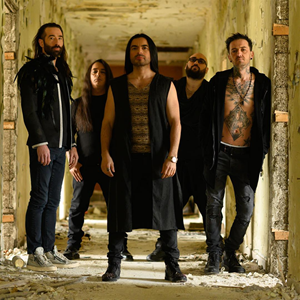
Few bands in contemporary Progressive Metal occupy as singular a position as Myrath. Born from the confluence of North African heritage and European metal sensibility, the Tunisian–French quintet has spent over two decades forging a sound that resists easy categorisation — one in which modal Arabic scales coexist with cascading double-bass polyrhythms, and where cinematic orchestration frames introspective, emotionally charged songwriting. With Zaher Zorgati‘s voice soaring over the architecturally precise guitar work of Malek Ben Arbia and the richly textured keyboard landscapes of Kevin Codfert, Myrath have carved out a musical identity that is unmistakably their own. Their catalogue — from the ambitious early promise of “Hope” (2007) and “Desert Call” (2010) through the breakthrough maturity of “Legacy” (2016) and the atmospheric grandeur of “Shehili” (2019) — traces an artistic evolution that has steadily expanded the band’s sonic and emotional vocabulary, earning them performances at Hellfest, Wacken Open Air, and Sweden Rock, and a devoted international following. Now, with “Wilderness of Mirrors” set for release on March 27th, 2026, through earMUSIC, Myrath return with what promises to be their most dynamic and layered statement to date: ten tracks navigating the tensions between fantasy and reality, darkness and light, memory and transformation. Ahead of the album’s release — and the major European tour that follows across 16 countries — Progressive Rock Journal sat down with the band to explore the genesis of “Wilderness of Mirrors,” its thematic architecture, and what this moment represents in the broader arc of Myrath‘s remarkable journey.
Myrath‘s origins trace back to Tunisia in the early 2000s, a context quite unlike the established European and North American Prog Metal scenes of the time. How did the band come to exist, and what conditions — cultural, musical, geographical — shaped your initial vision for the project?
Myrath’s story really comes from a pretty unusual place for this kind of music. In the early 2000s, growing up in Tunisia, there was no real progressive metal scene. We were discovering bands from Europe and the US on our own, with very limited access to resources, no real studios, no network, no clear path to follow. So from the beginning, we weren’t trying to fit into any scene. We were just playing the music we loved and trying to build something that felt honest to us. At that time, the band was still called Xtazy. We were very young, but extremely driven, rehearsing a lot, trying to push things as far as we could with what we had. Then there was a moment that really changed everything for us. During the Carthage Festival in Tunisia, we had the chance to meet Kevin Codfert, who was there playing with his band Adagio, opening for Robert Plant. For us, that was already surreal, just being there, seeing that level up close. We talked, we connected musically pretty quickly, and I think there was a mutual feeling that something interesting could happen. For us, it was the first time someone from the international scene really took what we were doing seriously. That meeting naturally turned into a collaboration, and it helped us structure things, think bigger, and believe that what we were doing could go beyond just our local environment. At the same time, we never wanted to just copy Western progressive metal. It wouldn’t have made sense. We grew up with different sounds, different melodies, different atmospheres, and that naturally became part of the music. It wasn’t really a strategy, more something instinctive. Being in Tunisia was definitely a challenge, but it also gave us a kind of freedom. We didn’t have trends to follow or expectations to meet, so we could just build our own identity step by step. So yeah, in the end, it really came from that mix. We didn’t have a scene around us, so we had to figure things out by ourselves. But at the same time, we had something personal in the music, even if we didn’t fully realize it back then. And meeting Kevin was a turning point. It made things feel more real, like this could actually become something bigger than just a band rehearsing in a room. From there, everything started to take shape naturally.
When one maps the coordinates of Myrath‘s sound, the references are genuinely eclectic — from Dream Theater and Nightwish to the Maqam traditions of Arabic Music, Cinematic composition, and even strands of Folk. Which artistic touchstones have proven most enduring in shaping your collective approach, and are there unexpected or less obvious
influences that listeners might not readily identify?
Of course, bands like Dream Theater had a big impact on us early on, especially in terms of composition, structure, and the idea that you can push things technically while still keeping it musical. Same with Nightwish, more on the orchestral and cinematic side, that sense of scale, of storytelling. But at the same time, we didn’t grow up only with metal. Tunisian music is something that’s just part of our environment. The maqam system, the phrasing, the ornamentation, it’s not something we “added” later, it was already there in the way we hear melodies. So when we started writing, it naturally blended into the music without us really overthinking it. Cinematic music is also a big influence, probably more than people realize. Film scores, the way they build emotion, tension, release, that definitely shaped how we approach arrangements, especially with orchestration and dynamics. And then there are more unexpected influences. A lot of us listen to things that are not metal at all, pop, world music, sometimes even very minimal or atmospheric stuff. Those things don’t always show up in an obvious way, but they influence how we think about space, groove, or even silence in the music. At the end of the day, we never really sat down and said “let’s mix this with that.” It’s more like everything we’ve been exposed to just filters naturally into the songwriting. And sometimes even we’re surprised by what comes out.
Tunisia has an extraordinarily rich and layered musical culture that remains largely underexplored within the international Progressive Metal conversation. How do you perceive the local musical environment’s influence on your work, and what does it mean for you to represent that tradition on a global stage?
Yeah, Tunisia has a very deep musical culture, but it’s not always something people outside really see or understand. For us, it’s not even something we had to “think about” in the beginning. It’s just part of how we grew up. The melodies, the rhythms, the way people phrase things vocally, all of that is in your ear from a very young age. So when we started writing music, those elements naturally came out, even when we were trying to play progressive metal. I think what’s interesting is that we never approached it like “let’s represent Tunisian music” or “let’s bring something exotic.” It was more instinctive than that. We were just writing music that felt natural to us, and because of where we come from, that identity is automatically there. At the same time, being from Tunisia, you’re aware that you’re not coming from the usual places where this genre exists. So when things started to grow internationally, there was definitely a feeling of responsibility, not in a heavy way, but more like… if we’re out there, we want to show something real, something honest, not a cliché version of our culture. It also pushed us to be careful with how we blend things. We didn’t want it to sound like a gimmick, or like we’re just adding “Tunisians” elements on top of metal. It had to be fully integrated, like it’s part of the same language. Representing that on a global stage is something we’re proud of, of course. But at the end of the day, we don’t see ourselves as ambassadors in a formal way. We’re just a band making music that reflects who we are. If that helps people discover a bit of our culture along the way, then that’s a really great bonus.
Looking across the arc from “Hope” to “Shehili,” the band’s evolution has been both organic and marked by specific leaps in ambition and sophistication. How do you yourselves read that progression — are there particular albums or transitional moments that feel pivotal in retrospect, where Myrath genuinely became a different kind of band?
When we look back at it, it definitely feels like a continuous evolution, but with a few key moments where things really shifted. The early albums, like Hope, were very much about proving that we could exist in that world. We were still heavily influenced by bands like Dream Theater, and you can hear that in the writing, more technical, more focused on showing what we could do musically. It was an important step, but we were still kind of searching for our own voice. With Tales of the Sands, we took that even further. That album really defined our sound in a clearer way, more cinematic, more storytelling, more confident in blending everything together. I think that’s when people really started to recognize Myrath as something distinct. After that, albums like Legacy and especially Shehili were more about refinement. We became more comfortable with who we are, so we didn’t feel the need to overplay or overcomplicate things. The focus shifted more towards songwriting, emotion, and impact. Karma in particular feels like a moment where everything is more balanced, the production, the arrangements, the identity. It’s less about proving something, and more about expressing something clearly. So yeah, it wasn’t a sudden change, but there are definitely those steps where you feel like, “ok, now we sound like ourselves,” and not just like a band influenced by others.
“Legacy” (2016) and “Shehili” (2019) represented significant breakthroughs in your international visibility. With the benefit of hindsight, what did those records teach you about the relationship between artistic ambition and audience connection — and how did those lessons inform the creative decisions you made entering the “Wilderness of Mirrors“
sessions?
Those two albums really changed how we see things. With Legacy, we realized that people were connecting more to the songs themselves, the melodies, the emotion, not just the technical side or the “exotic” aspect. That was an important shift for us. Then Shehili taught us something else: you don’t need to add more to make things stronger. It’s more about clarity, balance, and intention. So going into Wilderness of Mirrors, we kept that in mind. We focused on making every choice serve the song, less about complexity for its own sake, more about impact and feeling.
“Wilderness of Mirrors” is a title that resonates with layers of meaning — the labyrinthine nature of perception, the blurring of illusion and reality, the difficulty of self-knowledge in a world saturated with reflections and distortions. What is the conceptual and emotional foundation of this album? What questions or experiences drove its creation?
Actually the title Wilderness of Mirrors comes from something very specific. We borrowed that expression from a CIA double agent who, after coming back from a mission in Russia, used those words to describe what he had experienced, this feeling of being in a world where nothing is clear anymore, where everything can be manipulated, where you’re constantly surrounded by versions of the truth but never the truth itself. That really resonated with us. Because in a way, it’s exactly what we’re living today, not in the espionage sense, but in our daily lives. With social media, fake news, distorted narratives… you’re constantly navigating through information that may or may not be real. So the album is built around that idea. This confusion between reality and illusion, but also the impact it has on you as a person, how it affects your perception, your identity, even your sense of what’s true. It’s not just about the world being unclear, it’s also about how you deal with that internally. How you stay grounded when everything around you feels like a reflection of something else.
Could you describe the compositional and recording process for this record? When did sessions begin, where was the album recorded, and how did the working dynamic within the band evolve across the making of the album?
The process for this album was quite different compared to the previous ones. We started writing not long after Karma, but this time we took more time to let ideas mature. A lot of the composition was done remotely at first, with demos going back and forth, which allowed everyone to really focus on details and arrangements early on. Then we regrouped to refine everything together, making sure each part really served the songs. We were probably more selective than before, keeping only what felt essential. The album was mainly recorded between Tunisia and France, depending on the elements. Drums, vocals, orchestration, everything was done in stages, with a lot of attention to sound design and atmosphere. In terms of dynamic, it felt more balanced and collaborative than ever. Everyone was involved in shaping the songs, not just their own parts. Overall, it was a more controlled and thoughtful process, less rushed, more focused on intention and cohesion.
The album features ten tracks described as emotionally charged and spanning a broad expressive terrain — from haunting Melodic passages to thunderous riffing and Cinematic arrangement. How did you approach the sequencing and internal flow of the album as a listening experience? Was there a deliberate narrative arc in mind?
We definitely thought about the album as a full journey, not just a collection of songs. From the beginning, we paid attention to how each track would sit next to the others, the pacing, the energy, the emotional shifts. We wanted something that flows naturally, with moments that pull you in, others that hit harder, and some that let you breathe. There isn’t a strict linear story from track one to ten, but there is a clear emotional arc. It starts in a more introspective and uncertain place, then builds up into something more intense and chaotic, and toward the end, it becomes a bit more reflective again. We also played a lot with contrast, heavy versus melodic, dense arrangements versus more stripped-down moments, to keep the listener engaged all the way through. So yeah, it’s not a concept album in the traditional sense, but there is definitely a narrative in how it feels when you listen from beginning to end.
Walking through the tracklist: the album opens with “The Funeral” — a striking choice for an opening statement. What role does that track play in establishing the album’s world, and what can you share about its composition and thematic content?
The Funeral is actually a very important track for us, and that’s why we chose it to open the album. It’s a very progressive piece in its structure, it evolves a lot, it takes its time, and it sets the tone in a more emotional and immersive way rather than something immediate. What really defines the song is that contrast. Musically, it’s quite bright at times, with major harmonies, something almost uplifting. But lyrically, it’s very dark, it’s about the death of the wife of a close friend of ours, something we experienced directly. And that duality felt very real to us. Because when you go through something like that, it’s not just darkness. There are memories, moments of light, things that still feel alive. So the music reflects that side, while the lyrics carry the weight of the loss. So as an opening track, it kind of puts you straight into that space where emotions are not just one-dimensional. It introduces the album in a more subtle, human way, which felt right for what Wilderness of Mirrors is about.
“Breathing Near the Roar” has been chosen as the lead single and accompanied by an official video. What drew you to this track as the album’s public introduction? What does it crystallise about where Myrath are as a band in 2026?
It kind of captures a lot of what we are today in one track. You have the energy, the groove, something quite direct, but at the same time there’s still that melodic identity and the cinematic side that’s always been part of our sound. We didn’t want to introduce the album with something too complex or too introspective. This track is more immediate, it connects quickly, but it still carries our DNA. Lyrically, it also fits well with the concept of the album. It has that tension, that feeling of being close to something powerful and unpredictable, which echoes the whole ‘Wilderness of Mirrors’ idea. So yeah, for us it was a good balance. It represents where we are now, more confident, more focused, maybe a bit more direct, but still very much Myrath.
The tracklist includes a French-language title — “Les Enfants du Soleil” — which stands out both linguistically and evocatively. What inspired that composition, and what does the choice of French as a lyrical vehicle bring to the album’s emotional texture?
The choice of French actually came quite naturally. Kevin is a native French speaker, so it was simply easier for him to write in his own language and really find the exact words, the right nuance. When you’re dealing with a sensitive topic, that precision really matters. The song talks about children who are not born in the “right” place, kids who grow up in difficult conditions, depending on where they are in the world. It’s something very human, very real, and we wanted to approach it in a sincere way, without overcomplicating it. Using French also brings a different texture emotionally. There’s something more intimate, maybe more direct in the phrasing. It changes the way the melody flows, the way the words sit in the music. So it wasn’t just a stylistic choice, it really helped us express the idea in the most honest and accurate.
Are there further singles or video releases planned in the weeks leading up to the March 27th release? If so, what can you share about what listeners can expect?
Not at the moment, no. We really wanted to focus on releasing Breathing Near the Roar properly and let people
discover the album as a whole when it comes out. But we’re definitely thinking about what comes next. We might take advantage of the April tour to shoot some new material, maybe live footage, maybe something more conceptual depending on what we capture on the road. So yeah, nothing officially planned right now, but there’s a good chance we’ll come back with new visuals not long after the release.
The album will be followed by a major European tour spanning 16 countries. How does live performance function within Myrath‘s creative ecosystem — is the stage a space of pure execution, or does it generate something transformative that feeds back into the compositional process?
Of course, you want to deliver the songs as best as possible, but live performance is where everything really becomes real. You feel immediately what connects, what creates a reaction, what lives beyond the studio version. There’s something more physical, more instinctive on stage. The energy, the interaction with the audience, it changes the way you experience your own music. Sometimes a song takes a different dimension live, and that can influence how we see it afterwards. It also feeds back into the writing in a subtle way. You become more aware of dynamics, of pacing, of how moments build and release in a real space with people in front of you. So yeah, it’s not a separate thing. It’s really part of the same cycle, writing, recording, playing live, and each part influences the others.
Over the course of your career, you have performed at some of Europe’s most prestigious Heavy Music festivals — Hellfest, Wacken, Sweden Rock. Are there specific live moments or performances that stand out as particularly formative or revelatory — episodes that crystallised something essential about what Myrath means as a live entity?
Playing festivals like Hellfest or Wacken for the first time was already a big step. You go from being a band from Tunisia with no real scene, to standing in front of thousands of people who actually know your songs, that’s something you don’t really forget. I think one of the most striking things was realizing that the music was connecting beyond language or culture. You see people from completely different backgrounds reacting the same way, singing, feeling the same emotions, that’s when it really hits you. There were also moments where things didn’t go perfectly, technical issues, difficult conditions — and you have to adapt on the spot. Those situations teach you a lot about what the band really is live: not just playing the songs, but holding everything together no matter what. All of that helped us understand that Myrath live is not just about precision or performance. It’s about creating a shared experience, something that goes beyond the music itself.
Myrath has, almost by definition, been a singular presence within the international Progressive Metal scene — there are simply very few bands navigating similar cultural and musical coordinates. How do you perceive the state of Progressive Metal as a genre in 2026, and where do you situate your own work within its current trajectories?
Yeah, I think progressive metal today is in a very open place. There’s less of a “code” than before. It’s not just about complexity or technical ability anymore, a lot of bands are bringing in different influences, different cultures, different approaches to songwriting. The genre has kind of expanded beyond its original boundaries. At the same time, that also means it’s harder to define. Progressive metal is less a specific sound now, and more a mindset, the idea of exploring, mixing things, not being limited. For us, we’ve never really tried to position ourselves inside the genre in a strict way. We come from it, of course, but we’ve always followed our own path, based on our identity and what feels natural musically. So I’d say we’re somewhere at the intersection, still connected to progressive metal, but also a bit outside of it. Just doing our thing, without really worrying about where it fits.
Looking forward: beyond the release of “Wilderness of Mirrors” and the forthcoming tour, what longer-term aspirations define Myrath‘s horizon? Are there creative territories — sonic, conceptual, collaborative — that you have yet to explore but that feel increasingly urgent?
I think for us it’s always about moving forward without repeating ourselves. With Wilderness of Mirrors, we explored a certain balance between complexity and clarity, and now the question is how to push that further without losing what makes us who we are. There are definitely territories we’d like to explore more, maybe going deeper into the cinematic side, working more with visuals, storytelling, maybe even developing stronger links between the music and the stage experience. Collaboration is also something we’re open to. Not just within metal, but with artists from different backgrounds, different cultures. That’s something that feels more and more natural to us. But at the same time, we don’t plan things too rigidly. A lot of what defines Myrath comes from instinct. So it’s more about staying curious, staying honest, and letting the next step happen in a way that still feels true.
Progressive Rock Journal extends its sincere gratitude to Myrath for their time, generosity of reflection, and the care with which they have engaged with these questions. “Wilderness of Mirrors” represents a remarkable milestone in a journey that has been, from its very beginnings, driven by an uncommon artistic integrity — one that has consistently
prioritised depth of expression over accessibility, and authenticity over formula. We look forward to welcoming this new chapter and to following the band across the stages of Europe in the months ahead. “Wilderness of Mirrors” will be out March 27, 2026 via earMUSIC.
Pre-Order “Wilderness of Mirrors” here: https://myrath.lnk.to/WildernessOfMirrors
Lineup:
Zaher Zorgati / Vocals
Malek Ben Arbia / Guitar
Anis Jouini / Bass
Morgan Berthet / Drums
Kevin Codfert / Keyboards and Piano