

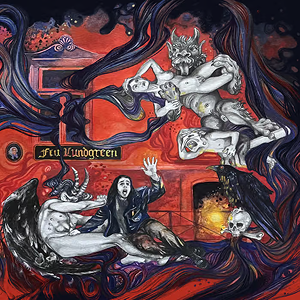
Few bands in the Norwegian Progressive Rock landscape carry the institutional weight of the Arabs In Aspic. Two decades of sustained output have cemented their position as the flagships of Trondheim’s Prog scene, and their third collaboration with Karisma Records, following the equally substantial “IV-VI,” “Pictures in a Dream,” and “The Magic of Sin,” arrives on October 21, 2026, with a gravity that transcends the merely musical. That date is not arbitrary. It marks the day the late Stig Arve Kvam-Jørgensen would have turned fifty. His sudden passing in 2025 removed from the scene one of its most distinctive architects, and “Sorgens Kapittel,” (“The Chapter of Grief,”), is conceived as both an act of mourning and a sustained eulogy to his musical legacy. The title frames the entire record within a deeply personal register: this is a band working through loss in real time, channeling it into compositions of considerable emotional and technical ambition. The resulting sound is a refined articulation of retro-Progressive Rock built upon a foundation that Stig Arve spent decades sculpting: Funky, insistent bass lines, dense, riff-driven guitar work, layered vocal harmonies of striking complexity, and keyboard textures spanning the Hammond organ, Fender Rhodes, and vintage synthesizers. Recorded at Børse Studio by Jostein Smeby, mastered at Cuttingroom in Stockholm, and crowned by Julia Proszowska‘s cover artwork, a dense, rewarding visual composition that rewards repeated, attentive viewing, the album confirms, without reservation, that the Arabs In Aspic remain an indispensable presence within the modern Scandinavian Progressive canon. The opening suite “Avgrunnen Kaller” does no slow-building. It declares the album’s technical ceiling within the first ninety seconds: a vast, immovable wall of sound underpinned by the Hammond and driven forward by the interlocking, polyrhythmic dialogue of the two drummers. Melodic and choral vocal lines weave above a bed of Symphonic Progressive textures that, in turn, play off the weight and solidity of interlocking Heavy riffs and organ voicings. The Norwegian-language lyrics, as with the entire record, are lyrical in the choral passages and incisive in the verses, alternating with dense, elaborately constructed Progressive passages that establish the band’s compositional and performative form from bar one. Darker, heavier moments are threaded through the complex architecture, supported by a monumental rhythm section: double drumming, deep and propulsive bass lines, continuous tempo shifts, and a constantly shifting interplay between guitar and keyboards that enriches the structure with virtuosic phrasing. The track closes with a sustained, expressive Hammond solo that lands, effortlessly, in the tradition of the genre’s most resonant solos, a deliberate, affectionate look back. A brief connective tissue, “Lokale Sagn og Mytteri,” tight, unrelenting riffing and a direct, no-nonsense retro-Prog sensibility keep the momentum between movements without overstaying its welcome. “Satanisten” is a flash of heavy energy in which the band’s characteristic wry, disenchanted humour, that glint in the eye, cuts through the distortion. One minute of concentrated intensity, nothing more is needed. A miniature that nonetheless demonstrates the fluidity of the band’s arranging instincts at sub-minute durations, “Kompisen.” Compact, purposeful, and structurally complete. A focused sketch on the absurdities of everyday life, “Nudisten,” delivered in the mother tongue for the sake of narrative immediacy. It sustains the album’s conceptual thread and ushers the listener into the next major movement. “Syndenes Magi Del 2” is a central pillar of the record, and a direct sonic descendant of the The Magic of Sin material from earlier in the band’s catalogue. Articulate vocal harmonies, vintage synth textures, and the warm scan of a Fender Rhodes anchor a composition that easily sustains its six-and-a-half-minute duration. The interplay of incendiary guitar riffs and Hammond counter-melodies places this unambiguously among the album’s peaks. Continuous tempo changes and extended instrumental passages showcase both the compositional architecture and the ensemble’s collective technique. A central section introduces experimental insertions and exploratory passages, a second, more expansive movement is layered with effects and modulation before the band releases into a dilated, open-textured close. A mid-length, groove-heavy statement, “King Size Brynje.” The push of the twin drum kits and the vigour of the bass lines provide a relentless foundation over which a sumptuous Hammond intertwines with the heavy guitar riffing. The sound here shifts decisively into the Heavy Prog register – dense, saturated, and underpinned by a cutting, penetrating vocal delivery that recalls the stylistic lineage of Dust or Black Widow. All of this is locked into a Nordic Progressive structure that evolves into an instrumental passage driven by percussive, groovy interplay and intricate keyboard writing. “Pentagram” is the darker, leaner episode with unmistakable echoes of 1970s Norwegian and British Prog: Høst, Uriah Heep, filtered through the band’s distinctive Scandinavian tonality. Solid in construction, elaborately detailed in execution, it continues the Heavy Prog trajectory that defines much of the album. The cutting vocal and the rich interweaving of organ and guitar develop over a steadily evolving rhythm section, building the central theme through carefully researched interlocking parts. An analytical snapshot “God på Dårlig Stemning“: relational dynamics and the friction points of modern society, compressed into a tight, observant miniature. The sonic prelude to the finale, “Lyset” is dreamier in texture, edged with Nordic Folk-Rock inflections, it calms the tempo and shifts the emotional register in preparation for what follows. Dynamic, impeccably executed, and utterly without filler. A brief passage that maintains the album’s unwavering tension without a single wasted bar, “Det er Deg!” Previously released in a shortened single edit at the end of September, “Siste Dans,” the full-length closing suite is the album’s emotional and structural apex. It opens with the musicians’ voices in the studio, an unadorned, intimate gesture – before unfolding into a nine-minute suite of profound catharsis. Grief, enveloping melody, and imposing instrumental architecture coexist and converse. The rhythm section, enriched by additional percussion and the ongoing dialogue between the two drummers, lays the rhythmic groundwork for an extended, multi-phase composition. The opening is softer but no less refined: Squire-esque bass lines (the Yes lineage is unmistakable), layered keyboard pads, and arpeggiated guitar figures over which a clearly Scandinavian vocal line delivers the lyrics with melodic grace and constant dynamic intent. Tempo changes bind together symphonic gestures, Nordic-Progressive development, and touches of Heavy exploration, drawing out every facet of the band’s sound. The track resolves in a sustained, expressive crescendo – a fitting, earned close. “Sorgens Kapittel” is raw, dynamic, and profoundly organic. It threads genuinely complex themes, grief, memory, the arbitrary trajectories of human lives, through the crisp, energetic grammar of retro-Progressive Rock and a distinctly Norwegian vein of dry, unsentimental humour. The album sustains a high level of expressive intensity from the first measure of “Avgrunnen Kaller” to the final swell of “Siste Dans,” and in doing so confirms the full compositional and performative maturity the Arabs In Aspic have spent two decades refining. The decision to present the material as a concept, a through-line of medium- and long-form compositions punctuated by sharp interludes and sub-minute bridges, all voiced in meticulously crafted Norwegian lyrics, is precisely the kind of structural integrity a serious Progressive Rock listener expects and values. The band steers well clear of genre cliché and stereotypical posturing, the content is original, the arrangements are specific, and the sound, while undeniably rooted in tradition, is never museum-piece. What it is, instead, is the sound of musicians who can carry the atmospheric weight of the genre’s greatest era into a present-day context without diluting a single harmonic or rhythmic idea. It is, by a significant margin, one of the most compelling records released in the Progressive field to date, and a strong candidate for any year-end top-ten conversation. More than that, though, it stands as the most sincere, most musically complete tribute one band could offer to the keyboardist, songwriter, and friend whose hands shaped so much of this particular sound. Stig Arve Kvam-Jørgensen‘s fingerprints are on every phrase. “Sorgens Kapittel” is, in the truest sense of the word, his.
Tracklist
01. Avgrunnen Kaller (9:30)
02. Lokale Sagn og Mytteri (1:49)
03. Satanisten (1:07)
04. Kompisen (0:52)
05. Nudisten (2:23)
06. Syndenes Magi Del 2 (6:53)
07. King Size Brynje (4:38)
08. Pentagram (2:26)
09. God på Dårlig Stemning (1:43)
10. Lyset (1:29)
11. Det er Deg! (1:12)
12. Siste Dans (9:05)
Lineup
Jostein Smeby / Guitar and Lead Vocals
Erik Paulsen / Bass, Vocals
Eskil Nyhus / Drums
Alessandro Elide / Drums and Percusion
Stig Arve Kvam-Jørgensen (Stig Jørgensen) / Hammond Organ, Keyboards, Vocals