

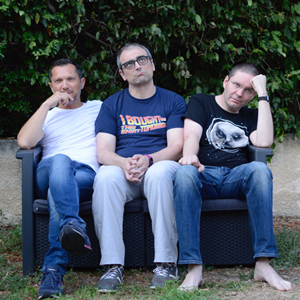
There is a particular kind of artistic integrity that doesn’t announce itself — it simply accumulates, album by album, until the body of work speaks louder than any press release ever could. Lunear, the trio from Avignon formed around the creative partnership of keyboardist and vocalist Paul J. No, drummer and vocalist Sébastien Bournier, and guitarist/bassist Jean-Philippe Benadjer, have been quietly building exactly that kind of discography since their debut “Many Miles Away” in 2018. Five albums in, their music sits comfortably in the lineage of Classic Prog — Genesis, Pink Floyd, Marillion are the obvious touchstones — while carrying something distinctly their own: a gift for Melodic architecture, a lyrical intelligence that cuts deeper than the genre average, and a commitment to the album as a unified emotional experience rather than a collection of tracks.
With “There Is Always Next Time,” released in April 2026 on LunearMusic, the band delivers what may be their most human record to date. Eight songs explore community, memory, friendship, determinism, and the quiet grief of impermanence — anchored by “Christmas Flowers” a 14-minute centrepiece that traces the slow death of a village through the successive closure of its shops. It is the kind of song that makes you think of a specific place, even if you’ve never been there.
We had the opportunity to put some questions to the band ahead of the release. What follows is a conversation about where Lunear came from, where they are now, and what this particular record means to them.
Lunear started from a long-standing friendship between Paul and Sébastien — two musicians who had been playing on each other’s records for years before deciding to write together. When you finally committed to forming a proper band, what was the spark that made you say: “let’s do this now“?
Paul: “Seb and I were both limited by our own abilities. We wanted to share ideas and write good songs—the kind we weren’t making in our own bands.“
Seb: “Being in a real band is very different from a solo project: we don’t have to carry the weight of every decision. But we do have to compromise, and sometimes we can’t get exactly what we want.“
Paul: “Still, that helps us reach levels we couldn’t achieve on our own.“
Jean-Philippe joined later to cover guitars, bass, and mixing. How did his arrival change the creative dynamic of the project — and what specifically did he bring to the table that Paul and Sébastien couldn’t provide on their own?
Seb: “Good guitars, real solos and bass! Neither of us is a great guitar player. And on the demos, solos and bass were often synths and plugins… And JP has a great ear, he mixed our first 3 records, and he is also a very talented graphist.“
JP: “When I joined for the first album, most of the songs had already been written and recorded, except for the guitar and bass parts. My role was to re-record those. But from that first album, I was already able to contribute to writing new songs and bring in my own ideas. For example, “Closed Doors”, the opening track of “Many Miles Away”, originally came from a riff I had written. In fact, the band quickly became a true trio. We’re lucky in Lunear to have three composers with different approaches; it allows for a lot of variety, and we complement each other well.“
Lunear is based in Avignon, in the South of France. Does your geographical location influence your music in any way — or is Lunear fundamentally a project born out of a shared emotional and musical world rather than a local scene?
JP: “We live in 3 different towns (Avignon in the south of France, Dijon in the east of France, and Barcelona, Spain). It’s 2 different countries (France and Spain), so there is fundamentally no “local scene” for Lunear.“
Paul: “Where we live has definitely influenced the way we work. From the start, we knew Seb would write the lyrics. As for the rest, we initially tried writing separately and then reworking each other’s ideas… but that ended up being frustrating. Now, we have to organize ourselves to meet up, spend time together, and compose in person. We don’t have much time, so it might sound stressful to say we only have four days to write an album, but it’s actually quite stimulating.“
Lunear’s sound is clearly rooted in the Classic Prog tradition — Genesis, Pink Floyd, Marillion — but there’s also a distinct melodic sensibility that brings in more contemporary influences like Muse or even Depeche Mode. How do you navigate that balance between the “classic” and the “modern” without losing coherence?
Seb: “It’s not something we think of really. We’re just trying to write the best songs we can. Of course, we love those bands and they have influenced us, there is no denying it. But we’re never trying to copy or ‘sound like.'”
Paul: “Additionally, the three members of the band, we obviously each have our own particular tastes and perspectives. So, it’s difficult to say whether one group influences us more than another. Since the previous album, the fact that we’ve been writing together through jam sessions helps to unify the musical style. On the earlier albums, the ideas were more individual and then developed collectively afterward.“
JP: “As Paul always says, the three of us can achieve what none of us could achieve alone. And that’s fundamentally true. Each of us brings our own touch, pulls the piece in one direction or another, while being tempered by the other two members of the trio.“
Your lyrics are always in English, and the band consciously writes album-oriented music meant to be experienced as a complete journey. In an era dominated by singles and playlists, what does the concept of the full album mean to you — and how does that shape your compositional process?
Seb: “You’re right. We said earlier that we are writing songs but that’s not exactly true: we’re writing songs with the idea of an album in our heads. We’ve never said, “let’s gather and write songs”, we’re saying “let’s write the next album”. Because an album is everything to us, musically speaking. It needs to have balance, a journey, with a beginning and an ending. It’s not just a collection of songs randomly put together. We are even debating how many seconds of silence there should be between the tracks!“
JP: “In a way, every Lunear album—except perhaps the first—is a concept album. At the very least, there’s a dominant idea behind each one. It’s important to keep the overall project in mind, even though, in the case of “There is always next time,” the main idea was “only” to compose the songs together, without having written a single note before the three of them were in the same room. Seb had cheated a little and written tons of lyrics. But for once, the lyrics adapted to the music, not the other way around. We started without any preconceived ideas about what the music on this album would be like, but once the first tracks were composed, we began to structure the album to give it meaning and rhythm.“
Paul, your keyboard work is entirely software-based — VSTs, piano, organ, Mellotron emulation. Is that a practical choice, a philosophical one, or both? And how do you keep the performances feeling organic and warm when working entirely in the box?
Paul: “My main instrument is actually the piano. When I write or when we jam, I always use a piano first. Only afterward do I start thinking about what could change depending on where the song is going. That said, on the latest album, for ‘Pool Balls’ we did start from an arpeggiator sound that I liked as an opening idea. I use VSTs more often, honestly, for space reasons. I’d love to have a room full of real instruments, but I live in Barcelona and I’d need to sell a lot more records to afford a bigger place! (laughs). That being said, to make the music feel organic, I think it’s about trying to have everything played naturally, without too much intervention like heavy quantization. I like it when, in some songs, you can actually hear the original jam session tracks (like the piano build-up in the song “Christmas Flowers”). Also, JP helped me a lot with the orchestral parts in this album to achieve better phrasing for the instruments.“
Looking back at the arc from “Many Miles Away” (2018) to “Curve.Axis.Symmetry“ (2020), “Gostraks” (2022), and then the landmark “From Above” (2024) — how do you describe the sonic and emotional evolution of Lunear across those five albums? What changed, and what remained constant?
Seb: “What changed: we’ve decided to write the songs in the same room and not over the internet. We also decided to have our music mixed and mastered by a pro (David Paredes). We bought a lot of new plugins. And for the last record we didn’t write music for the lyrics. We wrote music and then found what lyric would fit. What didn’t change: we are writing songs and, in the end, the only question we ask ourselves is: what is best for the song.“
“From Above” was widely received as a major leap forward, especially for its 25-minute opening suite “In Their Eyes.” That kind of extended composition requires a very different approach from song-based writing. Was that a conscious ambition, or did the music simply demand that form?
Seb: “In fact: we cheated! In their eyes is basically 5 short songs linked together 😉 Christmas Flowers is a real long song. But, to answer your question, yes, it was a conscious ambition, and I wrote a very long lyric on purpose (on the other hand I had no idea that Christmas Flowers would be that long when I wrote the words)“
JP: “The music for the different sections of “In Their Eyes” was written in chronological order. We basically followed the lyrics, trying to find the right mood for each part, which allowed us to work on the transitions simultaneously. Having recorded “Gostraks” just before that helped us a lot during the process.“
Paul: “Seb knew exactly what mood each part of the song needed. It was very challenging because we didn’t want to follow the classic structure of introducing a theme and repeating it later and at the end. It ended up becoming a suite of five songs, all strongly connected, but it feels like one long piece. And that’s what we wanted.“
Each Lunear album seems to refine and deepen the formula rather than radically reinvent it. Is that intentional — a commitment to a core identity — or do you ever feel the urge to go somewhere completely unexpected?
We like to challenge ourselves. That’s why we made a concept album after the first record. Then a cover album with all the songs linked. Then a “homage” to the 70’s prog albums with one side filled with one song. This one is a “song album” like the first one, except that we wrote it together. We might have run out of ideas though. We’ll see next time! In a way, each new album is the result of experience accumulated on previous ones, as well as a desire to do something different.
“There Is Always Next Time” feels like a more intimate and introspective record compared to From Above. The themes — loss of community, memory, freedom, impermanence — read almost like a personal reckoning. Where did the emotional core of this album come from?
Seb: “From me! I wrote the lyrics (laughs). But seriously, we share a lot of things, we have the same opinion on a lot of subjects, and we don’t like the state of the world right now. It makes us angry, makes us sad, and makes us worried. It shouldn’t be like this. And we hate feeling powerless but that’s how we feel and it’s sad.“
Sébastien, you wrote all the lyrics. The album opens with “Tom & Colin,” a song about a friendship between two drummers that fractures and — hopefully — heals. Is this purely metaphorical, or does it draw from something real? And why open the album with that particular story?
Seb: “You have almost figured out the song! Congratulations, you’re the first one. Yes, it’s about two drummers and it draws from something real (there are obvious clues) and it’s no coincidence that the song ends with two drum parts! We chose this song to begin with because of the music, not the story.“
“Christmas Flowers” is the centrepiece of the album — over 14 minutes — and it’s one of the most quietly devastating pieces Lunear has ever written: the slow death of a village told through the closure of its shops, one by one. What was the seed of that song? Was it a real place, a real experience?
Seb: “Yes. Three places in fact. The first one is a village that I drove through that had a Florist sign on the Main Street. The shop had been closed for many many years apparently. The second one is a village that I went to every weekend in my childhood. At the end, there were only three people left living there yearly. The last one is my in-law’s village. My wife left to study and never came back. When we get there for Christmas, the streets are full. Rest of the time there’s nobody. I took these three places and merged them to write the lyrics.“
Paul: “Interestingly, when we started writing the music, we didn’t intend to create such a long track. In fact, the lyrics are far from being the longest on the album. But once we began, we experienced those magical moments where the music just starts to flow between us. I’m very proud of what we’ve achieved with this song: the orchestral intro, that ternary rhythm between the piano and drums, and the ending with JP’s fantastic guitar solo. I think alternating between shorter songs and longer ones on a record really allows you to emphasise these epics.“
“Rain” undergoes a remarkable transformation across its nearly ten minutes: what begins as a meditation on the simple pleasure of rain gradually becomes a reflection on climate anxiety — fear of floods, fear of drought. Was that arc planned from the start, or did it emerge organically in the writing process?
Seb: “It was planned. I used to love rain. Now it’s a subject of anxiety because of the lack of rain or floods… So, I can’t appreciate rain as I used to when I was younger. The lyric is really straightforward.“
Paul: “The change in the middle of the song was natural but also intentional—almost a need to take the song to another level. We tried other options, but Seb didn’t like them, so we looked for a middle ground. That mid-section allows the track to build toward a spectacular final climax, with a very Gilmour-esque guitar solo from JP!“
Seb: “and the moment the music changes is the moment the lyrics shift from nostalgia to anxiety.“
“Pool Balls” takes on determinism and free will through the metaphor of a billiard table — a genuinely philosophical concept delivered through a driving, almost mechanical groove. How do you approach writing music that carries such conceptual weight without becoming didactic or cold?
Seb: “The song is about fate, free will, determinism – call it whatever you want – and about a computer that can calculate everything and therefore knows the future and the past. Bear with me please: when you play a pool game, the computer can calculate the position of the balls on the table after each turn. The player chooses where to aim and how strong to hit and the computer calculates the position of the balls, so it can calculate the future. That’s also true the other way around: the computer can calculate the previous position of the balls from the way they are spread on the table. It can calculate the past. The song extrapolates this to the whole universe and interactions between atoms and electrons and other particles… So, the song basically says that everything can be calculated. So, I wanted something in the music, a pattern, that is somehow not predictable. I thought of the Conway Sequence (aka Look-and-Say Sequence) where you cannot calculate the next term. The beginning of the sequence is 1, 11, 21, 1211, 111221, 312211 (remember that I asked to bear with me: that’s why!) so, I translated that is sixteenth notes and that is the sequence you can clearly hear at the beginning and that runs throughout the whole song.“
Paul: “I used an arpeggiator as a foundation, that goes along the Conway sequence to create the mood of the song. There’s a certain mathematical coldness in the verses, with those repetitive minor patterns, but we contrast that with a more open, melodic chorus in major chords. The middle section shifts again, with a long guitar solo and synth textures that have a slight Giorgio Moroder-like feel.“
JP: “The coldness of the verse is counterbalanced by the very danceable, almost disco-funk bassline. I found that contrast musically fascinating. It has to be my favorite bassline on the album; it’s just so much fun to play! Similarly, during the instrumental break, the contrast between the synth arpeggios and a massive fuzz guitar sound felt perfectly natural to me. It needed to be huge, but at the same time, almost ethereal.“
The album closes with the brief and beautifully simple “Next Time,” which feels like a farewell — but an optimistic one. Was it always intended as a kind of coda, a way of leaving the listener with something warm after the emotional weight of the previous tracks?
JP: “When we wrote it, it was very clear that this would be the closing track. It was so obvious that we didn’t even question it. But it was not intentional. It only happened that way. In fact, this song came about almost by accident. Paul and I were relaxing in the living room, both with a guitar in hand, strumming aimlessly. Paul had two chords he liked, I added others, the melody line followed, and in less than an hour the song was finished, almost exactly as it appears on the record. We wanted to preserve that moment; it was magical.“
Paul: “the tambourine and part of the guitars are from the jam sessions!“
Seb: “the vocals too in fact. I never sang the song again. To keep it fresh, real and genuine.“
The record is dedicated to Gilles Snowcat, described as your “dear friend and first supporter.” Would you like to share something about him — and how his memory influenced the making of this album?
Seb: “Gilles was a dear friend of mine. Whenever I had a new music or lyrics, he was the first one to hear or read. I needed his approval; it meant everything to me. If he didn’t like something I either tossed or reworked it. He was my compass, my north star. Now I feel lost without him. He passed while we were making the record. He had read the lyrics but heard only a few of the tracks. I’m just left wondering ‘Would he have loved it? What would he have thought?’ He left us only two months after the release of his last album. Gilles Snowcat – Don’t Leave Your Mistakes Unattended. I urge you to listen to it please. It’s a beautiful record.“
On the production side: David Paredes handled mixing and mastering again. How does your working relationship with him shape the final sound of a Lunear record? How much direction do you give him, and how much do you trust his instincts?
JP: “David mixed Paul’s solo albums; that’s how we met him. Besides being talented, he’s a charming guy. And very patient. We really drove him crazy on “There Is Always Next Time.” If he’s reading this, we’re sorry. The thing is, we have a very clear idea of what we want, but it’s not always easy to put into words. And when we give him the tracks to mix, because of our recording method, the tracks are already full of mix ideas. Basically, we tell him, ‘Do it like the premix, but much better’ (laughs).“
Paul: “David is Spanish and I’m the original link between him and the guys. For “From Above” we went to his studio to finalize the mix. It was a wonderful moment. For this record, he offered a new technology that allowed us to listen to what he’s doing in his control room, in real-time. So, we did a lot videoconferencing to finish the mix properly. I know we drove him crazy, but I believe the result is fantastic and I hope he isn’t too mad at us (laughs).“
Lunear has always been described as a studio-focused project, consciously stepping away from the conventional touring model. Has that ever changed — have you played live, and if so, what was that experience like? Is it something you’d ever revisit?
Unfortunately, we live too far apart to consider playing live. There’s no way to rehearse properly. And more importantly, given the arrangements of our songs, we’d need to hire at least three additional musicians, which is complicated. Even “There Is Always Next Time,” which was composed and mixed with a “live trio” in mind, would be difficult to perform with just the three of us.
What comes next for Lunear? Is the creative process for a new record something you begin almost immediately, or do you need time to let an album breathe before moving on?
Nothing is planned for the future. This year will be a “blank year” for Lunear, and we’ll focus on our solo project. But there will be another Lunear album, for sure. We loved the way this one was created, and we really want to re-do the experience. We’ll probably start writing again in 2027. We still need to figure out our approach for the next album, because, as we’ve said, we don’t like to repeat ourselves. But right now, we need time for our respective projects, and we need to recharge our batteries because, believe it or not, we’ve released five albums in eight years, which is a good pace for a band.
A final question: what would you most like listeners to take away from “There Is Always Next Time” — the one feeling, image, or thought you hope stays with them after the last note of “Next Time” fades out?
Seb: “That’s a hard one to answer. We make the record for ourselves, first and foremost. That’s why we didn’t make ‘from above 2.0”. That being said, there’s nothing more satisfying than when we see, read or hear from someone who enjoys our music. I guess, in the end this is all that matters “I liked it, it was worth the time, I want to listen again.'”
Paul: “I’d love listeners to come away with a sense of hope — that even after something ends, there’s always another chapter waiting. That idea of ‘next time’ is really about resilience and moving forward. Musically, we wanted the journey to feel dynamic and alive. The album closes on a lighter note, but along the way there are some very intense, emotional and lyrical moments. We also brought in orchestral elements on the three longer tracks to really push those epic sections further. At the same time, we made a conscious effort to include more direct songs — something a bit more immediate. In a way, to me it unintentionally ended up echoing some of those neo-prog records from the ’80s: a balance between powerful, immersive moments and lighter passages where you can breathe before the next peak. If listeners can feel that same kind of journey — that contrast and release — that would mean a lot to us. I know that for many prog rock fans, the ‘epic’ is what they’re looking for, but I feel it’s often overemphasized. I’ve heard albums by great bands that lose their impact because they have too many epics, making them quite hard to digest. I believe that balancing shorter, more direct songs with longer pieces actually gives those epics much more power.
JP: “Even more so than on our previous albums, I want the listener to feel the pleasure we take in composing and playing together. I think you can hear that, and it gives the album a ‘live’ feel.“
“There Is Always Next Time” is out now on LunearMusic. It is the kind of album that rewards patient, full-length listening — the kind of record that Prog has always done best, and that Lunear, album by album, continue to prove still matters. We are grateful to Paul, Sébastien, and Jean-Philippe for their time and for sharing the story behind this music.
You can find Lunear‘s “There Is Always Next Time” at lunearmusic.com and on Bandcamp. Keep an eye on Progressive Rock Journal for a full review of the album.
Read our Review of “There Is Always Next Time” here: [Review] Lunear – There Is Always Next Time