

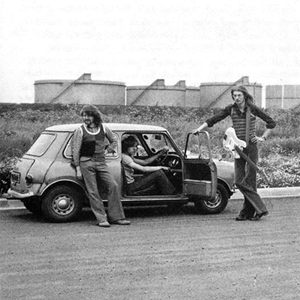
Dark, originating from Northampton in the United Kingdom, represent one of the most elusive and fascinating cases in early-Seventies British Psychedelic and Progressive Rock. A band that left behind a single studio album—now regarded as one of the rarest and most coveted private-press LPs of its era—before dissolving into near-total obscurity, Dark embody the archetype of the underground cult phenomenon.
Formed in 1968, the band developed a sound deeply rooted in Psychedelic and Acid Rock, gradually incorporating proto-Progressive elements. Their music sits at the crossroads between late-Sixties improvisational freedom and the emerging structural awareness of early Progressive Rock, combining extended instrumental passages, fluid rhythm sections and guitar-driven explorations shaped by a dark, introspective atmosphere.
— Dark Round the Edges – A private-press myth —
Dark’s sole original release, “Dark Round the Edges” (1972, S.I.S. Records), has achieved legendary status among collectors. The album was pressed in an extremely limited run of just 64 copies, making it one of the most elusive British private pressings of the decade. Twelve of those copies were issued in handmade gatefold sleeves, individually assembled and annotated by Steve Giles—frontman, guitarist and principal creative force—complete with photographs and handwritten notes.
Musically, the album consists of six medium-to-long compositions built on hypnotic grooves, fuzz-saturated guitar lines and elastic rhythm work. The material unfolds organically, often blurring the line between composition and improvisation. Echoes of Barrett-era Pink Floyd surface in the free-form sections, but Dark’s approach is heavier, earthier and more brooding, driven by a distinctly underground sensibility rather than cosmic abstraction.
At the time of its release, “Dark Round the Edges” went virtually unnoticed outside the band’s local circuit. Its rediscovery began decades later, with the first official reissue appearing in 1991 on Darkside Records. Subsequent reissues by Kissing Spell, Akarma, Machu Picchu Ltd and other specialist labels helped introduce the album to a wider audience, while the original 1972 pressing steadily climbed into the upper echelon of rare-record collecting.
— Insights from the official Dark archive —
The band’s official website, darkedges.net, functions as a primary archival source, offering first-hand accounts that deepen and humanise Dark’s story. According to the band, the name Dark was inspired by a photograph of French actress Mireille Darc—an anecdote rarely mentioned in secondary sources. The site also documents the band’s early local popularity around Northampton, their changing line-ups, and the pragmatic, almost accidental nature of their formation, including finding members through local ads rather than formal industry channels.
Equally revealing are the post-band reflections: members recount ordinary working lives following the split, failed industry opportunities—such as a missed Island Records showcase—and their bemused reaction to the album’s later collector status. Rather than mythologising success, the narrative remains grounded, often understated, and notably self-aware.
The website also serves as a distribution point for band-curated CDs and DVDs, featuring live recordings, anniversary performances and farewell concerts, many produced independently by the members themselves. Additional material includes lyrics, artwork, photographs and documentation of remastering work carried out at Abbey Road Studios, underscoring an active, ongoing effort to curate and preserve the band’s legacy.
— Archival releases and later material —
Beyond the original album, a substantial body of archival material has surfaced over the years:
– “Dark & Tarsus (Unreleased Sessions)” (1994, Kissing Spell), a split release featuring previously unheard studio recordings.
– “Teenage Angst (The Early Sessions)” (1994, Kissing Spell), collecting formative tracks recorded between 1969 and 1971.
– “Artefacts From The Black Museum” (1996, Acme), a limited edition of studio material from 1970–71.
– “The Jam” (2001, Kissing Spell), a single 24-minute track recorded in 1975, revealing a more expansive and exploratory approach.
– “Catalogue Raisonné” (2022, Seelie Court), a monumental 13-volume archival series compiling the complete Dark catalogue, including alternate takes, session material and live recordings, alongside a carefully produced reissue of “Dark Round the Edges.”
— Why Dark belong in Hidden Rarities —
Dark epitomise the essence of Hidden Rarities: a band whose creative peak produced a single, elusive artefact that transcended its initial obscurity to become a reference point for collectors and connoisseurs of underground British Psychedelia. Their music captures a fleeting historical moment in which Psychedelic experimentation, improvisational instinct and emerging Progressive ambition briefly aligned, resulting in a sound that remains raw, immersive and strikingly authentic.
— Discography —
“Dark Round the Edges” (1972, S.I.S. Records)
“Dark & Tarsus (Unreleased Sessions)” (1994, Kissing Spell)
“Teenage Angst (The Early Sessions)” (1994, Kissing Spell)
“Artefacts From The Black Museum” (1996, Acme)
“Anonymous Days” (1996, Darkedge Records)
“The Jam (2001, Kissing Spell)
“Dark Cross The Ages” (2019, Void Records)
“Catalogue Raisonné Vol. I-II-III” (2022, Seelie Court)
“In The Sky” (2024, Seelie Court Digital, S.I.S. Records)