

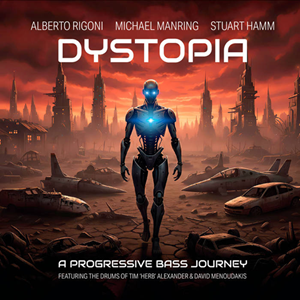
There are records that document technical achievement, and there are records that transcend it — works in which virtuosity becomes inseparable from a larger artistic intention, where the instrument itself is reimagined as compositional language. “Dystopia,” released on February 24, 2026 via the prestigious French imprint Musea Records, and Melodic Revolution Records, belongs emphatically to the second category. Conceived and produced by Italian bassist and composer Alberto Rigoni, the album brings together two of the most consequential voices in the history of the electric bass — Michael Manring and Stuart Hamm — in a collaborative statement of remarkable ambition and conceptual coherence. With drummer Tim “Herb” Alexander (of Primus) appearing as a special guest across three central tracks, and the precise, Progressive-oriented David Menoudakis handling the remaining rhythmic architecture, “Dystopia” is far more than a bass summit or a display of collective virtuosity. It is a fully realized album that maps the tension between collapse and regeneration, between fragmentation and form, through nine compositions that traverse Progressive Rock, Fusion, Cinematic Experimentalism, and Ambient exploration with singular conviction. What immediately distinguishes “Dystopia” from comparable collaborative endeavours is its commitment to identity over ego. Three bassists who each possess entirely distinct timbral personalities, compositional philosophies, and technical vocabularies have been assembled not to compete, but to converse. Rigoni’s powerful, groove-anchored approach, Manring‘s hyper-melodic and texturally otherworldly sensibility, and Hamm’s rhythmically ferocious, tonally commanding voice each represent a separate tradition within the instrument’s expanded canon. That these voices cohere into a single, unified artistic statement — without any one subsuming the others — is perhaps the album’s most quietly impressive achievement. “Genesis” opens the record with a declaration of intent that fully justifies its biblical title. This is not a gentle invitation but an immersive statement of musical purpose, built on a densely layered rhythmic foundation courtesy of David Menoudakis, whose drumming provides the structural bedrock upon which the track’s Progressive architecture rests. The theme evolves through a succession of time signature shifts that never feel gratuitous; rather, they accumulate meaning, mapping an internal logic that rewards attentive listening. All three bassists contribute to a sound that is simultaneously technical and organic, each melodic and solo intervention remaining in service of the collective voice rather than departing from it. The result is an opener that establishes Dystopia‘s conceptual framework with authority and compositional intelligence. “Echoes of the Machine” explores the symbiotic potential of Rigoni and Manring operating in close harmonic proximity, with Menoudakis‘ drumming lending a distinctly Rock-inflected muscularity to what is, at its core, a deeply sophisticated Fusion piece. The interplay here is of a particularly refined quality: bass lines weave and stratify, effects and modulations are deployed with precision rather than decoration, and subtle suggestions of Eastern tonality introduce a modal dimension that enriches the harmonic palette considerably. The title, with its implicit meditation on mechanical repetition and industrial entropy, resonates through the track’s rhythmic clockwork and its controlled, accumulative structure. “The Algorithm,” performed solely by Michael Manring, represents one of the album’s most arresting moments precisely because of its restraint. Here, Manring‘s signature capacity for sculpting entire emotional landscapes from a single instrument is placed in full evidence. Operating at the intersection of ambient music and Experimental bass technique, the piece unfolds as a meditation on minimalism — each carefully chosen note acquiring weight through space and deliberate understatement. The track reveals the album’s capacity for dynamic contrast and confirms that “Dystopia” has no interest in maintaining a single intensity. Tim “Herb” Alexander makes his first appearance on “Entropia”, and the compositional energy shifts perceptibly. Alexander‘s idiosyncratic polyrhythmic vocabulary — unmistakable to anyone familiar with his work in Primus — introduces a new level of rhythmic complexity and forward momentum. The groove is dense, elastic, and constantly evolving, creating an ideal foundation over which the bassists layer solos of considerable invention. Time signature changes arrive with the naturalness of organic breath rather than calculated calculation, and the track’s conclusion — a mounting crescendo of interlocking rhythmic and melodic intensity — lands with satisfying inevitability. Stuart Hamm assumes sole ownership of “Limbo,” delivering a self-contained statement that functions as both a character study and a conceptual pivot within the album’s arc. Hamm‘s tone is immediately identifiable: warm, rounded, and authoritative in its lower registers, with a rhythmic precision that recalls his celebrated work across three decades of instrumental collaboration. Drawing on ambient texture and carefully controlled electronic soundscapes — cupped, oppressive, and unsettling — the track operates as a sonic metaphor for suspension and unresolved tension. It is a piece that unsettles without alarming, creating a listening space of genuine introspective weight. “Born from Ashes” reunites the full ensemble with Tim “Herb” Alexander and emerges as one of the album’s most compositionally ambitious and satisfying moments. The track is built around an elaborate percussive foundation over which Progressive Rock structures and Fusion-derived harmonic thinking engage in sustained, productive dialogue. Symphonic openings — moments of genuine orchestral breadth — contrast with passages of dense, propulsive bass interplay, creating a dynamic architecture that justifies the track’s extended duration. A cinematic sensibility pervades the composition, particularly in its closing passages, where melodic lines acquire a gravity and finality that feels genuinely conclusive. The outro, percussive and strikingly effective, seals the track with a memorably kinetic energy. “Solar” arrives as something of a revelation in tonal and emotional register — an elegant, lucidly melodic piece that demonstrates the trio’s capacity for Jazz-inflected expressivity and harmonic warmth. Built around a masterful dialogue between bass and drums, the track navigates its dynamic shifts with the ease of long-practiced conversation, and the final percussive passage — an extended, expansive solo — offers one of the album’s most musically exhilarating sequences. It is a reminder that technical mastery, when deployed with musical intelligence, can generate emotion as readily as it generates admiration. “Ethereal Horizon,” performed solo by Alberto Rigoni, is a remarkable two-and-a-half-minute experiment in timbral transformation. Through a combination of sustained droning, layered electronic processing, and pitch modulation, Rigoni effectively dismantles the conventional identity of the bass guitar, reconstituting it as something approximating synthesizer texture. The piece is, in the truest sense, a study in instrumental deception — and a quietly radical one, demonstrating a compositional intelligence that extends well beyond conventional bass vocabulary. The album closes with its most substantial and multidimensional work. “Dystopia,” running to over eight minutes and featuring Tim “Herb” Alexander in his final appearance, operates as a genuine mini-suite — a terminal statement of considerable weight and structural complexity. The three bassists and Alexander build their most layered and sustained ensemble texture here, allowing themes to emerge, develop, and return in transformed guise. Orchestral in its scope yet intimate in its detail, the title track embodies the album’s central tension with uncommon precision: the coexistence of order and fragmentation, of technical discipline and expressive freedom, of individual voice and collective vision. It is a conclusion that arrives with the authority and inevitability of a work that has fully earned it. “Dystopia” is, finally, a record that demands to be understood on its own terms. It does not seek to accommodate genre expectation or audience comfort; it constructs its own internal logic and invites the listener into it. Alberto Rigoni, Michael Manring, and Stuart Hamm have produced not a showcase but a statement — an album that takes three of the electric bass guitar’s most consequential voices and deploys them in the service of a genuinely original artistic vision. In a landscape where collaborative projects of this kind risk resolving into little more than mutual admiration exercises, “Dystopia” achieves something substantially more significant: it establishes itself as an indispensable document of what the instrument can become when placed in the hands of artists who conceive of it not as a supporting role, but as the primary language of musical thought.
Tracklist
01. Genesis (04:24)
02. Echoes Of the Machine (04:12)
03. The Algorithm (Michael Manring) (03:15)
04. Entropia feat. Tim “Herb” Alexander (03:54)
05. Limbo (Stuart Hamm) (04:00)
06. Born from Ashes (feat. Tim “Herb” Alexander) (05:45)
07. Solar (03:36)
08. Ethereal Horizon (Alberto Rigoni) (02:34)
09. Dystopia (feat. Tim “Herb” Alexander (08:46)
Lineup
Alberto Rigoni / Bass
Michael Manring / Bass
Stuart Hamm / Bass
With:
Tim “Herb” Alexander / Drums (Tracks 4, 6, 9)
David Menoudakis / Drums (Tracks 1, 2, 7)