

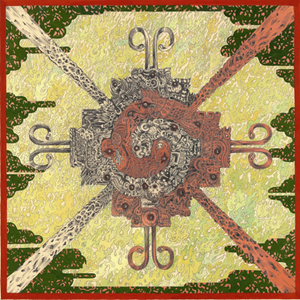
Corima is a Los Angeles-based ensemble whose artistic identity has been constructed, with notable deliberateness, at the precise convergence of Zeuhl, Rock In Opposition, and Avant-Prog — three traditions that demand from their practitioners not merely technical proficiency but a specific quality of collective intelligence, an ability to sustain structural complexity without sacrificing expressive coherence. “Hunab Ku,” released on February 16, 2026 via Soleil Zeuhl, is the band’s fourth full-length record and third consecutive release through the French label that has consistently championed the most rigorous and uncompromising strains of contemporary Zeuhl. Named after the Mayan concept of the supreme cosmic force — the galactic centre, the singular source from which all existence radiates — the album does not invoke this symbolism decoratively. It pursues it structurally, compositionally, and with full artistic conviction. What emerges across seven tracks and approximately thirty-seven minutes of music is a record that positions Corima not merely as capable inheritors of a well-defined lineage, but as one of the most accomplished and distinctly voiced ensembles currently working within this demanding and frequently misunderstood area of the Progressive spectrum. The instrumentation itself signals intent. Andrea Calderón on violin and vocals, Paco Casanova on keys, synths, organ and vocals, Patrick Shiroishi on saxophones, guitar, glockenspiel and vocals, Ryan Kamiyamazaki on bass, and Gopala Bhakta on drums, tabla, harmonium and vocals — this is an ensemble whose timbral range extends considerably beyond what standard rock configurations permit, and whose multi-vocal approach generates a choral dimension that runs through the entire record as both structural and atmospheric device. The presence of tabla and harmonium alongside conventional kit percussion, of violin alongside saxophone, and of glockenspiel within the broader textural fabric, speaks to a compositional philosophy that prioritises colour and density over reduction — music conceived not as the interaction of discrete parts but as a continuously evolving collective organism. “Yok’hah” opens the record and establishes the album’s coordinates with considerable immediacy. The track deploys the full range of Corima’s ensemble language from its earliest moments: a rhythmic foundation that is technically exacting and propulsive without sacrificing internal nuance, layered above it a melodic fabric woven from the interplay of saxophones and violin that carries unmistakable resonances of early-Magma while remaining grounded in a sensibility entirely the band’s own. The time signature shifts are frequent and handled with the kind of authority that speaks to deep ensemble cohesion — not change for its own sake, but structural articulation in service of a broader compositional arc. The combination of wind instruments and violin as primary melodic voices creates a particularly distinctive textural quality: warm but angular, lyrical but restless. As an opening statement, it is direct and fully convincing, declaring the album’s terms of engagement without equivocation. “Xock’ab” follows with a track of considerably tighter construction — under three minutes, but compositionally dense and rhythmically relentless. The pulse is driven and unrelenting, the melodic material obsessive in its repetition and claustrophobic in its harmonic tension, with the saxophone lines operating in a register that generates genuine psychic pressure. The choral vocal entry in the closing passage introduces a moment of controlled release that functions with real structural intelligence, expanding the sonic space at precisely the moment the compression has reached its maximum. It is a brief piece but a precise one, its brevity a compositional decision rather than a limitation. “Manla” represents a significant pivot in the album’s internal logic, introducing a more openly Jazz-inflected mode of address that draws upon the Canterbury tradition without reducing itself to pastiche. The bass work here is particularly distinguished — harmonically purposeful, melodically assertive, and capable of sustaining both the rhythmic framework and a genuinely melodic function simultaneously, anchoring a piece whose upper-register material moves with considerable freedom. The saxophone soloing opens the composition’s harmonic space with notable fluency, and the subsequent violin response — dialoguing rather than competing — generates an instrumental exchange of real conversational quality. Time signature changes arrive with consistent unpredictability, maintaining an attentiveness in the listener that is fully earned rather than arbitrarily demanded. Within the broader architecture of the album, “Manla” functions as its most generously proportioned moment of Jazz-Progressive synthesis, and it is among the record’s most fully realised pieces. The album’s Zeuhl and R.I.O. character asserts itself with particular clarity in “K’iik,’, a composition whose structural ambition and collective precision place it among the record’s most demanding and rewarding moments. The percussion work — at once melodic and rhythmically complex, with Bhakta navigating rapid metric shifts with the kind of authority that marks a genuinely accomplished player — drives a piece in which saxophone and violin are deployed as equal and often contrasting voices, generating a textural density that approaches, at certain moments, genuine heaviness. The vocal contributions here carry a specifically Experimental quality, functioning more as timbral elements within the ensemble fabric than as traditional melodic devices. What distinguishes the track above all is its sense of ongoing transformation: the composition does not settle into a recurring structure but continues to evolve, each section generating the conditions for the next, until the piece arrives at its conclusion having traversed considerable musical territory without ever losing its internal coherence. “Inlilnaluk” marks the album’s most overtly exploratory passage. Electronic processing and synthesised textures enter the compositional fabric in a sustained and structurally significant way, modulating the rhythmic and harmonic environment with a psychedelic quality that extends the record’s tonal palette considerably. The piece develops through clearly articulated phases: an initial section built on rhythmic complexity and electronic modulation gives way to a passage of greater lyricism, with violin and layered vocals constructing a quasi-symphonic texture above which the woodwind contributions accumulate and intensify. The closing movement introduces melodic and timbral inflections that carry an unmistakably Eastern character — not as surface decoration but as a genuine expansion of the composition’s harmonic vocabulary — creating a piece whose structural breadth is matched by its atmospheric range. At nearly eight minutes, “Ho-Huitzilopochtli-Tlaloc” is the album’s most expansive single statement, and it earns its length with consistent compositional generosity. The opening establishes a Jazz-Rock foundation — keyboards, percussion, and vocals interacting within a framework that is rhythmically alert and harmonically open — before the piece begins its gradual process of accretion, drawing successive elements into an increasingly dense and multi-layered texture. The references to the ensemble’s Zeuhl lineage are present and unmistakable across this passage, but they are contextualised within a broader compositional ambition that absorbs influence without being defined by it. What develops over the track’s seven-plus minutes is a sustained demonstration of Corima‘s capacity for large-scale musical thinking — the ability to maintain structural coherence and expressive momentum simultaneously across an extended compositional span. It is the album’s centrepiece in every meaningful sense of that term. The closing “Kultunlilni” brings Hunab Ku to its conclusion through a piece whose opening section is among the album’s most compositionally intricate — a fully scored, multi-voiced passage in which all instrumental elements operate at high density, generating a collective complexity that demands and repays close listening. The central section introduces a moment of genuine opening, the texture thinning and the harmonic space expanding in a way that produces a satisfying sense of arrival after the sustained intensity of what has preceded it. The closing passages carry Jazz-Rock and Avant-Prog inflections that bring the record to a conclusion at once resolved and deliberately provisional — the final statement of an album that has consistently refused the comfort of easy resolution. “Hunab Ku” is a record that confirms Corima‘s position as one of the most purposeful and compositionally assured ensembles currently working at the intersection of Zeuhl, Rock In Opposition, and Avant-Prog. The album operates across a remarkable tonal and structural range — from the rhythmic austerity of “Xock’ab” to the sustained expansiveness of “Ho-Huitzilopochtli-Tlaloc,” from the Jazz-Progressive generosity of “Manla” to the Electronic exploration of “Inlilnaluk” — without sacrificing the internal coherence that distinguishes a genuinely achieved body of work from a merely impressive sequence of performances. The ensemble’s collective precision is matched throughout by an evident commitment to compositional intelligence: this is music that has been thought through as well as felt, constructed as well as performed. The multi-instrumental scope of the lineup — violin, saxophone, tabla, harmonium, glockenspiel, alongside the conventional elements of keys, bass and drums — is not simply a timbral resource but a compositional philosophy, and it is deployed throughout the record with full consistency and conviction. For those with a serious engagement with the Zeuhl tradition and its Avant-Garde extensions, “Hunab Ku” is essential listening. For those approaching Corima for the first time, it is the most complete and fully articulated expression of everything this band has been building toward.
Tracklist
01. Yok’hah (04:06)
02. Xock’ab (02:53)
03. Manla (05:42)
04. K’iik’ (05:22)
05. Inlilnaluk (06:34)
06. Ho-Huitzilopochtli-Tlaloc (07:56)
07. Kultunlilni 04:15
Lineup
Andrea Calderón / Violin, Vocals
Paco Casanova / Keys, Synths, Organ, Vocals
Patrick Shiroishi / Saxophones, Guitar, Glockenspiel, Vocals
Ryan Kamiyamazaki / Bass
Gopala Bhakta / Drums, Tabla, Harmonium, Vocals
[…] [REVIEW] […]
[…] Corima – Hunab Ku: A Los Angeles ensemble working at the precise convergence of Zeuhl, Rock In Opposition, and Avant-Prog, Corima deliver their fourth full-length via Soleil Zeuhl — seven tracks, thirty-seven minutes, and a record named after the Mayan concept of the supreme cosmic force. The multi-instrumental scope of the lineup — violin, saxophones, tabla, harmonium, glockenspiel alongside keys, bass and drums — is not a timbral resource but a compositional philosophy, deployed across an arc that runs from the rhythmic austerity of “Xock’ab” to the nearly eight-minute sustained expansiveness of “Ho-Huitzilopochtli-Tlaloc.” One of the most purposeful and compositionally assured ensembles currently working in this area of the Progressive spectrum. Essential. [Read here] […]