

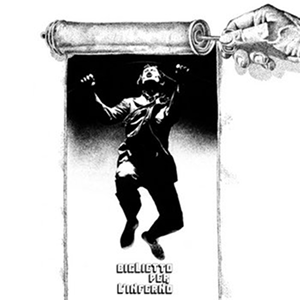
The self-titled debut of Biglietto per L’inferno, first pressed in 1974 on Trident, occupies one of the highest points in the architecture of Rock Progressivo Italiano (RPI). The Lecco ensemble carved a mark on Italian musical history that resists being reduced to a footnote, binding a distinctly energetic Heavy Prog force to the melodic, Mediterranean sensibility that defined the era’s finest groups. Anchoring the album’s visual and conceptual identity is the now-legendary cover photograph by Cesare Monti, an image that has grown into a defining icon of the genre across four decades of critical discourse. At the centre of that world stood Claudio Canali, singer and multi-instrumentalist whose lyrics oscillate between the provocatively confrontational and the deeply introspective. He led a sextet of exceptionally accomplished players through two years of relentless creative output before the collapse of Trident severed the band’s trajectory almost overnight. Their second record, “Il Tempo della Semina,” was left hanging in the ether for years, a ghost that never materialised in physical form. Canali‘s subsequent decision to withdraw from public life and take up residence in a monastery, a vocation he kept until his passing in 2018, added a layer of biographical gravity that no amount of posthumous commentary can dilute. Equally pivotal in the group’s DNA was keyboardist Giuseppe “Baffo” Banfi. After the dissolution of the band he followed a solitary path through Ambient textures and the broader orbit of German Kosmiche Musik, a trajectory that has earned him a reputation among practitioners and collectors as the Italian counterpart to Klaus Schulze. That duality, the fiery collective of the original group against the meditative solo work of its key members, gives the 1974 recording a particular emotional weight that purely musical analysis can only partially capture. The reissue programme mounted by AMS Records in 2026 is therefore not a mere nostalgia exercise. It is a corrective. By issuing a limited-run audiocassette of fifty copies distributed by BTF, a white vinyl pressing, and a CD digisleeve edition accompanied by a twelve-page booklet assembled by Mox Cristadoro and distributed through Astronomy Recording Music, the label restores the album to the physical and listening experience as a work that demands sustained, repeated engagement from anyone who takes the Italian Progressive tradition seriously. The record opens without pretence with “Ansia,” throwing the ensemble’s raw executory force into full relief from the first bar. Marco Mainetti‘s Gibson Les Paul Special locks into a driving riff, underwritten by the rhythmic engine of Fausto Branchini on Fender Telecaster bass and Mauro Gnecchi on Gretsch drums. Over that bed the keyboard architecture unfurls in two distinct layers: Giuseppe Cossa‘s piano and Hammond C3 organ on one hand, Giuseppe Banfi‘s Minimoog and Gem organ on the other. The interplay between these voices produces a dense, tension-charged field that Canali‘s transverse flute punctuates with phrases of unexpected clarity. The lyrical content is a gutted confession of guilt. Canali sings of a sorrowful, infamous life spent killing and stealing, a catalogue of sins that returns every night carrying the terror of finding no one willing or able to save him. A friend has spoken of priests he has never seen, and the narrator is left suspended between suspicion and hope, wondering whether those figures are charlatans, merchants of comfort, or genuine prophets capable of lifting the affliction that weighs on him. The song does not resolve that question. It lets it hang. A more theatrical piece, “Confessione,” built on a dialogue that snaps between tempos with the abruptness of a theatrical lighting cue. The guitar’s aggressive phrasing collides with the vintage keyboard evolutions of Cossa and Banfi, and the effect is sharpened further by the deployment of a Binson Echorec, which smears and repeats the instrumental phrases into a shimmering, almost hallucinatory texture. Canali himself steps in with the Orsi tenor saxophone, injecting a brassy, almost baroque counterpoint that no one expects from a Prog record of 1974. Dramaturgically the song stages a relentless interrogation. The figure of Frate Isaia demands to know the protagonist’s sin, with whom it was committed, and how many times. The irony is layered: the religious authority who should absolve instead interrogates, and the social conventions he represents are implicitly laid bare. The result reads as a conceptual manifesto in miniature, effective not because it preaches but because it exposes the machinery of shame from the inside. Closing the first side, “Una strana regina” that most clearly displays the band’s arranging maturity. Released independently as a 45 RPM single, it carries the polish of a composition shaped for the broadcast as well as the long-form album. The piece moves in waves between lyrical, almost vocal-instrumental passages and sudden instrumental outbursts where Mainetti‘s guitar trades figures with Banfi‘s synthesizer lines in a call-and-response that never feels rehearsed. Canali‘s vocal delivery here gains a particular intensity. He dissects the machinery of power and the hollowness of regal pretence with a coolness that makes the performance more unsettling than any overt anger could achieve. The “strange queen” is never fully identified, and that ambiguity is the point. The second side opens on a completely different register, and the shift is the album’s most disorienting. Co-written with Giancarlo Cappellini and Osvaldo Trimboli, “Il nevare” is the sextet at its most poetic and inward-looking. Delicate arpeggios and long, unhurried flute passages sketch Alpine landscapes in sound: high meadows, thin air, the particular silence of a mountain valley in early winter. Canali‘s imagery is precise and unsentimental. White clouds drift across a sky that is blue but opaque, gazing down on fields still bearing the marks of the plow. He imagines that the snow’s refusal to fall may not be malice but a small war waging itself even in the heavens. The narrative then turns to the moment of arrival: Heavy flakes landing on eyes that are struggling to see, to understand, to register how much pure joy can be generated by something as simple and as indifferent as snow falling. The song does not moralise. It watches. The compositional summit of the record, and its most devastating act of musical honesty, “L’amico suicida.” Running beyond thirteen minutes, the suite is structured in continuous, chromatically shifting movements guided by Cossa‘s Hammond and Banfi‘s Minimoog, each section bleeding into the next without the comfort of a traditional verse-chorus reset. Canali describes the scene with a directness that borders on the forensic: his friend’s body, the halo of death surrounding it, the gaunt face that still manages a fierce smile. The narrator then turns his full force against the “dirty, idiot world” that created this person and then condemned him for dying. The ethical statement arrives not as accusation but as identification. Canali declares that he does not blame the act, that he knows the sad poetry of it, and in doing so he grips his friend’s hand with a tenderness that the music reinforces in the long, majestically unhurried instrumental close. “Confessione (instrumental version)” [bonus, CD edition] was roduced by Maurizio Salvadori, this stripped arrangement removes the vocal narrative and exposes the skeletal architecture of the original. Without Canali‘s words, the interplay between the guitar, the Echorec-processed keyboard textures, and the Orsi tenor saxophone becomes the sole carrier of the dramatic tension. It is a valuable document for anyone who wishes to hear how much of the song’s impact resides in the playing rather than the text. Fifty years after its first pressing, the debut of Biglietto per L’inferno holds its ground with a clarity that younger reissues in the genre often fail to sustain. The album’s coexistence of Heavy Prog muscularity and a dramatic, almost theatrical Italian lyricism remains a point of reference that the broader Italian Progressive canon has not fully absorbed into its critical vocabulary. That is not a failure of the music. It is a failure of the conversation around it, and AMS Records‘ 2026 reissue programme is the most effective corrective available. The philological care evident across the three physical formats, from the fifty-copy cassette to the white vinyl to the CD booklet compiled by Mox Cristadoro, signals a label that understands it is handling a cultural document, not simply a catalogue entry. The decision to include the instrumental “Confessione” on the CD, the attention to the original production by Maurizio Salvadori, and the preservation of the Monti cover art all point to a reissue built for the long shelf, not the streaming playlist. For the listener who approaches this record with an ear trained on the wider Progressive tradition, the album rewards a second and a third and a fourth sitting. “Il nevare” reveals new details in its flute lines. “L’amico suicida” restructures itself in the mind each time. The weight of Canali‘s voice, the specific grain of Banfi‘s Minimoog, the particular way Gnecchi‘s Gretsch kit locks with Branchini‘s Telecaster, these are the things that survive the years and that no digital remastering can manufacture. Biglietto per L’inferno made one record. That record is enough.
Purchase “Biglietto Per L’Inferno” on Bandcamp: https://astronomyrecordingmusic.bandcamp.com/album/biglietto-per-linferno
Tracklist
01. Ansia (04:12)
02. Confessione (06:28)
03. Una strana regina (06:09)
04. Il nevare (04:37)
05. L’amico suicida (14:24)
06. Confessione (instrumental version) [Bonus] (03:14)
Lineup
Claudio Canali / Vocals, Flute, Saxhorn
Giuseppe Cossa / Piano, Hammond Organ
Giuseppe “Baffo” Banfi / Minimoog, Organ
Marco Mainetti / Electric Guitar
Fausto Branchini / Bass
Mauro Gnecchi / Drums