

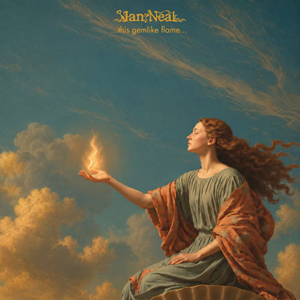
Four years after his preceding release, “Barkston Ash” (2022), UK composer Ian Neal returns with “This Gemlike Flame,” issued on June 23, 2026. The album does not merely gesture toward the Symphonic Progressive Rock masterworks of the 1970s, it deliberately occupies that late-decade sonic architecture to advance its compositional vocabulary along contemporary tracks. Neal’s approach is neither retrospective nostalgia nor stylistic pastiche. Rather, he extends a specific musical dialectism, one heavily shaped by the melancholic harmonic progressions found in Genesis’ “A Trick of the Tail,” “Wind & Wuthering,” “And Then There Were Three,” and “Duke,” alongside the overlooked intricacies of B-sides like “It’s Yourself” and “Submarine.” This historical awareness is matched by a rigorous production philosophy. Neal has closely studied David Hentschel’s Trident Studios mixdowns, meticulously replicating the EQ topology of the era while consciously rejecting modern brickwall limiting. The result is an album defined by expansive dynamic range, precise analog imaging, and meticulous harmonic layering. Complementing this musical architecture is Neal’s academic background: his 2011 PhD thesis on Victorian reverie and British painting deeply informs the record’s conceptual framework. Here, art historical theory and Romantic poetry are not mere footnotes but structural components woven directly into Symphonic Prog’s compositional fabric. The album opens with “How Dreams Do Creep (for Souls Asleep),” divided into three movements (i) The fruit to grow up / ii) Into the blushing pear or plum / iii) To cakes of ice, or flakes of snow). The track immediately establishes the record’s pastoral and symphonic coordinates. Evgenia Papamikrouli’s backing vocals frame lyrics drawn from 17th-century poet Robert Herrick, utilizing natural metaphors—ripening fruit, water freezing, rain evaporating—to evoke a bittersweet nostalgia and dreamlike longing for a lost love (“If you can see, how Dreams do creep / Into the Brain by easie sleep…”). Neal’s Symphonic Prog expands from Atmospheric openings into choral passages, with guitar and synthesizer lines interweaving intricately. The rhythm section navigates frequent time signature shifts, grounding the piece in both forward momentum and reflective pacing. The arpeggiated textures and vocal harmonies nod to 1970s British Prog, yet the compositional architecture remains distinctly Neal’s, establishing a generational bridge right from the first measure. “Late States, Eden’s Gates” shifts into a dynamic instrumental landscape driven by Kyle P. Nish on drums (recorded by Garrett Bills), augmented again by Papamikrouli’s backing vocals. Ian Neal’s synthesizer work guides the harmonic direction, intertwining with guitar phrases to recreate the airy sophistication of late-’70s Prog while occasionally pivoting into more technically demanding passages. The arrangement balances openness with structural precision. “Enitharmon’s Dream” serves as a brief but emotionally dense interlude. Inspired by William Blake’s visionary mythology, the piece was originally composed in 1996 before becoming a silent funeral tribute to Neal’s father, who passed away that same June. Included exactly thirty years later, the track functions as both archival echo and elegy, built on layered synthesizer textures that glide seamlessly toward the next movement. “Cretan Angel,” structured in four sections (i) Parousia / ii) Diaphania / iii) Quiescence / iv) The Marian Veil), expands into another symphonic suite, drawing heavily from Genesis and solo Anthony Phillips influences. Neal’s multi-instrumental approach allows airy compositions to unfold with architectural weight. The text describes protection against dark dreams and northern storms, culminating in the vision of a celestial figure descending “from Heaven to Earth… Enfolded veil, held me tight.” The track sustains an immersive atmosphere through delicate instrumental phrasing and evolving thematic motifs, leaving the listener anchored until its conclusion. “Fresco” acts as an essential instrumental bridge, functioning as a sonic fresco within the album’s romantic dreamscape. Driven by a leisurely rhythm section and atmospheric keyboard pads, the composition builds through a carefully calculated crescendo that culminates in an extended, intensely lyrical guitar solo. Conceptually, it echoes the opening track’s Herrick verses on ice, snow, and evaporating rain. “Of Aether, Rose And Spangling Dew” deepens the ethereal texture, featuring flute lines and expansive synth soundscapes that frame Papamikouroli’s vocalizations. The piece explores Neal’s more diluted, ambient-leaning sonorities while maintaining the harmonic cohesion established earlier. The record concludes with “Leonardo,” a five-movement suite (i) Uomo Barbuto / ii) Il Diluvio / iii) The Prism Flares / iv) Misterioso in 11/8 / v) To burn always, with this hard gemlike flame). Marked by intricate odd-meter passages, the piece operates as ekphrasis: a musical translation of visual art. Neal references Walter Pater’s 1873 Mona Lisa essay, with lyrics evoking Leonardesque visions and floods (“Uomo barbuto, mostrami un diluvio… / See sunlight, captured there…”). The fifth movement borrows its title from Pater’s famous maxim: “To burn always, with this hard, gemlike flame, to maintain this ecstasy, is success in life.” This aesthetic philosophy underscores Neal’s compositional ethos—the pursuit of beauty as an end in itself, manifested through the meticulous preservation of harmonic micro-details and timbral nuance. The suite closes the album with structural refinement, encapsulating the Symphonic Prog tradition while asserting a distinctly contemporary voice. “This Gemlike Flame” avoids the trap of mere replication. Its arrangement choices reflect deliberate personal curation: the Hammond organ deployed with a decelerating Leslie tremolo that dissolves into solemn, choral liturgical textures; the warm, expansive tonal palette provided by Polymoog, Arp 2600, and Pro-Soloist synthesizers, the acoustic resonance of 12-string guitars; and the nuanced layering of the RS202 string synthesizer. These decisions grant the record an undeniable authenticity. Highly recommended for its meticulous attention to production detail, exceptional dynamic control, and profound harmonic depth, “This Gemlike Flame” stands as a testament to the vitality of classic Symphonic Progressive Rock. It proves that the genre is far from a museum artifact, rather, it remains a fertile compositional ground, capable of absorbing historical references, academic inquiry, and modern sensibilities into a unified, uncompromising statement.
Tracklist
01. How Dreams Do Creep (for Souls Asleep) (9:11)
i) The fruit to grow up
ii) Into the blushing pear or plum
iii) To cakes of ice, or flakes of snow
02. Late States, Eden’s Gates (4:24)
03. Enitharmon’s Dream (2:51)
04. Cretan Angel (12:51)
i) Parousia
ii) Diaphania
iii) Quiescence
iv) The Marian Veil
05. Fresco (5:01)
06. Of Aether, Rose And Spangling Dew (5:06)
07. Leonardo (11:14)
i) Uomo Barbuto
ii) Il Diluvio
iii) The Prism Flares
iv) Misterioso in 11/8
v) To burn always, with this hard gemlike flame
Lineup
Ian Neal / Everything
Except:
Kyle P. Nish / Drums (Track 2)
Evgenia Papamikrouli / Backing Vocals (Tracks 1, 2, 6, 7)