

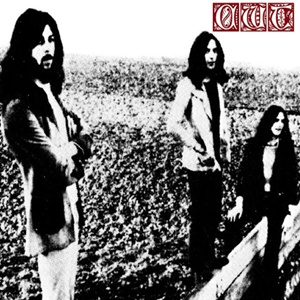
Among the many shadows cast by the British Progressive and Heavy underground of the early Seventies, CWT remain one of the most elusive and paradoxical cases. Documentary sources on the band are fragmentary but consistent in their core data, allowing a reliable reconstruction of their brief trajectory and sole recorded legacy. A band whose very name derives from an archaic and ambiguous unit of measurement, the hundredweight (abbreviated cwt), they seem almost destined to embody the same conceptual uncertainty: difficult to define, scarcely documented, and historically suspended between potential and disappearance. Their sole album “The Hundredweight,” released in 1973 on the German Kuckuck label, stands today as a fascinating artefact of Heavy Progressive Rock with bluesy and psychedelic undertones, remarkable not only for its musical content but also for the peculiar circumstances surrounding its creation. CWT were a British power trio formed around drummer Colin White, a musician with roots in the Canterbury Scene, alongside guitarist and organist Graham Jones and bassist Peter Kirk. Originally operating under the name Fireweed, the band honed its material through extensive live activity, particularly in Germany, where British Heavy and Progressive acts often found more receptive audiences and better working conditions than at home. This continental grounding would prove decisive, as “The Hundredweight” was released exclusively in Germany, despite the band being managed by Andrew Loog Oldham, the formidable and influential manager of The Rolling Stones and founder of Immediate Records. Despite this high-profile management, “The Hundredweight” was released exclusively on the German Kuckuck Records label, with Oldham’s involvement documented at management level rather than as a direct artistic producer. Oldham’s involvement, however, did not translate into a UK release or broader international exposure. Instead, the album emerged as a singular, almost anomalous statement within the Kuckuck catalogue, a label otherwise associated with Krautrock and Progressive experimentation. Production duties were credited to Adrian Millar, another figure orbiting the British Heavy Scene, who would later be linked for a time to Black Sabbath. The album arrangements are attributed to Ly Payne, a detail that hints at a more complex studio process than the band’s ostensibly stripped-down trio format might suggest. Indeed, “The Hundredweight” immediately challenges expectations. Despite being conceived by a power trio, the album features a prominent brass section and additional textural elements that expand the sonic palette far beyond a conventional Heavy Rock setup. Vocals on the album were handled not by the band members themselves but by Charles Jardine, whose theatrical and distinctive delivery adds yet another layer of ambiguity to the project. Whether these arrangements reflect a deliberate attempt to enhance commercial appeal or a genuine artistic vision remains an open question, but they undeniably contribute to the album’s unique character. The opening track “Widow Woman” sets the tone with a firmly Seventies Hard Rock riff anchored in a deep, swinging groove. The brass arrangements inject a big-band flavour that contrasts sharply with the heaviness of the guitar work, creating a tension between weight and flourish. The vocal lines are more declamatory than melodic, almost spoken in places, but the instrumental interplay—particularly during the guitar and organ passages played in unison—reveals a band with a keen sense of dynamics and arrangement. “Take It Slow” follows with a blues-rooted structure that flirts with doom-laden atmospheres before unexpectedly opening into a semi-acoustic, folk-tinged refrain. This contrast between dark, grinding verses and lighter, more reflective choruses highlights the band’s ability to move fluidly between stylistic territories without losing cohesion. “Roly Poly” returns to heavier ground, openly indebted to the early Black Sabbath school of riff construction, yet once again the brass section plays a crucial role, not merely accentuating the guitar but actively counterpointing and chasing the main motif. Although absent from the original LP tracklist, the single “Signed D.C.” — released the same year — deserves mention as part of the “Hundredweight” sessions. A reimagining of the Love original, CWT transform the song into a darker, more oppressive piece, replacing the Sixties acoustic sensibility with electric textures and a mood of uneasy introspection. Subtle additions such as flute and chimes enrich the arrangement without overwhelming it, demonstrating a surprising restraint within the band’s otherwise bold sonic choices. Back on the album, “Steam Roller” stands as a prime example of groove-driven Heavy Rock, bridging rhythm and blues foundations with proto-stoner weight. Its hypnotic pulse and muscular riffing anticipate later developments in Heavy Music, making it one of the record’s most forward-looking moments. “Simon’s Effort” offers a brief but effective shift in mood, with the organ providing a central, almost cathartic presence amid acidic textures and restless rhythmic changes. “Mind Cage” introduces acoustic arpeggios and flanger effects, unfolding as a constantly evolving piece held together by an insistent tambourine pattern. Once again, the recurring device of guitar and organ moving in unison reinforces the band’s identity and compositional coherence. The album closes with “Mephistophales,” which begins with a deceptive shuffle before erupting into a fast, aggressive triplet-driven finale. Here, Colin White’s drumming takes centre stage, showcasing both technical command and expressive force. In retrospect, “The Hundredweight” raises as many questions as it answers. How did a trio accustomed to live performances in German clubs translate such elaborate arrangements to the stage? Were these compositions long-standing pieces later embellished in the studio, or were they reshaped specifically for recording purposes? With so little documentation available, these questions remain unresolved, adding to the album’s mystique rather than diminishing its value. While working on material for a second album, CWT were drawn into a different project altogether. Adrian Millar recruited White, Jones and Kirk to support vocalist David Kubinec, formerly of Pieces of Mind and The World of Oz, resulting in the Glam Rock outfit The Rats. That chapter would end prematurely, with the band dissolving before their album’s release, which would only surface decades later. For CWT, this shift marked the end of their brief existence, leaving “The Hundredweight” as their sole testament. Reissued several times over the years, most recently in 2023 by the Greek label Missing Vinyl, “The Hundredweight” remains a compelling and underrated document of British Heavy Progressive Rock’s outer fringes. Straddling Blues, Psychedelia, proto-Metal and Progressive ambition, it stands as a classic “what if?” scenario—an album that invites speculation but ultimately demands to be judged on its own terms. Detached from conjecture and accepted as a complete artistic statement, it rewards attentive listening with depth, character and a distinctly unpolished charm that only true underground relics can possess.
— Discography —
1973 – “The Hundredweight” (Kuckuck Records)
1973 – “Widow Woman” (7″, Single – Kuckuck Records)
Credits:
Colin White / Drums
Graham Jones / Guitar, Organ
Peter Kirk / Bass
Arranged by Ly Payne
Produced by Adrian Millar