

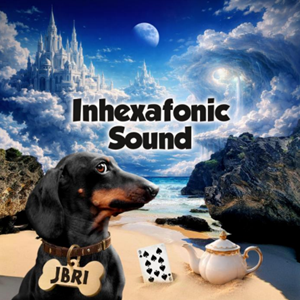
We are delighted to welcome JBRI to the pages of Progressive Rock Journal — the British duo of Jon Bastable and Robert Illesh returns with “Inhexafonic Sound,” their second full-length and a work that pushes instrumental Space Rock into genuinely uncharted territory. Conceptually layered, technically audacious, and laced with the kind of erudite wit that has become a JBRI hallmark, the album demands close attention and rewards it generously. We sat down with Jon and Robert to navigate its architecture, inspirations, and peculiarities.
“Inhexafonic Sound” feels like a significant step forward from your self-titled debut — not merely a progression but a reconfiguration. How would you describe the shift in your compositional thinking between the two records?
Jon: “We wanted this to sound more organic and the addition of real drums from Gary has helped that vision. Also the first JBRI album was more of a refresh and a mop up from past unfinished projects with the addition of a few newer songs.“
Robert: “Our philosophy is a constant. JBRI is a creative space where anything goes, the madder the better. There are no bad musical ideas, provided we can execute them admirably.“
Gary Wilson‘s arrival on drums appears to have reshaped the rhythmic foundation considerably. How did his presence alter the interplay between bass and guitar, and did it open structural possibilities that hadn’t previously existed within the JBRI framework?
Jon: “I’ve worked with Gary many times over the years in live bands. I couldn’t think of anyone better to be honest. The track ‘You Cooked Her Nines’ originally had my terrible attempt at drum programming but Gary has made it into something more with his Buddy Rich jazz style.“
Robert: “I think that applies to everything. Me and Jon would cook up demos with programmed drums, give them to Gary and it would open up a new space. We would then sometimes go back and revisit the instrumentation and parts so that the space was not too cluttered. In the future, we envisage writing with Gary’s live drums in mind – this already happened by the time we got to ‘Two Lumps, No Prizes’.“
Gary: “This project has been enjoyable and challenging in equal measure. I’ve taken the original programmed drums as a guide only, and not allowed that to over-influence how I’ve approached each track. Rob and Jon have given me an incredible amount of artistic license which I’ve really appreciated. I wanted the drumming to sound natural, ‘first take’ as much as possible, and I think we’ve achieved that.“
Your sound occupies a fascinatingly rare space — rigorous in its technical architecture yet consistently inflected with irreverence and absurdist wit. How consciously do you calibrate that tension, and do you ever find the two impulses pulling in opposing directions?
Jon: “Music should make you smile and this album does that a lot. I am not one for serious love songs.“
Robert: “Jon and I spent many years on the road in the Yes tribute band Fragile – ample chance to flex our technical chops. I think Jon’s historical infusion with music like Cardiacs underpins some of the wit. I am into avante garde things and like to break rules and boundaries. This is a perfect complement.“
“Infinity Shores” carries material originally conceived for “Blim.” What drew you back to that riff, and how substantially did it need to transform before it felt genuinely native to the JBRI sonic language?
Robert: “The main riff in ‘Infinity Shores’ used to be called ‘Shanghai’ and was on the table for Blim’s ‘No Frills’ project. As a writer, you carry many musical ideas and riffs waiting for the right moment to flower. And this was it. I knew Jon would love it, and he did!“
The lyrical perspective of “Infinity Shores” — a presiding consciousness observing the early migrations of Homo Sapiens — is a striking conceptual choice. What drew you to that vast temporal vantage point, and how does it connect to the expansive, borderless quality inherent in Space Rock?
Robert: “My initial demo for ‘Infinity Shores’ was quite long. There was plenty of space and it needed something else… During a BBC documentary I was falling asleep, and the underlying theme of humans moving out of Africa, looking at the infinity of the sea, led me to the thought that it was possible they might have had some super-sensible help. All concordant with the remit of space rock I think.“
“You Cooked Her Nines” is built around nine-beat cycles in a way that feels compositionally inevitable rather than merely theoretical. Jon, how did that metric framework first present itself, and what specific challenges arose in sculpting the Taurus bass drone intro around it?
Jon: “The track started out as a random bassline that just came put of nowhere. After playing it for a while I noticed it was in 9/8 timing so I had to come up with a second half of it that was also in nine. After presenting the idea to Rob and getting the green light, I came up with a Midi version of the whole thing, adding different bits and key changes. The fast sequencers you can hear are actually the bassline played really fast and the huge power chords are the same but on beat to the bars of 9. I have always liked ambient trance music so I had an idea of a build-up intro that was half the song. My contribution was a G drone using my Moog plugin – then “over to you Rob”. The rest is history!“
Robert: “Yeah thanks Jon! Four minutes of the ultimate tabula rasa! I hope I did a good job with the intro. I gradually built up some layers of guitar and the master streak was to also use a bit of steel guitar – much like you might hear Steve Howe!“
William D Drake‘s Mellotron contribution on “You Cooked Her Nines” — that deliberately unhinged “aunty solo” — is one of the record’s most memorable moments. How did that collaboration come about, and what creative latitude did you offer an artist of his calibre to arrive at something so bracingly eccentric?
Jon: “I have known Bill since the early 80s and we have collaborated a lot musically over the years. I can take any new music to him and he instantly records something amazing (on first listen). Bill never disappoints being the virtuoso musican that he is. He owns a modern version of a Mellotron with throusands of sounds that you can merge and tweak.“
The How Do You Take Your Tea? trilogy is the conceptual centrepiece of the album. The ritual of tea-drinking is such a deceptively ordinary lens through which to examine three centuries of social and technological upheaval — what made that particular motif feel like the right one?
Robert: “Just a mad moment of inspiration and something us British do on a daily basis! The three tracks are quite different in instrumentation, but there are some common musical motifs, so I thought, why not? And the prog fans will love all that kind of conceptual stuff…“
Robert, your decision to sample your own voice across two octaves in that same track is an intriguing piece of sonic design. How does that self-referential gesture function within the broader architecture of the piece?
Robert: “No surprises I’m a lover of jazz and people often comment on the way I juxtapose jazz sensibilities into prog and space music. I’m reverential to the likes of early Yes and Focus of course. With ‘Big Sultana’ I wanted honky tonk piano, accordian and a drum kit of the era as the basis. Jon played fretless bass, double bass and tuba sounds! The ‘yums’ were added in later and I feel help to consolidate the concept at the outset, of this important and pleasurable business of tea drinking.“
“Listen! Get Out!” shifts the trilogy’s timeline to 2013 and adopts a decidedly synthetic, computer-driven palette. Is there a deliberate critical edge to that sonic choice — a commentary on cultural erosion — or does the aesthetic arise more organically from the subject matter?
Jon: “This track started off as my own side project – I like to experiment with samples as this can sometimes write the song for you. Rob added more things like guitars and extra keyboard sounds. The overall concept came together over many months finding a common theme so it was organic really.“
The track’s internal structure splits between a rave-adjacent first half and a more reflective second. What was your approach to making that transition feel earned rather than arbitrary, and how did you maintain the piece’s internal coherence across such contrasting emotional registers?
Jon: “With Rob and myself we bounce ideas back and forward very easily, and nothing is off the table. We thought that the harshness of the first section could have a more mellow second half which would lead into the next song. The odd seemingly random stab notes were exactly that; when I programmed the sequencer (Moog again) I dragged some of the notes out of the sequence on the offbeats which gives it that strangeness.“
The trilogy closes in 2113 aboard the HMS Serendipity, and you’ve chosen a resolutely Classical Prog orchestration to depict that future — a notable inversion of conventional sonic futurism. What does that choice say about your vision of where genuine artistic Avant-Garde ambition might lead?
Jon: “Just one thing from me – listen to the beginning of 2112 by Rush!“
Robert: “Yeah, slightly tongue in cheek, this piece is set a year after that classic prog masterpiece where the protagonist digs up a guitar or something. 2112 ends kind of dystopian, so we imagined that things turn around quite quickly – maybe because of that guitar – and by 2113, people are having tea again and riding around on inter-planetary pleasure cruisers!“
The nine-string guitar loaned by Rachael Townend is a striking instrumental resource. At which moments on the album does it surface most prominently, and what specific timbral or harmonic possibilities did it unlock that a conventional instrument couldn’t have provided?
Robert: “Rachael is a dear friend and bandmate of mine locally. I use her 9-string on ‘Infinity Shores’ for some power chords and two slower ‘sickly’ sounding solos. I also use it on ‘You Cooked Her Nines’ mainly in the intro for the slow searing lines, the Holdsworth sounding chords, the staccato 60s spy film lines and also some Q&A soloing right at the end. In contrast to my classic Gibsons, the 9-string Ibanez has a sound totally of its own. The pick-ups are very hot. There is a bit of a synthetic quality to it and you can go down, down, down! Even lower than a standard bass!“
Producing the record entirely in-house, the two of you wore multiple hats simultaneously. Where did the sharpest tensions between your roles as musicians and as producers emerge, and how did you resolve them in pursuit of Inhexafonic Sound‘s characteristic density?
Jon: “There is no tension – we both know what each other are thinking and nothing is questioned as being too weird. This is the third album we have worked on together and it gets easier each time. If I was pressed I would say there was a bit of ‘turn up the bass in the mix’.“
Robert: “Jon and I have a rather unique musical relationship in that we have probably never had an argument. Part of that comes with age and wisdom. But also our philosophy of musical creation without boundaries. We also need to credit James Larcombe who does the final mastering – a very important step to draw out the best in the sound.“
Greg Forster‘s artwork and Maria Bastable‘s photography carry a strong visual identity. To what extent is the visual dimension of a JBRI release conceived in parallel with the music, rather than applied retrospectively?
Robert: “Jon likes to mess about with AI and things. All through the development of the music he would generate some mad image with playing cards, brains, cooking, dark figures and the like. I had a go and did this image of a sausage dog carrying a 9-card running away from someone’s aunty. When it came to the album cover, Greg, another dear friend and bandmate was our human choice to put it together and he had a good framework to make it happen.“
Given the compositional intricacy of this material, how do you approach the prospect of live performance? Is Gary Wilson a permanent fixture in that configuration going forward?
Robert: “Jon and Gary are fairly local to each other and continue to play together. I live a couple of hundred miles away so logistically it is challenging, but never say never!“
Gary: “I’d certainly be very happy to take this on the road, but we’d either have to scale up the band or use backing tracks. Either way, the prospect remains. The three of us have gelled incredibly well musically, and i’ve really enjoyed the way the drums and percussion have developed in an iterative way on each track. It’s been an absolute pleasure working with the guys and I’m looking forward to the next album.“
What should listeners and readers of Progressive Rock Journal anticipate from JBRI in the wake of this record?
Robert: “Gary and Jon are already writing album three! I’m going to take a bit of rest! New material will likely be more organic with a live feel. In any case, it’ll be Gary’s virtuosic drumming, Jon’s mad space sounds and my epic arrangements!“
We extend our sincere thanks to Jon, Robert, and JBRI for the time, candour, and creative generosity they brought to this conversation. “Inhexafonic Sound” stands as proof that Progressive and Space Rock remains a living, breathing, and irreducibly strange proposition — and that JBRI are among its most compelling current practitioners. Stay tuned to Progressive Rock Journal for further updates on the band and whatever peculiar voyage comes next.
Jon: “Thanks for having us.“
Robert: “A pleasure to dive deep into our work!“
Gary: “Thanks so much for supporting us.“
Purchase “Inhexafonic Sound” on Bandacmp: https://jbri.bandcamp.com/album/inhexafonic-sound