

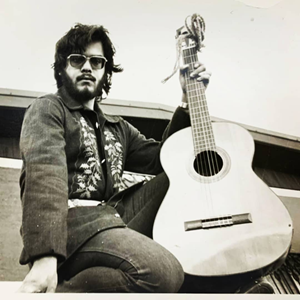
León, Nicaragua, 1951. There are biographies that read like a Hollywood screenplay written in the grip of a lysergic delirium — where music is not merely artistic expression, but an act of physical and spiritual survival. That of Alfonso Noel Lovo, born on August 12 of that year, is one of them. Composer, guitarist, and multi-instrumentalist, Lovo is the best-kept secret of Latin Rock and Central American fusion: an artist whose creative arc was forged in the fire of Nicaraguan history and the rubble of natural catastrophe.
— The Roots of a Rebel: From Accordion to “Nicaraguan Elvis” —
Son of Alfonso Lovo Cordero — influential politician of the Somoza regime and Minister of Agriculture — the young Alfonso displayed a prodigious talent from childhood. At just five years old, during a Christmas shopping trip in San José, he fell in love with a red Hohner 48-bass accordion spotted in a shop window. Despite the vendor’s suggestion of a children’s model, Alfonso demanded the professional one. Within two days, he had learned to play “Astro del Ciel” entirely by ear, astonishing both his parents and his first teacher, Professor Blanco — who, after months of failed attempts to teach him music theory, surrendered with the verdict: “He can only play by ear. I give up.”
At the Jesuit boarding school Colegio Centroamerica, Alfonso ended up in isolation with some regularity. It was precisely in those hours of forced solitude in the music room that he taught himself, with no guidance, to play the Hammond B2 organ and piano — composing his first piece: “In the Woods of the Moon.” The decisive revelation, however, came through the guitar, an instrument he learned from the family’s gardener, Adán “Bienvenido” Jaime, known locally as the Nicaraguan Elvis. Alfonso’s own conclusion was blunt: “With the accordion I attracted only nuns. With the guitar, I attracted girls.”
Through the 1960s, Lovo became a pillar of the local rock scene, co-founding seminal bands such as Los Rockets (1963) and Los Juniors (1965) — formations riding the wave of surf rock and the British Invasion. It was during the halftime of a high school basketball game that the fateful encounter occurred: he met José “Chepito” Areas, future legendary percussionist of Santana. The two improvised a set using military band equipment, marking the beginning of a musical friendship that would shape the history of Latin fusion.
— December 12, 1971: Six Bullets —
Lovo’s destiny was permanently marked on December 12, 1971. While returning home for the holidays from Atlanta, his LANICA BAC-111-149 flight was hijacked by a Sandinista guerrilla commando. One of the hijackers was a former schoolmate, who recognized him immediately as the Minister’s son. Lovo became a political hostage — the guerrillas intended to exchange him for imprisoned Sandinista leader Humberto Ortega.
The standoff at San José airport deteriorated when Costa Rican president José Figueres Ferrer descended onto the tarmac armed with a submachine gun, refusing any negotiation. In a moment of cold violence, the hijackers shot Alfonso at point-blank range. Six bullets struck him: one to the thigh, four to the abdomen — perforating the intestine eighteen times and devastating the liver — and one to the left hand, which he had raised to shield himself. Surviving miraculously after twelve surgeries, Lovo returned to the United States and used the guitar as rehabilitative therapy to regain use of his disfigured hand.
— Terremoto: Rebirth from the Rubble of Managua (1973) —
In 1973, while studying at Louisiana State University, Lovo decided to translate another tragedy into music: the earthquake that had razed Managua to the ground in December 1972, claiming 19,000 lives. Recorded at Knight Recording Studios in Metairie, Louisiana, the album “Terremoto Richter 6:25 — Managua” is a lysergic kaleidoscope.
On this record, Lovo fuses Classical Spanish guitar, New Orleans Jazz, Gospel Choirs, and a pioneering use of Minimoog and Echoplex. Alfonso brought the tapes back to his student room to refine them on a TEAC 3300 recorder, creating unique psychedelic layerings that distilled, in his own words, “freshness, naivety, and a hunger to experiment.” Among the tracks, “Hijack” stands out — a pure improvisation conceived as a sonic weeping willow mourning his hijacking. The album achieved such local success that a bank purchased 1,000 copies to give away to its customers.
— La Gigantona: The Lost (and Recovered) Masterpiece (1976/2012) —
In 1976, Lovo gathered the Nicaraguan musical elite at Producine Studios to create what would become his masterpiece: “La Gigantona.” The title drew on the folkloric figure symbolizing resistance against the Spanish conquistadors. At the timbales: his friend Chepito Areas, fresh from worldwide success with Santana.
The album was an Avant-Garde vision recalling the “studio trickology” of Lee “Scratch” Perry and the propulsion of Billy Cobham. Under the guidance of engineer Roman Cerpas, the sessions became a laboratory of effects: phaser applied to percussion, trumpet filtered through wah-wah, tape manipulations. Tracks such as “La Bomba de Neutron” were explicit political attacks on the nuclear threat and on then-president Jimmy Carter. Alfonso, with the audacity of a man who lacked nothing materially, told Cerpas: “I don’t care about the market. This is what my money is for.”
In 1979, however, with the Sandinista revolution at its peak, the original masters were destroyed in the fire that consumed the Lovo family headquarters in Managua. Alfonso managed to flee to the United States — loading his family into a limousine and a van — carrying with him only a box of acetate test pressings, which remained forgotten in a warehouse for decades.
— The Resurrection and Global Recognition —
After years in Florida devoted to the fish trade, Lovo returned briefly to the spotlight in the 1980s with the band Wolf and the Pack and the track “Freedom Fighters” — a rock-political anthem that earned him an invitation to the White House during the Reagan administration and the unofficial title of “King of Contra Rock.”
The true rebirth came in 2012, when Chicago label Numero Group rediscovered those surviving acetates and officially released “La Gigantona.” The response was resounding: the record reached #4 on the Billboard Tropical chart, and Lovo was acclaimed by international critics — including praise from Gilles Peterson of the BBC.
In 2014, he performed at the Rio Loco Festival in Toulouse before 28,000 people. In 2016, “Flamenco Immigration Blues” addressed the migrant crisis at the US border with the same unflinching directness that had always defined him. As Lovo himself is fond of saying: “When I play, I am happy. I sweat all the poison of the world out through my guitar.”
— Discography —
(1973) — Terremoto Richter 6:25 — Managua — (Reissued by Vampi Soul)
(1976 / 2012) — La Gigantona — Numero Group (recorded 1976, released 2012)
(1987) — Wolf & The Pack (2016) — Flamenco Immigration Blues
(2016) — Buckingham Palace Dreams