

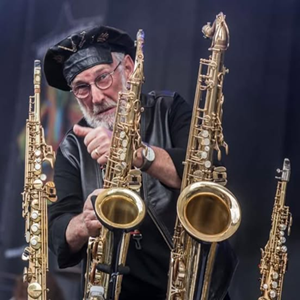
Dear readers, it is with great pleasure that we offer you today an interview with a legend of Progressive Rock music, David Jackson, who with his saxophone and flute has given us and continues to give us thrills for over 50 years.
Hi David how are you?
“Hi Jacopo, thanks for this interview. I am very well thank you and lucky to be so at a mere 76 years old.“
You play the sax and flute like few people in the world can, how did your passion for these instruments come about?
“It all started when I was very young. I always loved listening to the radio as a young child – Listen with Mother! My elder brother Michael (when 10) made bamboo flutes at school and played lots of tunes really well. When I was around 5 years old he gave me one and showed me the correct fingering. I immediately loved playing all the nursery rhymes and making up my own tunes. I always found the places in the house with the best acoustics – and particularly loved playing when the streaming sunlight made motes of dust dance around my moving fingers. I used to get loads of praise from my family which was really special! Lights, sounds and applause – probably the start of my career – and a bit like what it would eventually feel like being on stage!
My bother studied the clarinet at his boarding school, but before then I had heard the oboe on the radio and decided that’s for me! I was sent off to Stamford School as a boarder at 7 and singing in the choir was definitely my first duty. But I had also to learn the piano and when my hands were big enough my father gave me his old flute. Musical children were valued and encouraged, as were sportsmen, but I was rubbish at sport! All instruments were extremely expensive and so were music lessons! Start with the flute, I was told. I did well on the flute, won prizes and was 1st flute in the orchestra. Sir Malcom Sargent and Sir Michael Tippett (very famous classical musicians) came and conducted us and I felt important and valued.
By the age of 13/14 I was still singing solos everywhere, even visiting famous Cathedrals, but getting rather bored with the flute and classical music and thinking a lot more about the amazing music on the radio and on the records
people were buying. The oboe was always going to be out of reach and no one had one or taught it, so I thought about a clarinet. My wonderful brother Michael intervened yet again and suddenly gave me his old Alto saxophone in stead. I wasn’t sure what to make of it as it needed a lot of repairs. It was a serious challenge! With rubber bands and tape it was soon good enough to attempt ‘Throckmorton the Plumber’ by Charlie Parker: some first lesson – my bother being a very brilliant sax player by then. Anyway, I took it off to boarding school and me and the ‘cool rebel musicians’ formed a blues band and a Traditional Jazz Band. My credibility started to rise – as the school had never had a saxophone player ever before. I had to teach myself, of course. I practiced so so much and annoyed the music teachers and I was commanded to take it home and leave it there by the head teacher. My parents made a stand. ‘Loose the horn, loose the boy!’ I was still Head Chorister and 1st flute and had good academic potential too – apparently – so the school caved in and my life with a saxophone survived!
My passion for these instruments is that I was successful at it and loved the physical sensation of playing and feeling the audience responding. I had practiced like mad and mastered it in my own way, always improvising and playing tunes by ear from the earliest age. That instrument came to me and gave me the freedom to express myself and play the music that I had heard and that I could imagine too. I was important and had very prestigious responsibility as the choir’s soloist until my voice finally broke at 17½. The saxophone was waiting in the wings to take over from my treble voice – and trying to take over – and so it did!“
A characteristic of your style is the ability to play several instruments at the same time, who or what inspired this technique of yours?
“Both at home and at school my secret homemade Crystal set radio was the vital link to the outside world and to what else was happening in music in the real world. Dave Brubeck had a hit with ‘Take Five’ (1959 – I was 12). There was cannonball Adderley, Sonny Rollins, Miles Davis and John Coltrane, to name but a few. There was also an amazing Pop Music scene too – The Beatles and The Beach Boys stood out for me. But this music was NOT encouraged or even respected by my teachers or my parents at all. All these astoundingly different and unique professional musicians were giving me and my friends amazing tunes and complete inspiration to find something unique and original within ourselves too.
One day when I was 15 years old I heard Rahsaan Roland Kirk who had a Radio hit with ‘We Free Kings’ (1962). I saw his image in the music papers and on an LP in the Record Shop. ‘Phew’ – this was something else. It sounded amazing and looked astonishing. I had an Alto sax, all I needed was a Tenor sax so I could make a start. The inspirations were the sound, the image and the personal challenge to master playing two saxes at once. And of course I had someone to copy and give me some repertoire for what I eventually call ‘Double Horns’. But as with the single sax itself there was no one to teach me how to do it and how to master the music I wanted to play.
By the time I got to St Andrews University in Scotland in 1965 (to study Psychology!) I had saved enough money from holiday factory jobs to buy my first Tenor Saxophone – a Buescher, It went so well with the old Alto – a Guinot 1928! First I had to fix a few technical issues. The most important was the straps. Two saxophones around your neck are very heavy and can get uncomfortable rather quickly. Leather straps worked best for me as they adapted to my neck and my somewhat bent back and physique. These straps also combined organically together and swung well to adapt to the demands of playing one or the other sax as lead – and then quickly re-combining the two for Double Horn passages. I was actually developing an act!
I spent thousands of hours practicing musical harmony exercises, scales and tunes that I had created to extend my technique – together with jamming new tunes and rifs – and generally mucking about improvising! It was hard work
learning tunes from a vinyl record, but we all had to master that skill in those days! The best part was of course playing in bands where I could test my skills and new ideas in action – and build up my stamina and resilience to the
discomfort and pain! The emphasis was mostly blues and jazz in the early days, but 1960s Scotland was also the land of Soul Music – and Pop music was expanding in countless new unimaginable directions too! Nine gigs a week during those Summer seasons on the Scottish Islands was a training ground of infinite value for me and many of my young colleagues (Robbie McIntosh & members of The Average White Band included.)“
You were a member of one of the leading prog bands VDGG, what memories do you have of that experience and why did they part ways?
“There were 10 totally headlong years of career up and downs, between my joining the band and my leaving when we went finally went bankrupt 1977! It is impossible to remember all the events, but it is perhaps most necessary to explain that VdGG was a very intense band under enormous pressures from time to time. These were the needs to deliver new original albums to meet our Record Deal and very very heavy schedules of gigging, travelling and long tours. Don’t get me wrong, it was amazing, but sometimes members of the band ‘snapped’ and the band just ‘stopped dead’ for a while. We were a fixed co-dependent team, with no substitutions ever available. There was no regulator or balance in our personal lives and in our professional careers as our Management Company was also our Record Company!
But of course I can remember some of the amazing highlights – and some of the devastating crashes. And I can remember the friendship within our band and extended crew and the new friends we made along the way that have lasted a lifetime! Though sadly some notable friends (5) did not survive the quite common use of drugs and alcohol in those crazy days!
We had an Album of the Month in 1970 in Melody Maker with ‘The Least We Can Do is Wave to Each Other.’ This Rock Music paper loved the band (Prog Music hadn’t really become a genre by then – or had it? By 1971 Mayday, I was on the front page of melody Maker in my lucky hat – as the Van Driver! VdGG headlined The ‘Six-Bob Tour’ with Lindisfarne and Genesis. The idea that cheap concerts in enormous venues with the real money profit coming from merchandising was born!
There followed many Charisma tours of Europe with usually 3 bands in the coach and a truck carrying the gear. In Ülm in 1971, the Frei-Music brigade set fire to the building and stopped the show. In 1972 VdGG went to Italy and there were massive crowds, the Police and Army at gigs! There were amazing town festivals with the power tapped from lampposts. There was the first Italian Festival at Villa Pamphili when VdGG were No. 1 in the charts with the legendary ‘Theme One’ – written by George Martin of The Beatles fame!
After a break of a couple of years whilst we sometimes helped Peter Hammill with his solo career, we returned to Italy in 1975. But this time, our gargantuan concerts were becoming opportunities for full on political rallies involving the rival Fascists and Communists Parties. At a big gig in Bolzano, our truck was being used as the emergency dressing room with us on the back. The stage was attacked by a stone throwing mob during the show and we dashed back inside the truck. Our driver was then attacked in his cab and to escape he crashed it through the glass panels of the Market Hall! Two days later at the ‘Stadio Olimpico’ in Rome our gig with Genesis as support was stopped in an emergency by the Police – as the stadium had been set on fire! The next day our truck was stolen and the big big tour stopped immediately and it made the front page of the Evening Standard in London. The truck was eventually found in a Carabinieri Motorway carpark, with most of the musical equipment stolen. By a miracle my saxes inside a big flight-case called ‘The Van Gogh’ was never opened, so I still have those beautiful horns to this very day. Not so Peter Hammill; his beloved guitar ‘Meurglys III’ was stolen and is gone to him forever.
We somehow recovered from this diabolical shock and went on to tour Canada. At a big gig in Montreal my new parents in law (Ernest and Betty Mann) were attending an International Dairy Conference on the top floor of the same skyscraper. All the scientists were looking down on the noise and commotion and the wailing sirens of Police cars way down below. “Oh” announced Ernest. “That’s all because of my son-in-law David just here and the English band Van der Graaf Generator.” I think he was rather proud of our fame and reputation and did quite like some of our music too!
Years later in around 2003/4, VdGG were asked to play a big Reunion gig at The Royal Festival Hall in London. We decided to meet up, plan new music and make a new album – and prepare for the gig! However, Peter had a heart attack at the end of that year and the future looked very precarious and very stressful yet again. But Peter slowly recovered and we did manage to make that double album, called ‘Present’ – and ‘the gig’ evolved into a big European Tour. As always with VdGG, the Music Business took hold of us in its power and wrote all the agendas!
I was at that time (and already had been for many years) very heavily invested and involved in my Special Needs music career. I’d had already several big commissions to compose big works for massed forces at big venues like The Anvil Theatre, Basingstoke, and I was then being offered wonderful opportunities to create new pieces for The Queen Elizabeth Hall and The Lighthouse, Poole amongst others international events involving my Soundbeam and Switch systems. Developing my own musical career and vision onwards beyond 2005, that was my priority!“
How would you describe the magical Prog years of the 70s to younger fans?
“In the 60’s and 70’s we were a post war generation – now of age and having been born after to the people who survived WW2. University Education was payed for by large grants the British Government, so many many young people became students in all sorts of new Universities with many new courses and new subjects. There was a sense of freedom – and also one of rebellion. We were not too popular with our parents generation – who were understandably worried for our security and future. Drugs were very common, varied and even psychedelic – and were becoming extremely popular and almost normal. It was a glorious heady time with comparatively great prosperity from the expansive growth of post war economies. Record companies were expanding and becoming very experimental and they were signing band after band. So many of us musicians and artists had practiced and studied hard in a very repressive education system and the strict classical music tradition. Armed with the skills we needed, all we had to do was to be ourselves and do something different and exciting and unique – and we would hopefully get discovered. We were a blessed generation.“
In 2024 a new album will be released in collaboration with René van Commenée, how would you describe this work?
“‘Keep your Lane’ – Talking Elephant TECD488 was released 2/2/24 – and thankfully a lot of people are trying to work out what it is all about. For René and I, it started during lockdown 2020, when we were all isolated from each other and our normal musical activities. I’d had been doing loads of saxophone and flutes sessions at home for other bands and René had a lot of heart problems too and was gently building his new dream home and studio, so we were both in a unique place in our lives. René was really interested in the music I was working on all by myself and volunteered his help as a drummer and percussionist. What I didn’t realise was that René had also gathered an enormous amount of skill mixing and producing his own music projects over the years. He started to develop some of my pieces and suddenly the project really came alive. He called it ‘Keep your Lane’, because we had both been drivers (Trucks and Buses): because I played the horns and he played the drums – just like when we first worked together on Batteries Included. In reality, ‘Keep your Lane’ became a philosophy for life too! We had so much fun and it was so creative, we felt we could try anything musical together – so we just kept testing each other out with new musical challenges – one after the other. Some of these pieces were old, some completely new, some inspired by other musical collaborations and some inspired by each others boundless ideas and skills. And of course both of us learned so much along the way. We are able to share most of the writing credits together too. It’s a great international creative friendship and partnership. We laugh everyday we are joined together working across the internet!“
Over the years you have collaborated with other musicians and bands as well as members of VDGG, which of these projects do you find yourself in the most?
“I’m ‘in’ a project the most when people value me for what I and doing now, as well as respecting me for my past musical reputation and adventures. I spent a lot of years doing other jobs to make money for my family (driving and teaching mostly) – but writing music and making solo albums was my main direction behind the scenes. Since 2005 VdGG’s Reunion, I have been blessed by many many bands asking me for new collaborations – and the majority have been Italian. Now, that is the icing on the musical cake for me! I love Italian Progressive Rock (since 1972 VdGG tours) – and I adore the wide and diverse and beautiful people and countryside and cities. A quick check shows 35 Italian bands that I have recorded with over the years and quite a few that I have joined on stage. So the Italians band really win, but there have
been other British & German bands in recents years. There are many great associations, but I have to mention, Osanna, Le Orme, Alex Carpani, Jerry Cutillo (O.A.K.), Unsere Zeit band, Cross & Jackson, The David Cross Band and Nick Lowe. But the most creative and satisfying band in recent years for me has been ‘Kaprekar’s Constant’ – which also stars my daughter Dorie Jackson – and gigging with my daughter is always heaven! Getting my son Jake Jackson to produce the Cross and Jackson’s ‘Another Day’ was a wonderful achievement too!“
You’ve taught disabled kids to make music, what has this experience, which I imagine was very intense, given you?
“I had a couple of difficult health and developmental problems when I was growing up – and always away from home at a boarding school for 11 years. I was taught music in a very strict suppressive and unimaginative classical music regime. Most people hated Music lesson at school, but their hobby was listening to or playing their own music, their own way, almost in secret – until they felt confidence enough to ‘come out’ and say they liked John Mayall or Frank Zappa! My main experience of disabled children was a Downes boy who played with my son, when they were 2/3 years old. I love trying to teach him and he love music. I think live music with small children is unbelievable magical for player and listener alike, and I often used music play to teach other varied things too. My first degree was Psychology, my second degree after Van der Graaf Generator was at a Child Centre University College. I chose Mathematics and Special Education. This helped me to get mainstream teaching jobs, but I was increasingly more and more disillusioned with ‘normal’ education and most interested in children with difficulties, whether learning, emotional or even behavioural. I always found live music an
enormous motivational tool in any situation. I got a job at an Arts Centre where I could develop my ideas for Music workshops. One day a Soundbeam man came to call – and my life changed as radically as it had when I discovered I loved the saxophone, above all other instruments.
The Tonewall Soundbeam and Switch system I developed lasted me 25 years of workshops, concerts, international projects – all of which involved disabled children and adults at the very heart of the experience making music for themselves with my programmed Soundbeams & Switches. My routine projects often involved mainstream children and adults alongside professional musicians who worked supporting the disabled performers. I was determined to break the ‘disability ghetto mentality’ hardwired in British schools, Arts Organisations and even venues. I had some success and was commissioned to write several large scale works. My part-time base at SCOPE (Meldreth School for Cerebral Palsy) gave me a centre to work from and to receive visitors, often international. This allowed me to train many guests – teachers, musicians, therapists and students whom guided in my philosophy, my approaches and methods and particularly in how to program the new breakthrough Soundbeam music technology. I was extremely influential in helping CRAMS in Lecco to become Soundbeam Italy.
Yes, it was intense, but extremely rewarding. I got paid back by my ‘disciples’ by their invitations for me to lead projects in England, Scotland, Wales, Ireland, Norway, Germany and especially Italy. The profound effects of playing music regularly in a Soundbeam changed children’s emotional, intellectual and even physical body shape. Locked-in children and adults were released and permanently involved in creative activities with each other and with visitors to their somewhat isolated worlds. Many activities were expanded by inspired leaders whom I worked along side. I loved seeing the changes in young people and their families – and especially the teachers who got new inspiration for working with me – and visa versa. But of course it was a two way street and I always gained something form the hundreds of different projects and people over those 25 years.“
You have always been very active live also as a guest of other bands, will there be a chance to hear you in concert in the near future?
“Thankfully, there is always something live in the pipeline. In my most busy guest period, I played with six different Italian Bands in one year, but Covid and Lockdown and Brexit have really caused damage to musicians and the band I guest in! Some recent gigs have involved Jerry Cutillo in Rome (again), Osanna in Japan (again), & Alex Carpani in Sardinia (again). The highest spot in 2022 was the 50th Anniversary of Italy’s first Festival ‘Villa Pamphili. I went back to the Park and played ‘Theme One’ live with the mighty Osanna and got a medal! That time before that was in Italy 1972 when the single was Number One for 17 weeks! We were all moved to see the original Festival creator Giovanni Cipriani in his 80s dancing in front of the band ‘just one more time’.
Live News update: just in is confirmation of a live ‘Microcosm’ gig with Alex Carpani Band with DJ and Theo Travers on 6th April 2024 – in Reichenbach, Germany.“
The music market has changed, music has changed, but you have always remained, what difficulties are there today in proposing your genre (if any)?
“I have just released a new album with Dutchman René van Commenée called ‘Keep your Lane’. There are no particular difficulties making music these days in comparative isolation because of the astounding communication (internet) and MIDI, sampling and general music technology available now. All my musical life I have been able to play and record the
music that I feel. When the music I wanted to play was unviable – because the right people had gone, no band, no gigs, no money, no record company, I have always taken a rest and recharged my batteries.
Then I’ve always thankfully got inspired again and written and arranged the new or old music that I feel come to the surface. Then I have luckily found the collaborators I needed to achieve my vision. People have chosen me too, which is great, if I’m not too busy, but I have never made music by numbers like some highly trained professional musicians who can play anything – and have to do that to survive. I’ve always played what I feel is true to me!“
Given your great experience, what advice would you give to young artists who decide to propose more sophisticated music such as yours?
“I suppose I was exceptionally lucky Jacopo. The 1960s and 70s were free spirited and prosperous and future education was encouraged and paid for with grants. We even had hippies and flower power! There was such an appetite for change and creativity – and rebellion against our parents and grandparents generations who had only known wars, depressions, crashing economies and basically just trying to survive! They tried to steer us into safe jobs:- the bank, teaching, law, medicine, the army, the church – something stable and guaranteed to always be needed by society.
I suppose my advice for your artists is to aim high and try to do what you want to do and what you believe in artistically. Practice hard and perfect your skills and individuality. Remember it takes at least 10,000 hours to become really good at what you want to do professionally. But try to fit in a back up plan for when times are difficult, or for when you need a rest from creativity and originality. Do a physical or parallel job that will not stifle your creativity. I got an HG1 licence to drive trucks, as a slower wind down from 12 years of VdGG touring – and it left my mind free and I became fit and stronger than ever before. Follow a parallel path that will nourish your creativity. There were two in my life. I studied psychology (not music) after school age to be able to learn and teach myself better. I studied ‘alternative child centred teaching’ in my thirties to be able to help my children – and help myself too. Ulterior motives were both my guides and saviours!“
Do you have any other projects or artistic passions outside music?
“Even more important than the music and my career are my family. I married Sue whilst in VdGG in 1973, being the first member of the band to ‘tie the knot’. When my son Jake was born in 1976 I was awarded the ‘VdGG Perambulator’ (know as a pram – or baby carrier!) I’ve had to put the family first over the band several times when money and security were running out! I’ve always loved driving and as my father was a master motor engineer, I’ve gained a lot of experience and always had a hand in motor maintenance. I have always loved photography and have always had a reasonably good camera. I love looking at great portraits, wildlife photos and landscapes. In the modern era I really enjoy editing my own photos: a few of which have been used professionally! I need to watch the news everyday. And every day I still listen to the Radio – 50/50 news and music – choosing nations where I will be guaranteed to find something new to me. Stories have always been my passion too, so I always finish every day by reading in the dark with my Kindle – magical stories – like being an infant all over again!
David Jackson – Friston, Suffolk – 3rd February 2024“
I thank David for the interview, an honour for our webzine to be able to propose this article. I wish him all the best for the continuation of his musical career.