

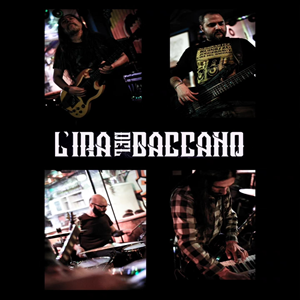
With the unveiling of “The Praise of Folly (Part 1),” Italian instrumental collective L’Ira Del Baccano open the door to the most ambitious chapter of their career to date. The title-track, conceived as the first movement of an extended suite, anticipates a record that deliberately escapes conventional song structures in favour of long-form composition, live interaction, and conceptual depth. Scheduled for release on February 20, 2026 via Subsound Records, “The Praise of Folly” draws inspiration from humanist thought and philosophical reflection, translating abstract ideas into a dense, immersive sonic language rooted in Heavy Psychedelic Rock, Doom-laden textures, and Progressive expansion. Recorded with a strong emphasis on live performance and minimal fragmentation, the album captures the band’s organic chemistry and commitment to authenticity. In this interview, L’Ira Del Baccano reflect on their origins, evolving musical identity, the creative process behind their new album, and the role of live performance as both catalyst and destination. The new record can be explored through the band’s official Bandcamp page, as featured in our news coverage.
Answers by Alessandro Drughito Santori: guitarist, composer, producer, recording and mixing engineer of
the band.
Looking back to the early days of L’Ira Del Baccano, what was the initial spark that led to the formation of the band, and what artistic need were you trying to fulfil at that time?
L’Ira del Baccano is the evolution of Loosin’o’ Frequencies, a band formed by me and the other guitarist Malerba back in 1995. At that time we were a six-piece band, with a vocalist as well and we released an ep in 1997, produced by the Italian doom guru Paul Chain
Your sound has always moved between Heavy Psychedelia, doom-inflected riffs and Progressive structures. How did this musical identity take shape over the years?
The decision to change the name happened around 2004, when we decided to officially become an instrumental band and no longer have a vocalist. Loosin’o’ Frequencies were already a band with many ideas that blended different musical genres, from stoner to psychedelia to doom and so on. With this official transformation into an instrumental band, we wanted to broaden things and push even further toward a sense of diversity and freedom, which paradoxically we felt was coming precisely from not having a voice and lyrics in the songs. From that moment on, we truly felt free to create without having to confine ourselves to song structures, different choruses, and all those elements that the presence of a vocalist can inevitably bring.
As an instrumental band, how important is collective chemistry compared to individual expression within your writing process?
Even though I’m the main composer of the group, the contribution and uniqueness of every single musician who is part of the band — and who has been part of it in the past — has in some way shaped how I conceive riffs and themes. Beyond that, there’s also the fact that we have always improvised in the rehearsal room; I basically never tend to write riffs and songs on my own, so the moment of creation is a collective one, even if the main idea might come from me. “The Praise of Folly” is presented as a work that moves beyond traditional song formats.
What motivated you to embrace extended form as the core language of this album? The title and concept reference a classical humanist text. How did those philosophical ideas translate into musical choices rather than lyrical ones?
As I was saying before, this kind of creative and compositional liberation happened when we decided to become an instrumental band and free ourselves from the need to stick to a more traditional song structure with verses and choruses. So in a way, it was already around 2003–2004 that we started writing music without setting limits for ourselves, simply thinking, “Okay, what do we want to say?”—and once a piece had expressed what we felt it needed to express, then it was finished. That’s why we eventually found ourselves with tracks ranging from 8 up to 25 minutes long. As for how much our track titles might influence the music itself, that never happens at the beginning of the songs creation. As I said before, we tend to improvise a lot, record a lot of music, and only later start shaping a structure. It can happen that once a piece begins to take form, we then decide what it might be saying and what could be expressed through a title. From that point on, if the track isn’t finished yet, the title itself can become part of the inspiration that guides the further musical development of the piece.
“The Praise of Folly (Part 1)” serves as the opening movement of the album. Was it conceived as the starting point from the beginning, or did its role emerge during the writing process?
Not really. The Praise of Folly in its entirety is 22 minutes long, so we already knew it would take up a whole side of the record. That meant we didn’t really have to worry about where to place it — it had to be either side A or side B. So honestly, it wasn’t exactly a random choice, but more a practical one: we decided the album would open with the 20-
minute suite, with the other two tracks on side B.
Can you describe how the compositional framework of Part 1 evolved from initial ideas into its final recorded form?
The Praise of Folly is a composition we’ve actually been working on for years, and it has gone through several rearrangements and reinterpretations. Parts have been added and removed, and up until recently it just never felt finished to us. In fact, many sections of the piece were written even before our latest full-length album, Cosmic Evoke Potentials, which came out in 2023 — so they go back quite a while. We even played an early version in 2019 in Wurzburg at the Psychedelic Network Festival. So in a way, it’s a track that has had a very long evolution, and only last year did we start to feel and say to ourselves, “Okay, the piece is complete, this is it — it’s time to finally capture it on record.”
The album unfolds as a suite divided into two main parts, followed by additional compositions. How did you approach continuity and narrative flow across the record?
As for the sense of continuity across the album as a whole, having only three tracks didn’t really leave us with many options, as I mentioned before. So the main decision was about the two pieces on side B — which one would come second and which one third. In the end, we chose what will be our second single, Rosencrantz and Guildenstern Are Dead,
which is the slowest and most epic track on the album, yet still deeply psychedelic, as the perfect closing chapter of the long journey that this new record represents.
You chose to record the core instruments live in single takes, privileging complete performances over technical perfection. What did this method allow you to capture that a more fragmented approach would not?
Recording the main instruments live, all together, is fundamental for us and always has been. We’ve tried in the past not to do it that way — recording one instrument at a time — but it simply wasn’t us. The dynamics weren’t right, the emotional intensity wasn’t right, and the natural fluctuations in tempo, which are essential in our music, just weren’t there. For us, those shifts in tempo and the use of dynamics are what truly captivate the listener and keep them engaged until the very end, especially considering the length of our tracks. We once tried playing everything to a metronome, and it felt too static, not alive — it just wasn’t us in any way. So in the end, this approach definitely allows us to be ourselves.
How did this live recording philosophy influence the emotional intensity and dynamic range of the album?
I’m not sure whether I’ve already answered this, at least in part, with my previous reply, but the fact that we play together in the same room means that, beyond just hearing each other, we can also see each other. That allows us to feed off one another’s energy and make the piece truly alive and more emotional for us, because we’re really capturing that moment when someone might push the others slightly forward in tempo or intensity, or pull things back, and so on.
Once the live foundation was laid down, how much room was left for refinement and arrangement during the production phase?
The phase that follows this initial live recording has varied quite a lot for us over the years. For example, on our previous release — the split album with the Dutch band Yama, Tempus Deorum — our track Tempus 25, which again runs about 20 minutes, was recorded using the same technique, all of us playing live together, just as we always rehearse it. After that, though, I did a lot of work on the structure and added various layers of sound — synthesizers, additional guitar arrangements, and other elements — because in that case I really wanted to create two different versions of the piece: one specifically for the record, and another for live performance. So in that situation there was a significant amount of overdubbing and post-production to achieve certain ideas I had in mind. As for The Praise of Folly, this time I chose to go in a more direct direction. The tracks are essentially the way we play them live, with very minimal overdubs and additional arrangements that we don’t actually perform on stage.
In what ways does “The Praise of Folly” connect to your previous releases, and where does it represent a clear step forward or departure?
We don’t really see our albums as an evolution in the strict sense. For us, each album stands on its own and simply represents a specific moment that we choose to capture in a recording and then release. It’s not about saying that one album is somehow more mature than another, or that it’s the evolution of a previous one, and so on. As I mentioned earlier, some parts of The Praise of Folly actually date back to before our 2023 album. So we see every album we release as a snapshot of that particular time and of the artistic reality we were living in that moment.
Do you see this album as a synthesis of your past experiences, or as the opening of a new creative cycle for the band?
Building on what I said before, no, I don’t see The Praise of Folly in any way as something that points toward or defines our future artistic direction. At the moment we have a huge amount of other recorded improvisations, and we could just as easily go back to something we played five, six, or even ten years ago and start working on that. So we really have no idea right now what will happen or what the next L’Ira del Baccano album will sound like. And in a way, that’s exactly what keeps us going and continues to inspire us.
Live performance has always been central to your identity. How do you envision translating the extended structures of the new album to the stage?
Well, our debut album, recorded in 2006, was actually a live concert recording, so from that point of view I think we’re a band that, right from the start, truly expressed its nature — what mattered to us and where we were able to express ourselves best. As for performing long pieces live, we’ve always done that in the past as well. On our first proper “studio” album, Terra 42, there were the three parts of a single piece that totaled 30 minutes, and we often played them live as one continuous performance.As for The Praise of Folly, as I was saying before — and this time even more so — we leaned heavily into the live aspect, using fewer overdubs. So we’ll simply play the tracks as they are on the album, though in reality we might even stretch them out a bit, because we tend to do that live and allow ourselves some freedom, also just to have more fun on stage. Honestly our only problem during concerts is that our songs are too long so we have to decide what song play!!
What role do improvisation and spontaneity play when performing material that is structurally complex and conceptually defined?
When we play live we always try to leave room for improvisation. There are sections of the songs that we sometimes deliberately change just so we can play around with them during concerts. This means that the whole live performance process never feels mechanical to us, and it also gives us the chance to keep developing and reshaping the songs over time. One of our core ideas has always been that even after fixing a track on record, we still want the freedom to keep changing it later — we don’t set limits for ourselves in that sense. That was also one of the reasons why last year we decided to re-record Tempus, a track that appeared on our first album SI Non Sedes Is in 2006. Over the years it had changed so much and gained so many new elements that, at a certain point during shows, people were asking us which album they could find it on — and we realized it wasn’t actually on any record in that form. So we decided to record what, at that moment, was the current version of the piece. So yes, improvisation is always part of our concerts, and it helps us stay inspired and keep having fun while performing our music.
What would you like listeners to take away from “The Praise of Folly” once they experience the album in its entirety, from the first movement to the final note?
Well, in general, what we’ve always wanted with our music and our albums is for people to come with us on these journeys — these long journeys — without knowing exactly what will happen from one section of a piece to the next. That’s something we care about deeply. In fact, we often like to say that we’d love our tracks to be approached the way
you’d read a new book or a new story, where you reach the end of a page knowing that something is going to happen. Sometimes it’s what you expect, and very often it’s something completely unexpected. That’s how we approach our compositions, how we like to present them to people, and how we like to imagine listeners being carried inside our
musical creations.
With “The Praise of Folly,” L’Ira Del Baccano reaffirm their commitment to music as an immersive, time-based experience — one that rewards patience, deep listening, and emotional surrender. The first chapter already reveals a band operating at full creative awareness, confident enough to let performance, interaction and concept guide the music rather than format or expectation. As the album’s release draws closer, anticipation grows around a work that promises to stand as a defining statement within the band’s discography and the contemporary instrumental Progressive scene.
Pre-Order “The Praise Of Folly” on Bandcamp: https://liradelbaccanoofficial.bandcamp.com/album/the-praise-of-folly