

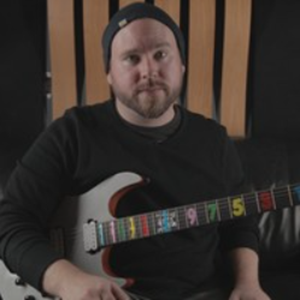
Progressive Rock Journal sits down with Trey Xavier to dig into the story behind “Age of Legends,” the Sisyphus-inspired concept album that may well be In Virtue‘s most ambitious and personal statement to date.
Few records arriving in the final stretch of 2025 carried the conceptual weight and compositional scope of “Age of Legends,” the fourteenth-track opus released by Los Angeles Progressive Metal outfit In Virtue on November 21st. Built around a reimagining of the myth of Sisyphus — escape, guilt, redemption — and featuring a cast of guests
including Charlotte Wessels, Dave Davidson, and Chaney Crabb, the album announced In Virtue as a band operating at the top of their game. We caught up with guitarist, vocalist and primary architect of the project, Trey Xavier, to go deeper into the story behind the record.
Hey! Thanks for having me.
In Virtue was originally formed in 2004 in the Bay Area, then underwent a decisive reinvention in 2015 when you relocated to Los Angeles and took over lead vocal duties. Looking back now, how do you describe that transition — and what made it the right move at the right time?
In retrospect, I think it was mostly about artistic autonomy for me. Although we had some excellent vocalists in the previous incarnations of the band, it was still always a struggle for me to actualize my musical ideas through someone else’s voice. Until I really spent a few years taking voice lessons and learning how to really sing, I was dependent on having someone else sing my songs – but then it became clear to me that it was never going to be what I knew it could until it was really mine. I don’t think I’m the world’s greatest singer, but I actually am really happy with my voice, even with its limitations. The move to LA should have been a no-brainer. My only regret is not doing it 10 years earlier. The music industry here is huge, and people come here to have creative careers – you’re just constantly immersed in a culture of creating things.
Rebuilding a lineup entirely is never a small thing. How did you go about putting together the current lineup — Alex Nasla, Rami Khalaf, Jamie Hush — and what did each of them bring to the band’s identity that felt essential to you?
I met Alex when we played a show together with our separate bands near where I was living in the North Bay, and it was actually him that convinced me to finally make the move to LA. Jamie was introduced to me through a mutual friend almost immediately after moving, and he and Rami had also just moved here from Windsor, Ontario, Canada. They were good friends for a long time and had been in a band together in Windsor, and after some discussion and hearing them play, we sort of figured out that not only were we on the same page musically, we got along really well, which is just as important to me. Alex brings not just awesome keyboard parts and playing, but also a deep sound design and engineering knowledge to the table, so he’s always thinking of it on several different levels. Rami’s guitar playing has all the feeling that mine is missing, and his solos really elevated the album. Jamie has the most positive, undefeatable attitude of anyone I’ve ever met, and that’s hugely important because the music industry can be incredibly soul-crushing, and it’s easy to give up. Really, it’s awesome to get to be in a band with my friends, because there are tons of sick musicians out there, but if they’re not a good hang, I don’t want to be in a band with them. It’s just not worth it.
Your sound sits at a very particular crossroads — Progressive Metal, Power Metal, traces of Blues Rock, Cinematic orchestration. How did that sonic palette develop over the years? Are there specific artists or albums that function as foundational references for In Virtue?
I don’t ever really think about it like that when I’m making music. I’ve listened to so much different music over my lifetime, and I’ve absorbed things from everywhere as much as I could because I just love music. I’ve sat down and really learned and analyzed specific pieces of music many times, but when I’m writing for In Virtue, it’s all completely organic, and I’m never specifically referencing anything. That being said, there are things that come out naturally that I know where they come from, even though I’m not consciously referencing them – Sonata Arctica, Danny Elfman’s Batman soundtrack, Unearth, Symphony X, Dream Theater, Avenged Sevenfold. Stuff I listened to so much at formative times in my life that they’re deeply ingrained in me. I don’t recognize them until I’m already done writing the song, but then the similarities become pretty obvious to me.
“Age of Legends” is a concept album built around the myth of Sisyphus — specifically his escape from eternal punishment, his confrontation with guilt, his pursuit of redemption. Where did the idea for this concept come from, and when did you realize this was the right framework for this particular record?
I’m honestly not entirely sure where I got the idea from, it’s not like I was reading Greek mythology or something, but I must have seen the concept somewhere at a time when I was feeling stuck in a loop. At the time I was definitely in that kind of a situation – I felt like my life wasn’t going anywhere, and that I had been treading water for a long time. I think it wasn’t until I had written a few songs with the same theme that it started to feel not just correct, but inevitable.
The review noted — and it feels hard to ignore — that an album about shedding guilt and redefining one’s own trajectory carries unmistakable autobiographical undertones given your own story with the band. How much of Sisyphus is Trey Xavier in “Age of Legends”?
To some degree, all of it. I’m not any kind of monster like Sisyphus was – I don’t have those same kinds of horrors to atone for. But I was treating myself like I did – punishing myself, living with deep shame and guilt, not even over anything I had done, but more based on feeling like I wasn’t living up to my potential. Writing this album was therapy for me, and it really helped me work through this idea, and also helped me to develop a kind of life philosophy on forgiveness and self-love.
Walk us through the structural logic of the album. The two orchestral bookends — “Ascent Glorious” and “Descent Limitless” — frame the whole narrative arc. Was that symmetry planned from the very beginning, or did it emerge during the writing process?
The symmetry of that was not planned, but it felt very natural to have it start and end with different versions of the same theme. It mirrors the Sisyphean journey up and down the hill, ascending and descending. The musical motif recurs throughout the album in various places at important moments, and it’s probably my favorite thing I’ve ever written. I knew it would be the opening from the moment I decided it was going to be an album, but it didn’t wind up as an ending as well until much later.
“Purgatory” was originally released as a standalone single in an earlier form before finding its place here as a pivotal structural chapter. What changed between those two versions, and how did you decide where it belonged within the sequence?
The song itself didn’t change, aside from getting a remaster to match the rest of the album, but the context of it being within the album really reframed it for me. We recorded Push That Rock, Purgatory, and Where the Edges Meet, and that was going to be a 3 song EP. After we decided it needed to be an album, of course Purgatory had to come directly after Push That Rock – they’re kind of inseparable, and I wrote them as one continuous thought really, to flow one into the other. It’s hard to decide on a sequence for an album I discovered – there’s a lot of factors you have to consider, like tempos and keys of the songs, the overall flow and experience of listening etc.. But in this case, I also had to consider the storyline, and whether it made sense to have certain plot moments happening in a certain order. Purgatory had to happen fairly early on, because he needed to break out in order for the story to happen, because the bulk of it happens after he returns to the real world.
“Gunslingers of the New American Desert” is one of the most distinctive tracks on the record — that opening Western-inflected passage is genuinely unexpected. Where did that idea come from, and how does it connect thematically to the Sisyphus narrative?
I love the soundscapes of old spaghetti Western films, and I was so happy that I had a solid excuse to do it in a way that didn’t feel shoehorned in. I actually had ambitions to do a whole album of the same name, with a lot of those kinds of sounds, but I don’t know if I could have kept it up for a whole album hahahaha! Gunslingers tells the story of Sisyphus The Kid really breaking bad after seeing the opportunity to once again take advantage of people, getting a posse together, seizing power through violence, and starting down the Sisyphus path of old that landed him pushing the rock in the first place. He eventually is able to see the error of his ways and correct, but for a while he’s just a bad guy again.
“Tempus Fugue” is the album’s centerpiece — over eight minutes, the most structurally complex composition on the record, and in many ways its emotional culmination. Can you take us through how that track was built, from the first idea to the final version?
Tempus is quite the journey, and it’s the one where I allowed myself to really stretch out the most. It’s a bit more meditative in the sense that Sisyphus has reached a kind of peace, and found a meaning and purpose, an understanding of himself, and some real compassion and empathy. I wanted to show the internal maelstrom of his conflicting, turbulent emotions, but then also be returning to the strong pillar of the chorus so we can feel him not giving in to them, not reacting and lashing out and allowing himself to be pulled back to his old ways. It started with that simple chuggy rhythm that we hear right after the acoustic intro bit, and the word “time”. I was really feeling the scourge of time blindness during this period of my life, like I was going to die having accomplished nothing at all. That simple riff sort of became the base broth of the “stone soup” – I just kept adding to it and layering lines until it felt like it had grown and built enough, and by then it felt a bit like counterpoint – and that’s when the name came to me. Tempus (time) Fugue – it’s (obviously) a play on “Tempus Fugit” – time flies. So then I doubled down and wrote the counterpoint melody that comes right after the “Welcome to the Future” line, and many of the other sections have a similar kind of contrapuntal feel with the interweaving melodic lines. Even though the parts have the most kind of disparate feel of any song on the album, I feel like I anchored it pretty well with coming back to the theme a lot, with bringing it back in a natural way to the chorus that grows each time we hear it (“can I be a light… /when I am complete, will you feel…” to “have I been… /now I am complete, do you feel…”). Reprising “Push That Rock” was an obvious choice for me, but it took me a while to really nail down the transition into it. I wanted it to feel like we were really starting back at the bottom of the mountain again, but this time with a new attitude. This time, as we ascend, it’s hopeful, cathartic, light. He’s found the meaning in the loop of pushing the boulder up, even though he knows it will fall again.
The guest contributions feel genuinely integrated into the compositions rather than added on top. How did you approach reaching out to Charlotte Wessels, Dave Davidson, and Chaney Crabb — and how did each collaboration actually unfold in practice?
For each of these, I felt like the songs were really asking to have these specific guests and that they wouldn’t be complete without them. I’m pretty lucky to have known all of them for a while and have collaborated on things in the past, so I felt comfortable reaching out to them to ask. Plus it was during the pandemic when people had a bit more time on their hands, so I was lucky in that regard, they weren’t touring or anything so they were available. It was pretty straightforward really – they’re all professionals with pretty sophisticated home studios and the ability to record themselves, so I pretty much just sent them the tracks once they’d agreed, and they recorded their parts and sent them over. There was a little back-and-forth with some of the details – for example, on Karma Loop. I noticed after Charlotte sent her “final” takes that she had said “it’s time for you to let it GO” instead of “let it ROLL”, and I honestly can’t remember if that’s what it said on the lyric sheet I sent her, or if I just realized that it needed to be “roll” because duh, the rock rolling down the mountain. But either way, she very graciously went back and fixed that word for me. They were all incredibly easy to work with, and they all went the extra mile. I gave Dave basically no direction except to make the kind of boring chords I’d written a little more interesting, and he came back with some really cool harmonized guitar parts along with his absolute ripper of a solo.
Chaney Crabb‘s performance on “Tempus Fugue” and Charlotte Wessels‘ work on “Karma Loop” are both remarkable in how they change the dynamic of those tracks. Did they have creative input on their parts, or did you provide them with a defined vision?
Because of how very specific the story is, and how important the lyrics are, I wrote the parts that they both sang, because I wanted it to be really cohesive and feel right. They’re both great writers, and it’s not that I don’t trust them to write something great – it’s more like I didn’t want to make them responsible for knowing the story inside and out just to do a guest spot, that felt like an added complicated burden. But in the same way that you give an actor some dialogue and they deliver a performance that makes you believe the words, both of them elevated the composition with performances that really took the final product to a new place. Charlotte added layers and layers of incredible harmonies, call-and-response parts, and ad libs, as well as really just understanding the assignment and being The Catalyst. Chaney’s part is pretty short on Tempus but she really just dropped the absolute hammer at a pivotal moment in the track, she gave it exactly what it needed.
The production process involved multiple hands — you produced the album yourself, Mazen Ayoub and Miami Dolphin on mixing, Alexander Backlund on additional mixing, and Jens Bogren and Tony Lindgren at Fascination Street for mastering. How did you manage that chain and keep a coherent sonic vision across all those contributors?
So just to clarify, I produced the album in the artistic sense, Mazen and Miami were the actual engineers on the album. Honestly, you either trust the people you’re working with to deliver because you know what they’re capable of, or you don’t. Then, you’re kind of just dependent on their availability and interest. The sonic vision is something that develops from hearing someone’s work a lot, and then understanding that you could also sound like that, and then you have ideas that exist within that framework. Jens’ and Tony’s body of work is what inspired a lot of what the album sonically became, because I knew they were waiting in the endzone to receive the ball and work their magic. They can handle anything really. Really, we were all on the same page the whole time in the studio I think, so it was really easy to keep it cohesive.
Niklas Sundin created the cover artwork. The visual language he brings is very specific and immediately recognizable. How did that collaboration come about, and how closely did you work together on translating the album’s concept into a visual statement?
I knew the second that I saw the cover for Dark Tranquillity’s Moment album that I wanted our cover done by whoever it was that had done that. The stark contrast of the colors, the framing, the placement of everything and the attention to scale – it made such a profound statement and hit me so hard emotionally that I was immediately on the hunt for that artist. Honestly, if I’d seen it in a gallery somewhere and it wasn’t already an album cover, I would have tried to buy the rights to it outright to use as our cover. Luckily, it turned out to be Niklas, one of the original guitarists of Dark Tranquillity and the artist for all their covers, and he answered my email with enthusiasm. We discussed the concept, I told him what I was looking for, and he got cracking on it pretty much immediately. I took a reference photo of myself just as an idea of what I was thinking Sisyphus would look like, tearing through the fabric of reality to get back to Earth, and he recreated it in the painting so well. I suggested a few things, like adding the broken crown and vines and chains, and there were a few other small adjustments for color and such, but it didn’t take much to get to the final version. I think the lesson with a lot of these things is that most artists and musicians are willing to do these kinds of collaborations, as long as you approach them in a professional and real way, and you have something to offer. You should expect to pay them, because you wouldn’t want to be asked to work for free, and if not, then you’re communicating that you think what they make has no value, and then, why do you even want it at all? But in many cases, the person you might think is completely out of reach is actually just an email or DM away, and much more accessible than you think. The worst that can happen is that they say no, and then you thank them anyway and find someone else.
The album was released on your own imprint — a significant choice in today’s landscape. What were the reasons behind that decision, and what does full creative and commercial control mean to you at this stage of In Virtue’s trajectory?
I’m not opposed to the idea of signing with someone if the right partnership were to present itself – someone who understood what we’re doing, and our goals align and it felt right. But in the same way that the album had to be right before it got released because it was such an enormous and personal statement, I didn’t want any kinds of restrictions or direction on how it was released and promoted. I have such belief in this album and keeping complete control over it was aligned with that. This album is really the hard relaunch of the band – we sort of did that with the first singles, Purgatory and Where The Edges Meet, but since they’re also on the album, this is really the big complete statement of who we are now. It’s an invitation to board the In Virtue train, and once that train gets a full head of steam and enough passengers, that gives other entities a real reason to invest. Record labels aren’t charities, they don’t spend promo budgets out of the goodness of their hearts – they expect that they’re going to get a return, and that’s directly proportional to the fanbase that you can accrue. Same with promoters and the like, they’re not going to book you on a tour if no one is going to come out to see you. So we’re here proving that we’re worthy of the audience’s attention, and if someone wants to invest in us at some point, that could also be great. But releasing this album 100% independently was the right move for us.
Are there live dates planned in support of “Age of Legends”?
Bringing this record to the stage — with its orchestral elements, its multiple guest vocalists, its structural complexity — must present some interesting logistical and creative challenges. We just played on the 70,000 TONS OF METAL cruise in February and got a really great response and had a total blast, so were hoping to get out there and play some more shows
this year. We managed to get around those challenges and more, so I’m confident that taking it on the road would be fully doable.
Progressive Metal is a scene with an enormous global audience but also one in which it can be genuinely difficult to cut through. How do you see the current state of the genre — and where do you feel In Virtue sits within it?
I think our primary strength is the songwriting, while many of our contemporaries rely on musicianship and technicality to impress – no shade intended, but I think impressing your audience has a far shorter shelf life than cutting them to the core emotionally. I didn’t do anything on this album to try to impress anyone with how well I can play (I can’t compete with most of these total sickos anyway), and although our stuff is pretty hard to play, I only really care about being vulnerable so I can find like souls who connect with what I’m saying. And writing catchy shit, of course.
We want to thank Trey Xavier and In Virtue for their time and openness. “Age of Legends” is out now via the band’s own imprint — our full review is available on PRJ (here). A record this carefully constructed deserves a careful listen: start at “Ascent Glorious” and don’t stop until the last note of “Descent Limitless” fades out.
Thanks for all the great questions and the kind review!
Purchase “Age Of Legends” on bandcamp: https://invirtue.bandcamp.com/album/age-of-legends