

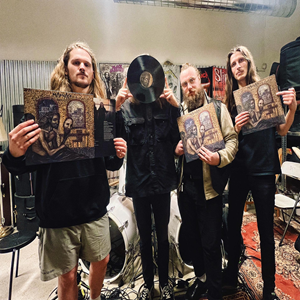
There are bands that build their identity looking outward — toward the elements, the landscape, the grand gestures of nature — and then there are those that, having done exactly that, choose to turn the lens around entirely. Deadnate, the Progressive Metal quartet from Fredericia, Denmark, falls squarely into the second category. After establishing themselves with their 2022 debut “The North Sea,” a record praised internationally for its fusion of muscular grooves, Progressive songwriting, and a deep relationship with the natural world, the band returns in March 2026 with “Mosaic” — a second album that trades open water for urban complexity, and panoramic landscapes for the complicated interior of the human being. Eight tracks, two vocalists, and a band that has clearly been sharpening its tools with patience and precision. We sat down with Deadnate to go deep on the making of Mosaic, the ideas behind it, and what the road has looked like since “The North Sea” first made waves.
Deadnate started from a thrash metal foundation before evolving toward Progressive Metal. How conscious was that transition, and was there a specific moment — a record, a concert, a conversation — when you knew the direction had changed?
It was pretty conscious but also very natural. We all discovered Gojira at the same time and honestly it blew our minds that metal could sound like that, and that you could have their kind of attitude towards music and the world. Obviously that’s why our sound is so close to theirs. Perhaps we also felt that the thrash genre was a little bit stuck or limiting in some ways.
The lineup has been stable from the beginning: two lead vocalists and guitarists, drums, bass. How does having two front voices — Simon and Kenneth — shape the songwriting process? Is it ever a tension, or always an asset?
Having two vocalists makes for a lot of cool options when it comes to the songs. Are they doing brutal harmonies, clean harmonies, growling, singing individually, accentuating certain words and so forth. It’s pretty much only an asset. The difficult part is to sometimes keep it simple and actually just leave it to either Kenneth or Simon. It’s tempting to always have both singing because it creates this wall of sound which is cool, but sometimes the simple and honest approach is better for the song.
Your debut EP “Concrete Flood” received strong reception nationally and landed you spots alongside Baest, Møl, and Eyehategod — quite a range. How did those early shows influence your understanding of where Deadnate sits stylistically? Did playing with those bands push you in any particular direction?
I wouldn’t say that any of those have had any particular influence on our music. However, they and others have taught us what level to go for when it comes to playing live. On a weekly basis we’re multi-tracking all our rehearsals and trying to do everything better and better. Our music is difficult to play, so it takes time to get it to a high enough level and you have to stay humble to let that process be optimal.
“The North Sea” was recorded in 2020 with Ole producing and Andreas Linnemann engineering. What was that process like — recording your debut album during what was globally a very strange period — and how much of that context ended up embedded in the music?
It was pretty cool actually. We could spend weekdays recording guitar, bass and vocals. I don’t think it shaped the music that much, but it definitely gave us more time to experiment and try to get to the best version of those songs.
“The North Sea” looked outward — nature, human relationships with the environment, large-scale themes. “Mosaic” turns inward, toward the city, the self, the dynamics between people. What triggered that shift in perspective? Was it a collective decision or did it emerge organically from where the members were personally?
Just the fact that we’re a few years older and everybody in the band has had some pretty rough things happen in their lives. So it was pretty organic. Also we want to challenge ourselves to not write the same music and lyrics again, so once we had that framework it was cool to have something to aim for on a broader level.
The press release describes “Mosaic” as “both more complex and more simple” — amplifying the extremes rather than finding a middle ground. Can you walk us through what that means in practice? Where on the album do you feel the complexity hits its peak, and where does the directness take over?
A perfect example is the song ‘Two Tongues’ which is probably the most complex song we’ve ever done. The intro is pretty technical with all these different groupings strung together, however the riff right after is extremely simple and goes to regular time. That tension and release is a cool dynamic and gives us and the listener something to hold on to. A simple example could be the song ‘Mosaic’ which is literally just one note in each guitar playing quarter notes. However what makes that sound huge is the octave effect, the fuzzed tone and the bass playing power chords. So it’s much more about the sound, texture and size of the part. It is also meant in the way that we have focused a lot on how we actually play the parts down to the smallest details. Sometimes even the simple riffs or drum parts can become challenging to play with
enough confidence and intent for them to sound great.
The title — Mosaic — implies that each song functions as a fragment of a larger picture. Was this a concept you built the album around from the start, or did the pieces come first and the overarching idea arrive later?
That idea came pretty early in the process. It’s not really a concept per se, just more a loose guideline that gives a thread throughout the album. We’ve put a lot of ourselves in these songs, so in some way they show who we are as people, and the things that matter to us.
The themes — grief, anger, empathy, the lack of it — are handled without judgment, rooted in the recognition that everyone is shaped by the world around them. That’s a nuanced and mature approach. How did you find that balance in the writing? Were there moments where the material became uncomfortably personal?
I think it’s the way we view the world. We don’t want to go around and judge people. It might sound naive but we believe that most people are trying to do their best with what they have. One time we had to find a balance was with the song ‘Guilt & Sorrow’ which deals with a pretty heavy subject of a stillborn child. However, that mostly comes down to specific choices of words. How direct or vague do you want something to be? There were some other considerations during the songwriting, but we’re okay at finding that balance.
The first single “He Who Pays” came with a music video and was described by the band as showcasing “elements of Hardcore and a powerful but raw production.” How representative is that track of the full album, and why did you choose it as the opening statement?
We chose ‘He Who Pays’ because it sets the tone for the records and because it has an ear- and eye-catching intro and sound that is very different to what we’ve released before. We wanted to make a statement that we’re evolving and not doing the same again. Also the words powerful and raw seem to describe the sound of the album quite well.
Looking at the tracklist — Guilt & Sorrow, Funeral Cortège, Two Tongues, The Lie We
Can Trust, Morass — the language is Heavy, morally charged. Can you give us a window into two or three of these tracks: what situation, emotion, or experience is each one processing?
‘Guilt & Sorrow’ is the process after you’ve lost someone or something close to you. Kenneth Kejlstrup and his wife had a stillborn son very late in the pregnancy and it was quite traumatizing. Kenneth wrote some of his thoughts and feelings down and some of this came as a surprise to me. Guilt wasn’t something I had thought about because it’s a situation you have no control over however that feeling was still there. ‘The Lie We Can Trust’ is about how most people, including ourselves, sometimes have to tell or make a lie up in order to live. These lies can be big or small, and we tell ourselves that it is okay, which it might be because they don’t really matter. However sometimes this becomes a way of living in order to hide the truth from yourself, and that is where it becomes a problem.
Production-wise: who took the lead on “Mosaic”? Did Ole step back into the producer’s chair, and how does the sound differ from “The North Sea” — intentionally rawer, denser, different?
Yes I (Ole) produced the record. The production is way more direct and not as layered. Every instrument has been recorded to a way higher standard. Instead of editing we’ve spent the time learning to play the parts well, even if that means tracking certain sections one bar at the time. The sound is also more punchy and raw as in the drums are hitting harder and the guitars sound more “evil” or dirty. Also we have better taste on this record meaning we don’t just add stuff to add stuff. Every part is very carefully written and executed for a purpose.
Progressive Metal in 2026 is a wide and often fragmented space — Djent, Post-Metal, Tech Metal, Atmospheric approaches. Where do you position Deadnate within that landscape, and what are you consciously pushing against or toward?
Honestly I don’t know where we fit in with all the labels. I just think we’re progressive because of the way we view and think about music. We might have a bit of a contrarian approach to our music in the sense that we don’t want to sound or do like some generic metalcore band. But really we write the music that we want to hear, and we let that guide us.
Denmark has a rich and often underrated Heavy Music scene — Baest, Møl, Konvent, Orm, Solbrud, among others. How connected do you feel to that scene, and do you sense a specific Danish identity in what you do, or is geography incidental to the music?
I think you can’t and shouldn’t hide where you come from in your music. We have a certain culture here in Denmark and that way of thinking is definitely coming through in our music. Also just listen to Kenneth and Simon sing and you can hear their Danish accent here and there. We don’t feel that connected to the scene, but rather to a handful of other bands that share our attitude towards their music and the way they are as bands.
“The North Sea” gained attention internationally. Did that surprise you, and has it changed how you approach releasing music — who you’re making it for, how you’re thinking about reach?
Some of the international attention surprised us in a very good way, but it doesn’t really change anything when it comes to releasing the music. Sure we’ve learned some things from it that we can bring to this cycle but it doesn’t change the basic way we do it or how we write the music. We just want to do the best we can with what we have and keep getting better.
On the live front: what are your memories from the most significant shows you’ve played so far — a moment where something clicked on stage, or an experience that defined what Deadnate feels like in a live context?
The show we did at Copenhagen Metal Fest last year was special. Both because we were playing the big stage and because it was the launch of a new Deadnate in the live setting. We spent an absurd amount of hours in our rehearsal space before that show because we were going to play a bunch of new songs from ‘Mosaic’, and we wanted them to hit hard. And the hard work paid off. It’s the single best show we’ve ever played and we’re going through the same process right now for the release shows. We want people to leave there with no points to criticize.
Are there live dates confirmed or in the works around the “Mosaic” release? What can audiences expect from the show — how do you translate the album’s dynamics to the stage?
Yes, we have a few release shows booked and then we’re focusing on the fall with more shows. We’ve already played a few of the songs live and they translate way better compared to the songs of ‘The North Sea’. I think it comes down to the directness of the songs and playing to our strengths. Earlier we had a lot of clean singing which sounds cool on a recording, but often has fallen short for us live for many different reasons. So we’re very much looking forward to play these new songs live.
Looking at the broader picture: four members, two albums, a decade of work coming into focus. Where do you see Deadnate heading from here — stylistically, ambition-wise, practically?
Our dream right now is to get on a tour around Europe to see if we’re capable of keeping it up. We firmly believe in the idea of staying humble and just trying to get better and work towards new goals whether that is shows or a new album. In terms of style, I think we’ve reached a sound that we’re very happy with and something that also works well live, so we should keep building on that while finding new ways to expand and refine our songs.
Last question, open floor: what do you want someone to walk away with after sitting with “Mosaic” front to back? Not the themes, not the production — the feeling.
Hopefully a lot of different feelings. The songs showcase many moods and changes through energetic, aggressive, beautiful, simple, technical, sad and so forth. So maybe a sense of fulfillment like there is nowhere else to go would be a suitable feeling.
“Mosaic” arrives at a moment when progressive metal could use exactly this kind of band: one that takes the genre’s technical ambitions seriously without losing sight of what the music is actually trying to say. Deadnate have spent the years since “The North Sea” quietly building something more focused, more demanding, and more honest — a record that asks its listener to sit with discomfort, complexity, and ultimately, recognition. The pieces are in place. The picture is coming together.
Purchase “Mosaic” here: https://deadnate.bigcartel.com/
Read our Review of “Mosaic” here: [Review] Deadnate – Mosaic