

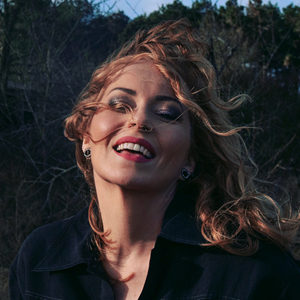
Few voices in contemporary rock carry the emotional range and narrative weight of Anneke van Giersbergen. From her landmark tenure with The Gathering — whose 1995 album “Mandylion” defined a generation of Atmospheric and Progressive Metal — to her expansive solo career, Anneke has consistently approached songwriting as a form of
intimate testimony. Her most recent creative cycle, the trilogy “La Vie,” “La Mort,” “L’Amour,” represents perhaps her most personal artistic statement yet, rooted in the devastating experience of losing both parents within just two months of each other. The second chapter of this trilogy, “La Mort,” arrives as a four-track EP of considerable
emotional depth. Recorded with her live band, the record navigates grief not as a linear process but as a landscape of shifting memories, unexpected beauty, and the quiet persistence of love beyond loss. The lead single “Red Sky” opens this chapter with characteristic grace, while “Sail Towards The Sun” — inspired by her father’s handbuilt sailboat and the family holidays spent on the water — distills an entire world of private remembrance into song. This conversation invites Anneke to reflect on the creative and emotional dimensions of “La Mort,” the artistic architecture of the broader trilogy, and how a renewed connection with her former bandmates in The Gathering has shaped her
understanding of her own musical journey.
”La Mort” is the second chapter of what you’ve described as a deeply personal trilogy. When you first conceived of “La Vie,” “La Mort,” “L’Amour,” as a structured creative arc, how much did you allow the emotional reality of grief to dictate the form the music would take — and was there a conscious decision to separate these experiences into distinct episodes rather than a single unified statement?
The title came about during a time when I kept being confronted with life-changing events. In many ways, those three words capture our entire existence: the beginning, the end, and everything in between. And within that, I see love, and just as much its absence, as something that shapes all our lives. The title naturally lent itself to a trilogy, particularly as my schedule was so full that taking a few months out for a traditional writing and recording process simply wasn’t
an option. Working in blocks meant I could keep creating alongside all my concert commitments and continue adding new material to my live set more quickly, which keeps things far more exciting and creatively fresh.
The EP includes “Sail Towards The Sun,” inspired by your father’s handbuilt sailboat and the family memories woven around it. Transforming something so intimately personal into a shared artistic object is a profound act. How do you navigate that threshold between private grief and the music’s life once it moves beyond you — into rehearsal rooms, mixing desks, and ultimately the ears of strangers?
I wrote the lyrics for this song while sitting at my father’s bedside as he was dying, keeping watch over him in those final days. Every now and then, a deeply personal song can still catch you off guard and hit you emotionally, and it usually happens when you least expect it. At a certain point, though, you become wrapped up in the practical side of things, whether the guitar’s sitting right in the mix, if the bridge needs a bit of keyboard, all that sort of detail, and that inevitably creates a bit of emotional distance. Even so, songs like this always carry a particular weight. If one gets dropped from the setlist on tour, it tends to feel that bit more personal than usual. That said, I’m not reliving those same emotions every night the way I did when I first wrote it. Quite frankly, that just wouldn’t be sustainable.
You’ve spoken about the fact that not every song on “La Mort” is literally about death — that writing doesn’t follow rules. There’s something liberating in that statement, and yet the thematic gravitational field of the record is unmistakable. How do you understand the relationship between emotional truth and formal constraint in your songwriting, and what role does that creative freedom play in keeping grief from becoming a fixed or closed subject?
I’ve been writing throughout the entire trilogy, so the EP titles were set from the start. Before we begin working on the songs as a band, though, I pick the pieces that feel the most promising. Each release starts from a certain idea, but there’s also a practical side to it. For example, I’d already written “Sail Towards The Sun” in the lead-up to La Vie, but it felt like something was missing. After adding a bridge, it ended up on La Mort, where it’s a better lyrical fit, though the decision itself was mainly a practical one. I also write very intuitively. I’m very aware that losing both of my parents is something that’s on my mind a lot right now, but I never sit down thinking, “today I’m going to write a song for my father.” I just let things develop naturally. It makes sense that grief is never far away in this trilogy, but at the same time, there are also a lot of beautiful things happening in my life. I don’t want to leave that out of my songs, which is why there’s also a real sense of lightness and optimism running through them.
The reunion with your Gathering bandmates for the “Mandylion” 30th anniversary shows clearly resonated far beyond nostalgia — it has grown into a full programme of concerts and festivals in 2026. How has this renewed creative brotherhood informed the way you hear your own solo work, and does moving between these two musical identities — the collective history of The Gathering and the deeply personal arc of the trilogy — illuminate different dimensions of who you are as an artist?
Most of my solo work is written by me, whereas with The Gathering we always worked as a collective. The band’s music really came from all of us, so even though our style evolved over the years, it was still shaped by the same people and their individual voices. As a solo artist, I’ve always had, and taken, the freedom to bring in different musicians, which has resulted in a wide range of interpretations in the music. Lyrically, things were different in The Gathering, where my lyrics had to be embraced by the whole band. My solo work, in that sense, is much more personal. I share a lot more of my own thoughts and feelings there. I’m very proud of what we created together as The Gathering. I do notice a clear difference in how closely my solo work reflects who I am, but that doesn’t diminish the strong connection I still feel to the band’s music, it’s very much still there.
As “La Mort” is released and the trilogy moves toward its conclusion with “L’Amour,” how do you envision the complete work sitting within your catalogue — both as a monument to a specific chapter of your life and as something that might speak to listeners navigating their own experiences of love and loss? And what does the prospect of closing this trilogy mean to you, emotionally and artistically?
Because of the way it was released, this has turned into one of the longest-running projects I’ve ever worked on, which makes it especially meaningful to me. The trilogy grew out of a period of grief and reflection, but as time has passed, it’s also come to represent a specific chapter in my life. I know people connect with my lyrics, but I don’t really think about it in those terms when I’m writing. I just write from a personal place, and more often than not I catch myself wondering: who am I, and why would anyone be interested in my story? At the same time, experience has taught me that listeners respond to that honesty. That they find comfort in it as they process their own grief or try to make sense of their own lives.
Progressive Rock Journal extends its deepest gratitude to Anneke van Giersbergen for engaging with these questions with the same openness and generosity that has always distinguished her work. “La Mort” will be available digitally on March 27 with a special vinyl edition released for Record Store Day on April 18, 2026. We look forward to continuing this conversation as the trilogy reaches its conclusion with “L’Amour” — and to following the ongoing chapter that The Gathering’s reunion has opened alongside it.
These questions went deeper than most interviews and really reflected a genuine interest in my work, thank you!