

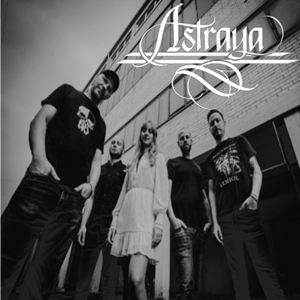
Stuttgart has never been the first city that comes to mind when you think of Dark Rock and Doom, but Astraya have spent the better part of a decade making that irrelevant. Founded in 2018, built through lineup changes and self-released recordings, the band quietly earned their reputation the hard way — track by track, show by show. Their 2022 debut “Myth of Dike” landed in the right places and made the right noise. Now, four years on, they return with “Atropine,” a record that doesn’t ease you in. Ten tracks on mortality, fate, addiction, war and trauma — held together by Melina Abele‘s voice and a wall of sound that their own guitarist produced. We spoke with Astraya ahead of the release.
Astraya was founded in 2018 by Melina, Benjamin and Tim. What was the initial idea behind the band — what did you set out to build, and how does that original vision compare to what Astraya is today?
Melina: “Honestly, the music turned out exactly the way we had envisioned it: a heavy, powerful sound paired with clear, classical vocals and lyrics that truly carry meaning. The journey to get here wasn’t always easy – at times it felt slow and exhausting, and there were moments when we came close to giving up. But in the end, I believe it was absolutely worth pushing through. It feels like we’ve finally arrived at the place we were aiming for all along.“
The lineup took a while to come together fully, with Tobias and Klaus completing the band later. How did those additions shift things — both in terms of songwriting and live energy?
Melina: “Finding band members who not only bring the right level of commitment but also truly fit musically and personally was a real challenge. Since completing the lineup, everything has changed for us. Tobi and Klaus form an incredible unit, providing the perfect foundation for our songs – something we hear from the audience at almost every show. They also contribute tremendously to the songwriting process, elevating each track to an entirely new level of quality.“
Your sound sits at the intersection of Dark Rock, Doom and metal, but Melina‘s classically trained vocals are the element that consistently sets you apart. How do you balance that — the heaviness of the instrumental approach against the clarity of the voice?
Melina: “For a long time, as a vocalist, I struggled to assert myself – both during rehearsals and on stage. Because obviously the guys are really loud. 🙂 I constantly had trouble hearing myself, which made performing much more challenging. After trying out a lot of different equipment, I’ve finally reached a point where I feel confident on stage, allowing me to focus more on performance and the finer details. When it comes to songwriting and our overall sound, I feel like things have clicked from the very beginning. Benny and Tims guitar playing is usually arranged in a way that complements my vocals perfectly. We also spend a lot of time rehearsing and refining our songs, making sure that everything fits together seamlessly.“
“Myth of Dike” received strong praises, with comparisons to The Gathering at their best. How did you take that reception — and did it create any pressure going into the writing of the second record?
Melina: “For me, it was truly surreal. Anneke van Giersbergen has been my biggest idol for as long as I can remember. I never would have dreamed that anyone would compare us to The Gathering. It’s an incredible honor and fills me with immense pride. I actually gave her one of our CDs at a concert and told her that she’s the reason I wanted to become a singer in the first place – so yes, definitely some hardcore fangirling here. 🙂 I didn’t really feel any pressure because of that, though. The pressure was more general – wondering whether people would love the new album as much as Myth Of Dike, and whether we could live up to the expectations of our label These Hands Melt, and so on.“
There’s a meaningful gap between the debut and “Atropine.” Was that time a deliberate creative pause, or did circumstances simply dictate the timeline?
Melina: “The long gap between the two albums was mainly due to what felt like an endless search for a drummer. Honestly, that search alone could fill an entire book – it was that chaotic. Before Klaus joined, we were so desperate at times that we barely knew how to keep going. I think we had already tried out around seven different drummers. When Klaus finally came on board, it naturally took some time for him to fully settle in and for us to really click as a band. All in all, I’d say that process cost us about a year. We started pre-production for Atropine towards the end of 2024, and in 2025 we ran into a number of technical issues as well. In the end, time passed much faster than we would have liked.“
In 2023 you covered Failure‘s “Heliotropic” with Bitume Prods. What drew you to that track specifically, and did that project feed anything back into the direction of “Atropine“?
Melina: “The request from Bitume Prods came at exactly the time I was just talking about – when we didn’t have a drummer and felt a bit directionless rehearsing as a four-piece, unsure of what to do next. That project turned out to be a lot of fun and gave us a much-needed boost to keep going. None of us were familiar with the band beforehand, but we’ve all since become big fans of Failure. The song we chose stood out to all of us and ultimately felt like the perfect match for our sound. During the recordings for ‘Heliotropic,’ we also experimented with new equipment, which may have ended up benefiting us later on while working on ‘Atropine.’“
The album title itself is loaded — “Atropine” as a substance, but also the title-track dealing with the moment of death and the idea of predetermined fate. When did that concept become the spine of the record?
Melina: “After we had finished recording all the songs, we initially planned to call the album Valley of the Damned. But as we listened back to the material, it became clear that Atropine captured the essence of the songs much more effectively. It also felt deeper and more intriguing. All of a sudden, everything fell into place – the album started to make sense as a whole, and a clear thread began to emerge.“
The themes across the album are unflinching — addiction in “Valley of the Damned,” war in “In the Pale Glow of Torches” and “In Devotion,” trauma in “Descendant of a Dead Man” and “Lighthouse.” Was there a conscious decision to go this dark, or did the material just take you there?
Melina: “It wasn’t really a deliberate choice. Some of the songs and lyrics came together during the pandemic, and honestly, it feels like the world has grown more unsettling with each year passing. For us, songwriting is almost therapeutic. It gives us a way to gather up negative emotions and release them onto the page, almost like cleansing the soul. I also find that sad music can be strangely comforting. It’s reassuring to realize that others experience similar feelings – it somehow catches you when you’re falling. That said, personally I don’t find the album all that dark, though I’ve heard that some people experience it differently. I suppose it`s just the nature of perception – deeply personal and unique to each listener.“
“A Spark Within” is the first single and the one moment of hope on an otherwise heavy record. Was it a deliberate choice to lead with that track — both as a single and as the album opener?
Melina: “Yes, ‘A Spark Within’ has always felt like the perfect opener. For us, it’s quite unusual to write such a short song, but I think it does a great job of introducing new listeners to who we are – like a musical calling card. In terms of meaning, the song is about this: no matter what’s going wrong in your life, as long as you can draw even a spark of hope or strength from something, you can keep moving forward.“
“A Theory of Time” takes a more philosophical and scientific angle — our existence within the structure of time. That’s abstract territory. How do you make that land emotionally in a musical context?
Melina: “I’ve always been fascinated by the universe, humanity, and how everything is connected. I once read an article in Space Magazine – a publication all about the cosmos – by Professor Sean Carroll. The piece was actually titled ‘A Theory of Time,’ and it was so interesting and inspiring that I felt compelled to write a song about it. Just as you said, it’s about connecting a scientific text with my own philosophical reflections. My grandmother passed away in 2017, leaving a huge void in my life. Since then, I’ve spent a lot of time thinking about where we go, what happens to our souls, and questions like that. In ‘A Theory of Time,’ I tried to capture exactly that – the desire to step out of the flow of time, to find a world where time no longer matters. I even sent my lyrics to Professor Carroll, and he replied with just two words, but they were more than enough for me: ‘Beautiful, thanks.’ 🙂“
“Valley of the Damned” is split into two parts, bookending the second half of the record. Was that always the structure, or did it evolve during the writing and recording process?
Melina: “‘Valley of the Damned’ means a lot to me, personally. As mentioned, it deals with the theme of addiction – something that has been on my mind for a long time. I also feel that the pandemic has intensified this struggle for many people. The story from ‘Valley of the Damned Pt. 2’ wasn’t entirely finished, which made the urge to write an opener for it very strong. In Pt. 1, I only sing the lines: “I’m wandering around, aimless. My face is calm but inside I’m screaming.” They are meant to convey the profound isolation of those trapped in addiction, and the long, silent shadows they cast over their own lives before the world ever sees their struggle. Since it was originally meant to be the album title, we decided that, at the very least, it should significantly shape the second half of the record and open and dominate the second side of the vinyl.“
Yael Su plays Experimental flute on the title track “Atropine.” How did that collaboration come about, and what did that element bring to the track?
Tim: “For the middle section of the song, we recorded some pretty wild stuff, lots of percussion, timpani, and various hand drums. When it came to mixing, though, I struggled to bring all those chaotic tracks together and spent a lot of time on it. Eventually, I had the idea to let Yael record a few takes on the flute. Then I ran this track through some of my guitar pedals. Suddenly, the flute acted like a kind of glue, tying all the other tracks together and making the section sound exactly the way I had imagined.“
Tim produced and mixed the album entirely within the band. What does keeping that process in-house give you — and what are the real challenges of having a bandmate in the producer’s chair?
Tim: “I can’t speak for the others, but for me it’s challenging to produce my own music. It tends to slow down the creative process and quickly shifts everything onto a more technical level. The biggest issue, if you can call it that, is that it’s easy to get lost in small details and spend a lot of time on minor things, which can drag the whole process out. A clear advantage, however, is that you don’t have to explain your vision to an external producer, you already know exactly where you want to go from the start.“
Melina: “We are really happy, that Tim took on the production and mixing. As he has said himself, there’s no need to awkwardly explain your vision to an outsider. Tim did an amazing job – guiding the process with authority, but always constructively. He poured an incredible amount of time and energy into the mixes, and it truly shows.“
Mastering was handled by Roland Böffgen at Hard Drive Sounds Studio. Was there a specific sonic quality you were targeting for this record — something you knew had to survive the final master?
Tim: “Its not that easy to put into words. To me, many modern albums are becoming increasingly interchangeable, everything sounds flawless, but also overly polished and uniform. Thats exactly what we wanted to avoid. Our goal was a modern-sounding album with real character. Thats why it was important for Roland to handle the final mastering without bending or altering the sound. He did a fantastic job with it.“
Any studio stories worth sharing? A moment where something broke in the best possible way, or a session that nearly went sideways?
Tim: “As mentioned earlier, we did some wild recordings for Atropine, walking around the drum room mics with various percussion instruments. At one point, I thought to myself: I hope no one sees us walking around here like some completely crazy idiots.“
Melina: “I recorded my vocals at home, in the basement, for about a month – around four hours every day. I imagine that wasn’t always easy for the neighbors! I also had to take breaks whenever someone was mowing their lawn or, since it was spring, whenever it started raining heavily, because otherwise all of those sounds would have ended up on the recordings.“
This kind of material — dense, layered, emotionally demanding — must translate into something very specific live. What has playing these songs in front of an audience taught you about them that the studio never could?
Melina: “Live, the songs carry a unique energy of their own. Sometimes I even get the feeling that the audience is drawn into a trance-like state. What I find really crazy is that so many people compare us to bands like Nightwish or Within Temptation – even though we don’t really play symphonic metal. Yet somehow, our music still seems to resonate with listeners who usually gravitate toward that style.“
Are there live dates confirmed around the release of “Atropine“? And if you could pick the ideal context — venue, city, atmosphere — for this record to be heard live for the first time, what would it be?
Melina: “Yes, we’ve planned a very exclusive release party, where we’ll also be debuting brand-new merchandise perfectly matched to the album. On top of that, we’ll be displaying our old cover art around the space. It’s going to be a very intimate show, and we’re already really looking forward to it. We also have more shows planned in Germany. As for my dream venue, it would be Colos-Saal in Aschaffenburg – that’s where I experienced my all-time favorite concert, by Dredg.“
Before we close — are there further singles or visuals planned ahead of April 24th? And is there anything you want listeners to know before they hit play for the first time?
Melina: “On April 8, 2026, we will be releasing “A Theory of Time” as the second single from Atropine. We also shot another video for it, which I think turned out very well. You can definitely look forward to it! Listeners can look forward to a deeply personal album, one filled with genuine passion and heart. I hope that people will be able to connect with the songs and find a sense of hope within them.“
“Atropine” is out April 24, 2026 on These Hands Melt. Available on Transparent Indigo vinyl (limited to 200 copies), CD digisleeve (limited to 300 copies) and all digital platforms. Our full review coming soon on our pages.
Pre-Order “Atropine” via These Hands Melt Webshop and Bandcamp
Lineup:
Benny Gölz / Guitar
Klaus Wintermayr / Drums
Melina Abele / Vocals
Tim Suske / Guitar
Tobias Hänsel / Bass
[…] Read our Exclusive Interview with the band here: [Exclusive Interview] Astraya: From Stuttgart’s Underground to the Edge of “Atropine” […]